
COPENHAGEN, Denmark - A German court has convicted a Turkish man of terrorism charges, handing a six-year prison sentence after finding him guilty of running the banned Kurdistan Worker’s Party’s (PKK) finances in Europe.
The Duesseldorf state court said the 49-year-old, identified only as Abdullah S. according to German privacy rules, was convicted of membership in the PKK, which is officially regarded as a terrorist organization by the European Union, the United States and Turkey.
According to the court Abdullah was a PKK leader in Germany over a decade ago before leaving for Iraqi Kurdistan, where PKK guerillas are based. It said that, from 2007 until his arrest in Belgium in 2010, he led the finance office of the PKK’s European branch in Antwerp.
Also, Danish police have been interested in Abdullah because his name was mentioned in a case against the Kurdish television channel Roj-TV, before it was found guilty of supporting the PKK by a Danish court in January 2012 and its office later closed.
Friday’s court sentence against Abdullah S has attracted much attention in the German, Turkish and pro-PKK media because this is the first time someone is punished for supporting the PKK since recent events have raised the profile of the Kurdish organization.
The PKK’s affiliated wings have been in the forefront of the fight against Islamic State (ISIS) in Syria’s Kurdish regions, or Rojava.
In the Kurdish-Syrian city of Kobane, the PKK-affiliated People’s Protection Units (YPG) were backed by some Western weapons and US-led air strikes in the fight against ISIS. The YPG and the Kurdistan Region’s Peshmerga forces evicted ISIS from Kobane in January.
The association "Solidarity with Kurdish political prisoners in Germany" (Azadi) has criticized the Dusseldorf court’s ruling and accused the case of being "political" rather than legal.
"Abdullah S has in no way damaged, attacked or threatened Germany," said a statement from Azadi. “It is unacceptable that the court uses membership in a foreign organization to give the person such a penalty."
The PKK, which fought a three-decade war for autonomy in Turkey after beginning peace talks with Ankara in 2013, has been banned in Germany since 1993.
An estimated 800,000 Kurds live in Germany where according to an official 2012 report the PKK has nearly 13,000 supporters, making it the “biggest foreign and radical force” in the country.
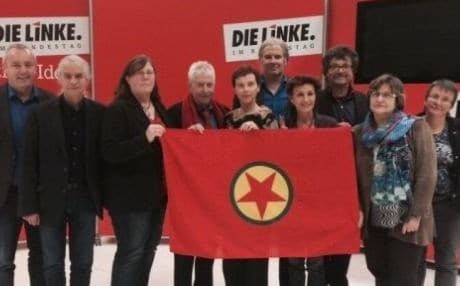
In November 2014, 10 MPs from the left wing Die Linke party unfurled the flag of the PKK inside the German parliament building, urging the lifting of the ban on the group.
The act was also in solidarity with fellow party member Nicole Gohlke, who a month before had lost her parliamentary immunity after waving a PKK flag at a Munich demonstration in support of Kobane.