
ERBIL, Kurdistan Region - The remarks of Mazloum Abdi, commander of the Syrian Democratic Forces (SDF), declaring the completion of the Kurdish-led forces’ integration under the Syrian state represent “an important and positive step” that will pave the way for further unification of institutions, a member of Syrian interim President Ahmed al-Sharaa's team overseeing the process said Friday.
Ahmad al-Hilali, who also serves as deputy governor of the Kurdish-majority Hasaka province in northeast Syria (Rojava), said Abdi's statement “regarding the completion of the military, security, and administrative integration of the SDF into Syrian state institutions represents an important and positive development.”
Speaking to state-run al-Ikhbariya channel, Hilali added that the SDF chief's remarks also constitute "a clear declaration of the transition from the phase of agreements to the phase of actual implementation of the merger” within the Syrian state.
“These remarks will be translated into practical steps on the ground through the unification of institutions and administrative authority, and the return of state institutions to exercising their full powers - ensuring unity of decision-making and Syrian sovereignty,” Hilali said, adding that they further signal an end to “the state of duality and parallel entities” and lay the foundation for “one state, one army, and one set of institutions” in the new Syria.
Abdi on Thursday declared that the "process of integrating our military, security, and administrative institutions into the institutions of the state has ended and been fully completed."
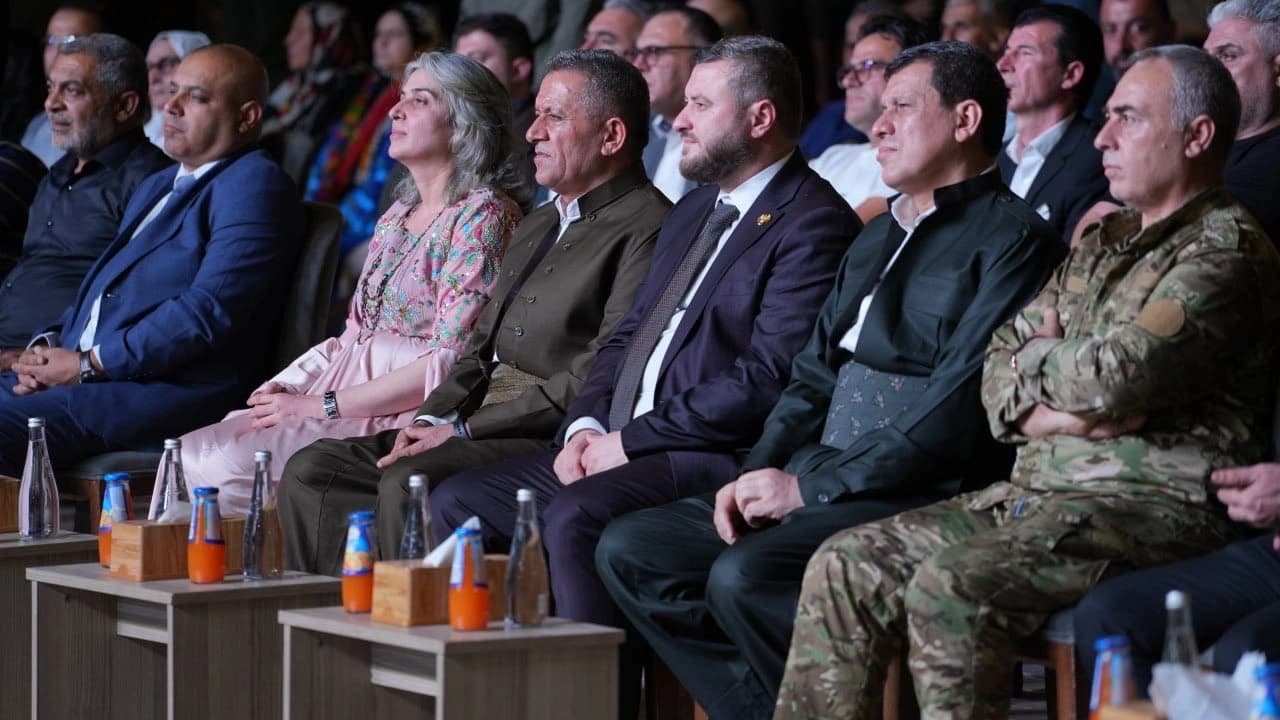
"Today, a new phase begins for us," the SDF commander said during a speech in Hasaka’s Qamishli, marking the 100th anniversary of the city’s founding. Hilali was notably present at the event, seated alongside Abdi, who attended in traditional Kurdish attire.
The SDF and Damascus signed an agreement on January 29 to integrate Rojava’s civilian, security and military institutions into Syrian state structures following weeks of clashes. The deal was mediated by the United States and France and endorsed by Turkey.
Several brigades have since been formed for SDF fighters who joined the Syrian army, with former SDF commanders leading them. Damascus has also appointed a former SDF commander as deputy defense minister for the eastern region.
Abdi also said Thursday that Kurdish fighters who had come to Rojava from Kurdish regions in Iraq, Iran, and Turkey to help defend the enclave - including against Islamic State (ISIS) attacks - have now left Syria.
The presence of Kurdistan Workers' Party (PKK) fighters in Syria has long been a point of contention with Ankara, which has fought the PKK for more than four decades and repeatedly demanded that fighters affiliated with the group
For his part, Hilali on Friday noted that while Abdi’s remarks represent a “very important political step, this does not mean that all phases of administrative, security, and military integration have been completed at once,” adding that “work is ongoing to finalize merger arrangements so that state institutions become the sole authority.”
Meanwhile, Mustafa al-Abdi, another member of Sharaa's January 29 agreement implementation team, told al-Ikhbariya that "the SDF file can be considered closed following the implementation of steady steps since the monitoring of the agreement began."
He added that the merger was carried out "with full consensus between both parties and within a framework aimed at implementing the agreement and overcoming obstacles," noting that departments in Rojava are now being activated "in accordance with applicable laws and mechanisms within state ministries."