
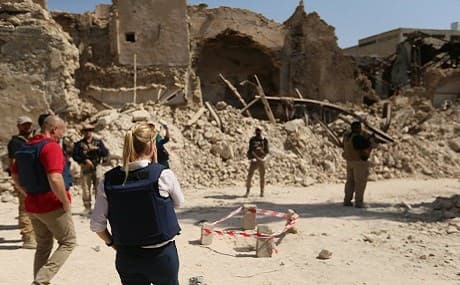

The United Nations Mine Action Service (UNMAS) hosted a delegation from Britain’s Department for International Development (DFID) this week visiting mine clearance projects in Mosul and meeting local officials.
The UK government is a financial contributor to UNMAS in Iraq.
#Iraq: United Nations Mine Action Service supports the delegation from UK Department for International Development (@DFID_UK) delegation’s recent visit with Mine Action organizations in #Mosul@UNMAS Press Release 👉https://t.co/crX19G5NgX pic.twitter.com/3BiMdYhtys
— UNAMI (@UNIraq) October 18, 2018
“Until mines are cleared and areas made safe, normal life cannot return,” said Deputy British Ambassador to Iraq, John Tucknott, in a statement.
“Mine clearance is an essential step in regenerating war damaged areas. The UK is proud to be supporting UNMAS in delivering this essential work.”
Mosul was liberated from ISIS control in summer 2017 following a ferocious land and air campaign, which left much of the city and its infrastructure in ruins. ISIS militants left whole neighborhoods rigged with explosives, making it impossible for families to return to their homes.
More than a year since liberation, mine clearance operations are still ongoing.
.@DFID_UK visited UNMAS #clearance operations in #Mosul #Iraq and met with a number of #national and #international #mineaction organizations and local authorities. Learn more about the visit here: https://t.co/OajUIvcrio pic.twitter.com/P4iqMrIqYJ
— UNMAS (@UNMAS) October 18, 2018
“Safety is the most important,” Faisal Abdul Rida Obaid Farham Al-Zaid, team leader for the UK security company G4S, told the visiting delegation, according to UNMAS. “We can fix a park or building after an explosion, but we cannot fix a lost limb or lost human soul.”
Rehabilitation of displaced families and reconstruction work can only begin once explosives have been cleared.
“Explosive hazard management is the first step and of crucial importance to allow displaced people to safely return to their homes,” said Pehr Lodhammar, UNMAS Senior Programme Manager in Iraq.
Although 3.9 million people have returned to their homes since the defeat of ISIS, some 1.9 million remain displaced, according to UN figures. Families still residing in IDP camps in the Kurdistan Region say a lack of security and services prevent them from returning.


