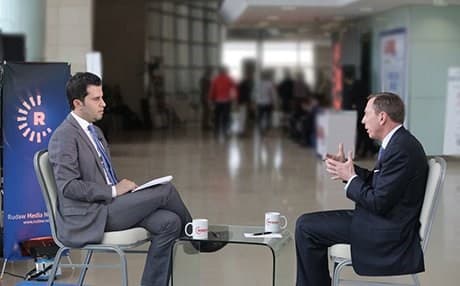
David Petraeus is the former Director of the Central Intelligence Agency and was the commander of US forces in Iraq in 2007-2008, when he oversaw the surge of troops that ended Iraq’s sectarian violence. Petraeus also commanded all coalition forces in Iraq. He was at the Sulaimani Forum earlier this month where he spoke to Rudaw’s Hemin Lihony about the war on Islamic State (ISIS, ISIL or Daesh) and the US strategy to degrade and defeat the extremist group. Here is an edited transcript of the interview. Hemin Lihony: What about Syria? Do you have the same idea [as Iraq]: no foreign troops there? David Petraeus: Yes, and again you see what can happen if you have a company ground force. The YPG, the Syrian Kurds around Kobane, fought very tenaciously, very courageously, and US air power killed 2,000 – 3,000 Daesh just in that area alone. The challenge in Syria, of course, is building, training, equipping, and supporting the opposition force that will not ally itself with the Al-Qaeda affiliate Jabhat al-Nusra, or the Khorosan group or indeed the Islamic State. Do you think there are moderate voices in Syrian opposition? I do. I think they need to be strengthened, supported and that has not been sufficient by the coalition so far. All of the coalition members recognize that they need to do more, I think. Do you agree with President Obama’s strategy to train moderate forces in Qatar and Turkey? Very much so. Will it work? It’s going to depend a great deal on the Syrian forces. I think it has the prospect to at least create a change that is significant enough to bring about a change and momentum in the dynamics on the battlefield that can make the desired end-state possible. The fact is, there are several possible outcomes in Syria right now. I think most people realistically assess that it may be difficult to put Syria back together. We have to see. Whatever outcome you want, whether it is to defeat ISIL, Jabhat al-Nusra, it’s to push the Bashar al-Assad regime into the diplomatic realm. Whatever the objective is, there has to be a moderate opposition force that is well-trained and equipped and robust. Will the priority be Assad or ISIS, or both? The priority for us right now, clearly is ISIS because that supports the effort in Iraq. Iraq is the initial main effort and that’s appropriate, that’s where the effort was very great, as I mentioned on the outskirts of Erbil, outskirts of Baghdad and so forth. That has been rolled back and there is a lot of work left to be done. Why are there no airstrikes in Halab [Aleppo] for example? I can’t talk about individual targets with you even if I had the information. Again, there has been considerable attrition of forces in Syria as well. In fact, you have seen specific strikes that have denied ISIL the ability to raise revenue that they have had in the past, going after some of their tankers and going after the tanks that smuggled crude oil to Turkey — after some of the refineries and so forth. How do you see the future of the Kurds in this uncertain situation? I think this is an interesting dynamic. You have seen a lot of different developments here, some of which are positive for the Iraqi Kurdish region, some of which are not. You see the reduction in the price of oil, which happens to coincide with all of the extremist threats and with the emergence of Daesh and that has been very bad, very challenging for Iraq and therefore for Iraqi Kurdistan. You see Kurdish forces fighting very well. Taking areas, controlling areas, keeping them safe. Safeguarding the Kirkuk oil fields. And over time, I think, this perhaps creates a new situation, new dynamics, as Baghdad and Erbil are determining what their evolving political situation will be. We have seen new relationships with Turkey, some of these developments have been reassuring to the Kurds, but probably not all. The episodes of the difficulties of getting assistance to the YPG in Kobane is one that is remembered. And of course there are developments with the exports of oil that have also been somewhat challenging as well. You see another interesting dynamic, Syrian Kurds who are very grateful for the assistance being provided by the KRG - the enormous support the KRG is giving to hundreds of thousands of refugees in Kurdish provinces. But you also see the desire by the Syrian Kurds to have their own autonomous region, not necessarily to be part of a greater Kurdistan. I think that’s an interesting development, to see how that evolves — what the relationships will be between Iraqi Kurds, Syrian Kurds and others. Let me just say, if I could, having not been in Iraq for four years, the progress that I see in Erbil and in Sulaimani is breathtaking. You all watch it every single day, you don’t realize how astonishing it has been. This is really remarkable. It’s something that all Kurdish people should be very proud and, indeed, the Kurdish leaders in particular should be quite proud as well.
Kurdistan24-10-2026Iranian drone strikes Komala base northeast of Erbil, no casualties reported: Party
ECONOMY24-10-2026Iraq expects up to $1 billion in new dollar shipments to stabilize dinar: CBI adviser
Iran24-10-2026Iranian judiciary chief urges wartime measures across state institutions amid fears of escalation


.jpg&w=3840&q=75)

