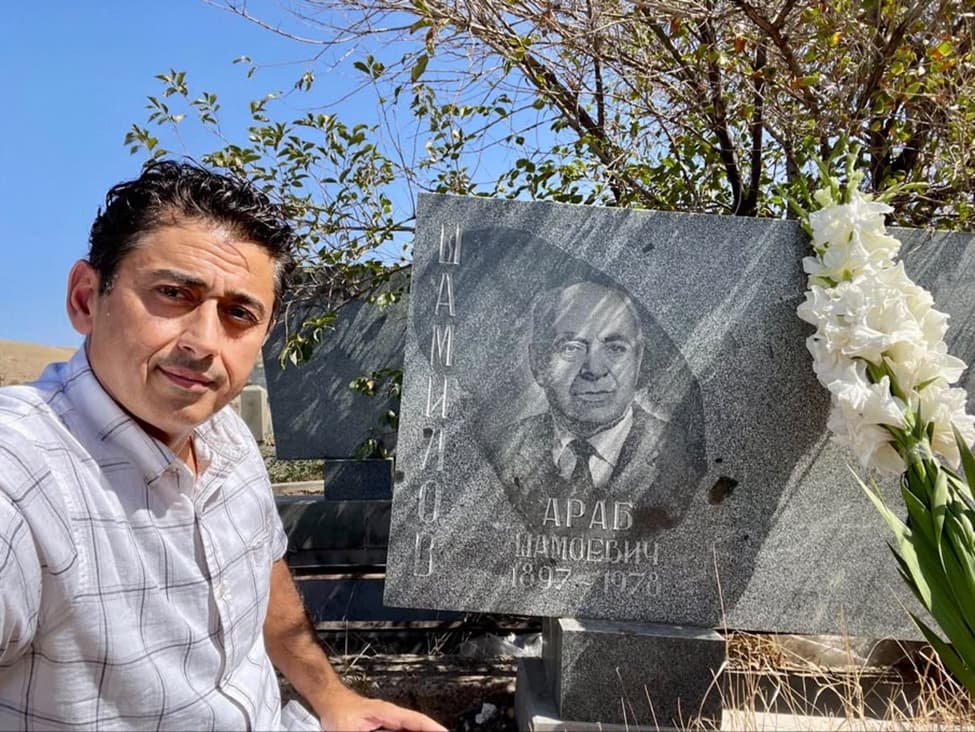
On Saturday, I was sitting in a conference room in Tbilisi. Kurds from the Caucasus and twenty other countries had gathered for the Third Conference of Caucasian Kurds to discuss religion, identity and the future of their societies. Among those present were Yazidis, Alevis and members of the Yarsan community, Sunnis and Shiites, Christians and Jews. They belonged to communities that had often been turned against one another throughout history. Not far from our meeting place, churches, synagogues and a mosque stand in the old town. They remind us of a history in which religious diversity did not always mean peace, but remained part of a shared life for many centuries.
As I listened to the discussions, one question stayed with me: How is it that people who lived in the same villages for generations, spoke the same languages, traded with one another and shared the worries of everyday life now increasingly emphasize their religious identity, as though they needed protection from their own neighbors?
The question is not new. What is new is its political significance at a time of growing uncertainty. In Syria, Iraq, Iran and parts of Turkey, religion is once again becoming the main foundation of identity for some communities. For some, it is an instrument of political power. For others, it is the last refuge they have left. These developments have different causes and cannot be considered morally equal. Yet both can contribute to a situation in which people increasingly cease to see themselves as members of the same society.
A danger is emerging that reaches far beyond the Middle East. What the American political scientist Samuel Huntington once described as a clash of civilizations may be taking a new form: a clash of religions, fought not necessarily between states, but within societies themselves.
The divide runs through society
When Huntington published his book The Clash of Civilizations in 1996, he described a world in which major cultural and religious civilizations would compete with one another. His argument was widely criticized. The Indian economist and philosopher Amartya Sen reminded us that no human being can be reduced to a single identity. We belong to families, language communities, societies and religions, or to no religion at all. We can be many things at once without having to decide which identity should determine our entire lives.
The Middle East shows how important this distinction is. Its conflicts are not simply confrontations between separate cultures. They unfold within states, between neighboring villages and sometimes within families. Sunnis and Shiites, Alawites, who should not be confused with the Alevis living mainly in Turkey, as well as Druze, Yazidis, Christians and Jews lived alongside one another in many places for centuries, although under very different political and legal conditions. Their history includes persecution and discrimination, but also long periods of peaceful coexistence.
Today, religious identity has become a question of security in many parts of the region. Who will protect me if I am threatened? Can I trust the state? Will my children have a future in their homeland? These questions go far beyond theological differences. When political institutions fail, and when rights and security depend on belonging to a particular community, common citizenship loses its meaning. People then seek protection among those who speak their language, share their history or follow the same faith.
Under such conditions, religion becomes something it does not have to be: a political dividing line between people who share the same homeland.
When faith becomes a political weapon
Anyone seeking to understand this development must also examine political Islamism. Organizations such as al-Qaeda, the so-called Islamic State (ISIS) and the former Nusra Front have combined religious beliefs with claims to political authority that deny fundamental rights to people of other faiths and to Muslims who reject their ideology. They claim to act in the name of Islam, but they do not speak for Muslims. Among their victims are many Muslims who oppose their rule or reject their worldview.
The genocide committed by ISIS against the Yazidis in August 2014 demonstrated, with terrible clarity, where the religious dehumanization of an entire community can lead. Violence justified in the name of religion is not limited to one denomination. In Iraq, Shiite militias have also persecuted, abducted and killed Sunni civilians.
Religion can also be used as a weapon by the state itself. In Iran, a political system has used its religious legitimacy for decades to restrict freedoms and persecute those who think differently. According to Iran Human Rights and Together Against the Death Penalty (ECPM), at least 1,639 people were executed in 2025 alone, more than in any other year since 1989. Members of ethnic minorities were particularly affected. Behind these figures stands a state that combines political power, religious authority and control over society.
Why do people join such movements? Oppression, humiliation, exclusion and experiences of violence can all play a role, but none of these factors alone explains radicalization. What often matters is how extremist ideologies place personal experiences within a larger narrative. Those who feel humiliated are promised dignity and importance. Those who feel excluded are offered what appears to be a community in which they are needed.
The social psychologist Arie Kruglanski has shown how powerful this search for significance can become. William Swann describes how personal identity can merge with the identity of a group. The group's enemies become personal enemies, and its goals become obligations for which even human lives may be sacrificed. Anyone who disagrees is no longer regarded as a person with a different view, but as an enemy of what is presented as a divine order.
The military defeat of the ISIS caliphate did not destroy this ideology. Jihadist networks continue to exist, including in Syria and Iraq. The situation in Syria is particularly troubling, as a leadership has come to power whose roots lie in the former Nusra Front. Whether its promised transformation will lead to a state that genuinely protects religious minorities cannot be judged by political declarations. It must be measured by the security and rights of its citizens.
One people, many religions
Few societies in the Middle East reflect the complexity of religious identity as clearly as Kurdish society. Most Kurds are Sunni Muslims. There are also Shiite Feyli Kurds, Alevis, Yazidis, Yarsanis, often known as Kakayis in Iraq, as well as Kurdish-speaking Christian communities. Many Assyrian and Chaldean Christians in the region, however, regard themselves as distinct peoples. For centuries, Jewish communities were also part of Kurdistan's cultural life.
Their religious traditions differ considerably. Yet their histories are connected in many ways. Language, music, shared landscapes, oral traditions and memories of persecution have created bonds that do not depend on belonging to one religion. When Kurds celebrate Newroz, the fire belongs to no single religious community. It is part of a cultural memory that reaches far beyond religious boundaries.
Many Kurdish political movements of the twentieth century understood themselves as secular. Language, cultural rights and national self-determination stood at the center of their political demands. Religious differences did not have to determine a person's place within the wider community.
Today, we can observe a change. In the Kurdistan Region of Iraq, religious political parties have become an established part of political life. In Turkey, parties that have long opposed Kurdish political demands also seek the support of religious Kurdish voters. The Free Cause Party (Huda Par), a Kurdish Islamist party whose representatives entered parliament through the ruling Justice and Development Party (AKP) lists in 2023, is now represented in Ankara.
At the same time, smaller religious communities are seeking greater recognition and political protection for their identities. The Yazidis in Shingal (Sinjar) are searching for forms of self-governance and security after experiencing how little protection existing state and political institutions offered them when they needed it most. The Yarsanis in Iran continue to struggle for recognition of their faith and for equal rights in society.
These developments are understandable in their historical context. They become problematic when religious and ethnic identities are treated as opposing choices. When people are asked whether they are Yazidi, Alevi or Yarsani first, or Kurdish first, they are forced to make a distinction that may not reflect their history or their own understanding of who they are.
No one should be required to choose between these identities. Nor should any community be prevented from defining its identity independently of ethnic categories. A shared society does not require one religion or one understanding of ethnic origin. It must be able to recognize different identities without turning them into reasons for political hostility.
The fears of vulnerable communities
For the Yazidis, August 2014 is not a closed chapter of history. More than 5,000 people were murdered. According to the responsible office in the Kurdistan Region, ISIS abducted 6,417 Yazidis, mainly women and children. Women and girls were enslaved and raped. More than 2,500 people are still missing.
I have worked with survivors of this genocide for many years. In their stories, I encounter the same question again and again, a question for which there is no simple answer: Why us? Behind these words lies more than the memory of suffering. They express the loss of a fundamental sense of security: the belief that one can live safely in one's own homeland without facing destruction because of one's religion.
Genocide does not harm only those who survive it directly. It also changes the collective understanding of an entire community. The stories of those who were murdered, the places where atrocities occurred and the experience of betrayal become part of a collective memory passed on to future generations.
What outsiders may regard as an exaggerated sense of threat can be understood from a psychotraumatological perspective when we consider the experiences of those affected. People who have witnessed neighbors suddenly becoming perpetrators, while state institutions failed to protect them, will not easily trust new promises of security. Such experiences can strengthen the need to withdraw into one's own community. Religion, rituals and collective memory then provide orientation and help preserve an identity whose very existence has been threatened.
These processes are not limited to the Yazidis. In Syria, the violence following the end of Assad's rule has renewed the fears of other minorities. In March 2025, according to a Syrian investigative commission, 1,426 people were killed in the coastal regions, including many Alawite civilians. In July, violence followed in Suwayda province, where more than 1,700 people lost their lives according to the findings of the UN Commission of Inquiry. Most of the victims belonged to the Druze community.
For those affected, these events revive memories of earlier persecution and raise the question of whether they will have a safe place in a new Syria. This is why religious minorities are increasingly organizing themselves politically. They establish associations, build international networks, demand autonomy or seek protection from regional powers. Some take up arms because they no longer trust others to guarantee their safety. We do not have to approve of every form of this response to understand its causes.
Yet repeated experiences of danger can create a dynamic that threatens the cohesion of society. The more a community focuses exclusively on its own security, the more difficult it becomes to restore trust in shared institutions. What begins as an effort to survive can lead to lasting separation.
When memory becomes a boundary
Kurdish history contains many places marked by collective violence. Dersim, Anfal, Halabja and Shingal represent different crimes and political circumstances. They cannot simply be equated. Yet they have left deep marks on the memories of many Kurdish families. It is worth looking more closely at who suffered in two of these places. In Dersim, the victims were mainly Alevis. In Shingal, they were Yazidis.
For this reason, I find it particularly painful when people today question whether Yazidis or Alevis can belong to Kurdish society at all. Such debates concern more than ethnic origins. They determine whose experiences are recognized as part of a shared history and who is allowed a place within that history.
We must also accept that people define their own identities in different ways. Some Yazidis clearly identify as Kurds, while others emphasize a distinct Yazidi identity. Among Alevis and Yarsanis, there are also different understandings of religion, language and ethnic belonging. This diversity has historical roots that cannot be reduced to a single national narrative. The real danger does not lie in the diversity of identities. It begins when these differences become reasons for exclusion and mutual rejection.
I often think of a house whose inhabitants have furnished different rooms. Each room has its own history, language, prayers and memories. No one has to leave their door open, and no one has to give up what makes them different. But when the inhabitants begin to deny one another the right to live in that house, the common roof will eventually cease to hold.
For small communities, the consequences can be particularly severe. Where political participation is denied and fear of renewed persecution remains, more and more families leave their homeland. With them disappear languages and traditions that have shaped the life of the region for centuries. The loss also affects the society they leave behind.
The psychology of a dangerous development
In long-lasting conflicts, a particular understanding of history often develops. The suffering of one's own group takes center stage, while the experiences of others receive less attention. Past violence becomes evidence that the other side will remain dangerous in the future. The Israeli psychologist Daniel Bar-Tal has described how a collective sense of victimhood can sustain conflicts that are difficult to resolve. The psychoanalyst Vamık Volkan speaks of "chosen traumas", historical wounds that retain a special place in collective memory across generations. Memory then does more than preserve the history of victims. It can also keep alive the expectation of renewed violence.
It would be wrong, however, to equate the fear of a persecuted minority with the ideology of its persecutors. Responsibility for crimes rests with those who commit them. Psychological mechanisms can help explain how hostile perceptions of other groups develop and persist. They do not remove the distinction between aggression and self-defense.
Yet even justified fear can be used for political purposes. The desire for security can lead to demands that other communities, in turn, perceive as threats. When every group begins to recognize only its own vulnerability, shared solutions lose credibility.
The terrorist attack by Hamas on 7 October 2023 and the subsequent war in Gaza have intensified experiences of loss and insecurity on both sides. Their consequences will affect relations between people for generations.
The effects of such conflicts extend far beyond the Middle East. Jewish people in Europe are held responsible for decisions made by the Israeli government, while Muslims face general suspicion because Islamist perpetrators invoke their religion. People are then no longer judged by their own actions, but are held responsible for the supposed guilt of an entire religious community.
The consequences of these hostile attitudes can be measured. A report from Tel Aviv University documents twenty deaths from antisemitic attacks worldwide in 2025, more than in any year for over three decades. In Germany, the CLAIM Alliance recorded 4,096 anti-Muslim incidents in the same year, around one third more than in the previous year.
In this sense, Huntington's thesis has gained new relevance, although in a different way from what he originally proposed. The danger is not that civilizations must inevitably fight one another because of their religions. It is that people increasingly believe their own safety can be secured only against others. When this belief begins to determine political action, the expectation of religious conflict can eventually become reality.
What makes a shared future possible
The answer cannot be to push religious identities aside or deny people their particular histories. For communities that have suffered centuries of persecution, preserving their religion is an essential part of their survival.
What matters is whether states are willing and able to guarantee the security and rights of all citizens, regardless of their religious identity. A Yazidi woman must be able to rely on the protection of the law just as much as a Sunni Muslim. An Alawite must not receive less protection because he belongs to a different religious community. Christians, Jews, Druze, Yarsanis and members of other minorities must be able to practice their religion without fearing for their place in society.
As long as this basic security is absent, people will continue to seek protection within their own communities. And as long as political power is distributed according to religious belonging, the temptation to use faith as an instrument of political division will remain strong.
This also requires confronting past crimes. The genocide against the Yazidis and the massacres of Alawites and Druze must be independently investigated. Those responsible must be brought to justice, and the rights of survivors must be recognized.
Through my work with survivors of war, torture and genocide, I have learned how closely individual healing and social justice are connected. Psychotherapy can help people process traumatic experiences. But it cannot replace the security that a state refuses to provide. Nor can it restore lost trust on its own when crimes are denied or efforts to uncover the truth are obstructed. Reconciliation therefore requires more than a wish to leave the past behind. It requires truth, responsibility and a willingness to acknowledge the suffering of others.
For Kurdish society, this means recognizing its religious diversity not as a weakness, but as part of its historical reality. No community should have to abandon its religion in order to be accepted as part of that society. At the same time, shared language, culture and history must not be used to deny the distinct religious identities of others. Political parties, religious leaders and intellectuals carry a particular responsibility here. Their actions can help determine whether differences become a foundation for shared freedom or a reason for further exclusion.
As we discussed these questions in Tbilisi, I was reminded once again of the contradictions in the history of this region. This year, Georgia marks the 1,700th anniversary of the adoption of Christianity as the state religion. At the same time, churches of different denominations, synagogues and a mosque have been part of its capital for centuries. This history, too, has known violence and exclusion. Yet it reminds us that religious diversity does not necessarily mean the end of a shared society.
The people in our conference room will return home with their different religious beliefs. They will continue to pray in different ways, celebrate their religious festivals and tell their histories in their own words. What matters is whether they will continue to recognize one another as people with whom they can build a common future.
A clash of religions is not an unavoidable fate. It begins when people come to believe that their own religion can survive only if another is pushed aside.
And it can still be prevented, as long as we refuse to turn our differences into hostility.
Dr. Jan Ilhan Kizilhan is a psychologist, author and publisher, an expert in psychotraumatology, trauma, terror and war, transcultural psychiatry, psychotherapy and migration.
The views expressed in this article are those of the author and do not necessarily reflect the position of Rudaw.