Returning home from work after eight hours of news coverage, I was disheartened to see dark clouds gathering in the sky, threatening rain. I had been hoping for a drizzle – something I love, as it refreshes me after a tiring day at work.
As I watched rainwater begin to fill the streets of my neighborhood, I hoped that my fellow citizens living in less developed parts of the city would remain safe.
Then, suddenly, my phone rang. It was my wife, who had gone out earlier in the day, when the skies were clearer, to attend to something important. Her voice was filled with fear as she called for help. She was trapped in a dangerous flash flood near the city center.
“Please help me. I am in the middle of a street filled with fast-flowing water. Meters ahead of me is a submerged underpass. What should I do?” she said in a trembling voice.
She also sent me footage of the scene, which was terrifying. But I did not want her to panic. I reassured her that everything would be fine and guided her toward a nearby alley where the water was shallower.
Footage filmed by the author's wife shows the flood from her car near the submerged underpass on November 7, 2026.
Following my instructions, she cautiously drove away from the dangerously fast-flowing water and eventually found a spot that had not been flooded.
But she could not have made it without the help of other families who were also struggling to save themselves. They warned her to leave her position in the middle of the flooded street as quickly as possible.
She was not completely safe yet. She had no idea how to navigate the narrow alleys, many of which were also submerged, to make her way back home.
The flooding had already claimed at least two lives – a young child and a man who had been trying to rescue others. Hearing about their deaths made me even more anxious. I had already watched enough terrifying footage of the flooding on social media that night to know how dangerous the situation was.
The race against time
After helping my wife reach a spot untouched by the floodwaters, my second mission began – racing against time to bring her safely home.
I immediately took my son to his grandfather's house and set out to bring my wife home.
After driving for about 10 minutes, I found myself stuck in traffic as the flooding had caused severe congestion across the city. It became clear that reaching my wife by car would be impossible that night.
I parked near a shopping outlet on the Erbil-Koya Road and decided to cover the remaining five kilometers on foot. Thankfully, the rain had stopped.
Alternating between running and walking, I soon began to feel exhausted. I tried to hire a motorbike, hoping it would help me bypass the traffic congestion, but the riders did not dare approach the underpass because of the severity of the flooding. I had no choice but to continue on foot.
I am reasonably fit and walk on a treadmill for at least 25 minutes three or four days a week. However, the fear that something might happen to my wife, combined with the tragic scenes I witnessed along the way, drained my energy.
I saw cars broken down in flooded streets, families seeking shelter by the roadside after their vehicles became stranded, and drivers damaging their cars as they desperately tried to escape the rising waters by driving over uneven ground.
I also saw dozens of families gathered outside their homes, anxiously monitoring the situation because their neighborhoods had previously been submerged by floodwaters.
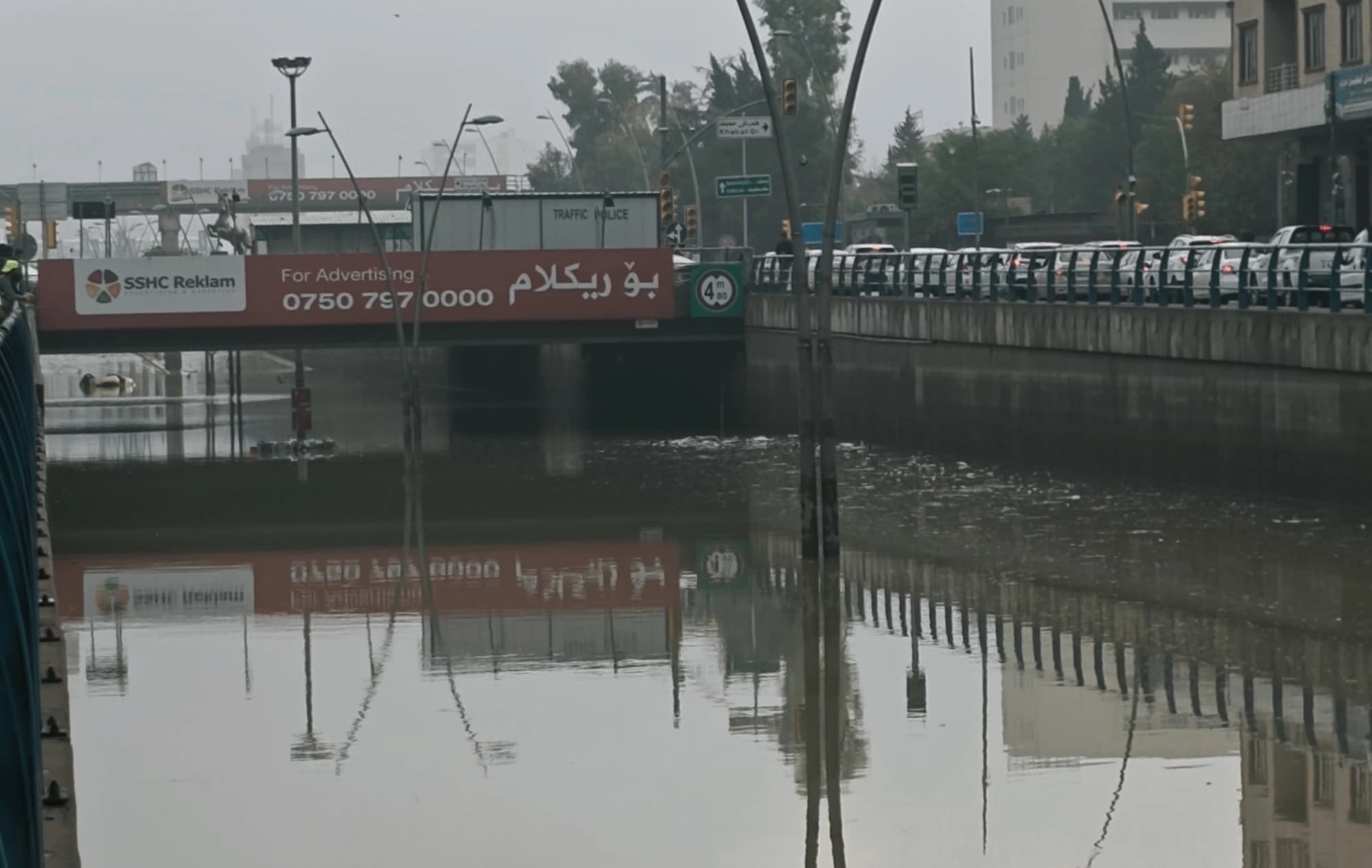
I finally arrived near the spot from which my wife had called me for help. Several cars were submerged in the underpass, while many others were stranded or had broken down.
My wife's car could easily have been among them. Thankfully, no deaths had been reported in that area.
Footage filmed by the author near the submerged underpass on Erbil-Koya Road while trying to reach his wife on November 7, 2026.
I tried to enter the alley where my wife was waiting, but its entrance was completely submerged. Most of the entrances to the Khabat neighborhood from the Erbil-Koya Road had been blocked by the flooding.
After searching for another route, I finally found a way to reach her.
I cannot describe the joy and relief I felt when I saw her safe. But even in that moment of happiness, I could not stop thinking about the families who had lost loved ones that night. I wished they could have experienced the same relief.
During my five-kilometer journey on foot, I had mentally mapped out a route that would allow us to drive my wife's car home without passing through the flooded streets.
We eventually made it home safely. But many other families were not as fortunate and are still reeling from the human and material losses they suffered that night.
A tragedy that must not be repeated
I want to make one thing clear: I am not sharing this experience to boast about what I did or portray myself as a hero. Helping my wife was simply my duty, and I believe anyone would have done everything possible to protect a loved one in such circumstances.
I am sharing it because, for a few terrifying hours, I experienced the fear and helplessness that many families across Erbil faced that night. My wife and I were fortunate enough to be reunited. Others lost loved ones, homes or possessions.
I understand that natural disasters occur around the world and cannot always be prevented. The Kurdistan Regional Government has taken measures to reduce flooding, including the construction of retention ponds and the expansion of drainage systems. These efforts are important, but the latest tragedy shows that more needs to be done.
The authorities must learn from what happened, identify the areas most vulnerable to flooding and take stronger measures to protect residents before the next heavy rainfall. Flood prevention should not become a priority only after lives have been lost.
That night, I walked and ran five kilometers to bring my wife home. I was exhausted, frightened and desperate, but I was lucky enough to find her alive and well.
My journey ended with relief and gratitude. For other families, the same night ended in unimaginable grief.
We cannot undo their losses, but we can honor them by doing everything possible to ensure that the next heavy rainfall does not turn into another deadly tragedy.
Karwan Faidhi Dri is a Senior Editor at Rudaw English.
The views expressed in this article are those of the author and do not necessarily reflect the position of Rudaw.