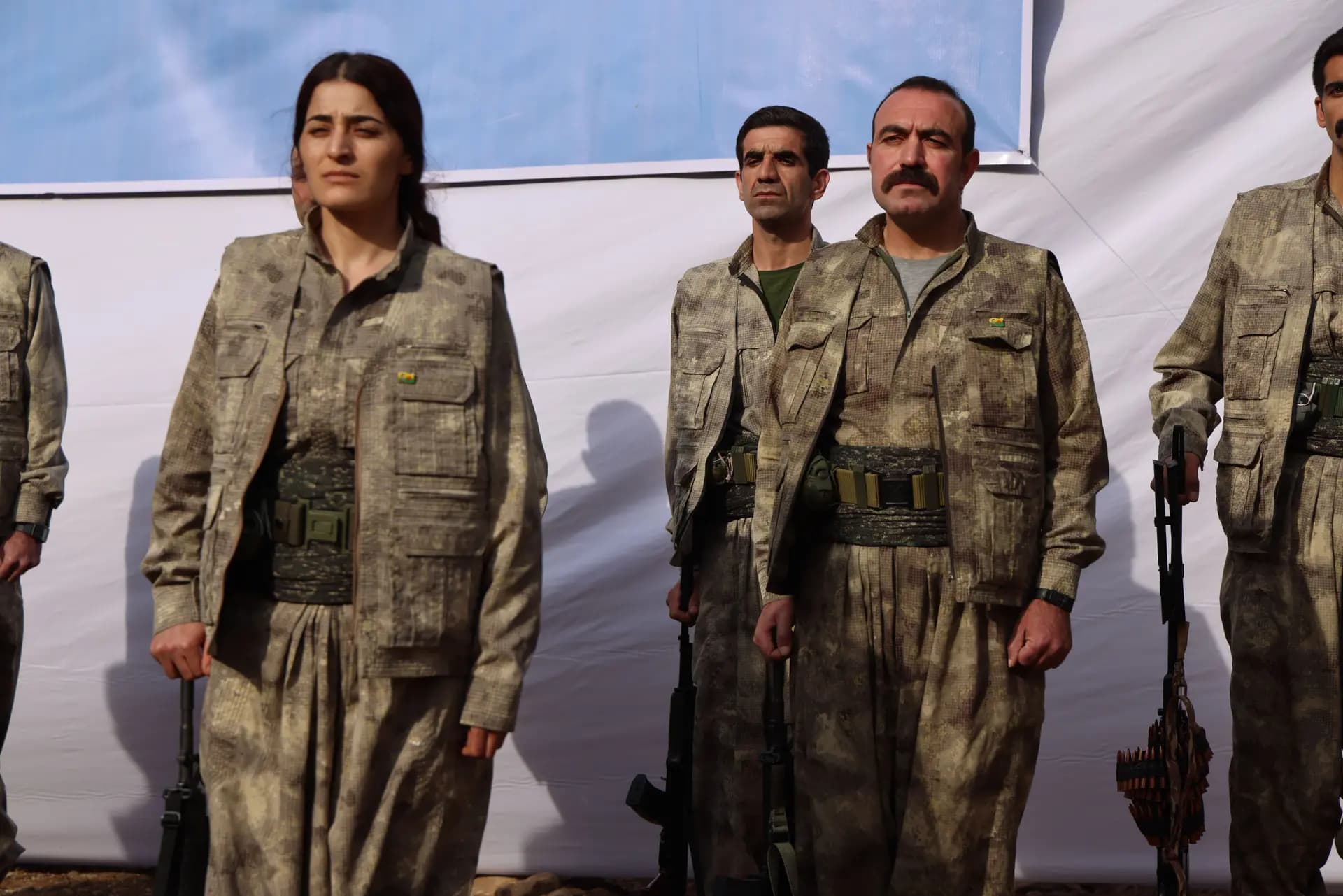
It is a historic moment, and yet hardly anyone trusts it. After more than forty years of armed struggle and more than 40,000 deaths, the Kurdistan Workers’ Party (PKK) decided at its 12th congress in May 2025 to dissolve itself. A parliamentary commission representing 11 parties held 21 sessions between August 2025 and February 2026, heard 137 institutions and individuals, and presented a final report. Why, then, is the mood in Turkey not one of hope but of skepticism, in Ankara as much as in Amed (Diyarbakir)? The answer lies not in the declared intentions of the actors, but in the nature of the space in which they move. The anthropology of violence teaches us that violence does not arise primarily from poverty, ideology, or hatred, but wherever spaces open up in which it can be exercised without consequences. And it does not end when an organization hands over its weapons; it ends only when the space that organization once filled is filled with something else. Moreover, these spaces of violence live on in minds, bodies, and families long after they have been physically closed. The space and its psychological legacy will together decide whether this process brings peace or merely a pause.
A century of denied existence
To understand what is at stake, one must understand what Kurdish identity in Turkey is made of. The republic founded in 1923 was built on the fiction of a homogeneous nation, and the country's largest minority disturbed that fiction. So it was defined out of existence: Kurds were declared “mountain Turks”, their language was banned from public life, their villages and even their Kurdish names were renamed, and their uprisings, from Sheikh Said in 1925 to Zilan valley and Dersim in 1938, were crushed with a brutality that depopulated entire regions. Anyone who experiences the official denial of their own existence learns a bitter lesson: the state is not a protector but a threat. It was in this climate of denied recognition that the spaces of violence opened in which the conflict escalated. The torture prison of Diyarbakir after the 1980 coup recruited more fighters for the PKK, founded in 1978, than any ideology ever did. The 1990s brought evacuated and burned villages, millions of displaced people, death squads, people who “disappeared” from police custody, and the Susurluk scandal, which exposed the entanglement of state, politics, and organized crime in the murder of Kurdish businessmen. The PKK, for its part, responded with the logic of guerrilla warfare: attacks on the military and the police, but also violence against teachers, village guards, and Kurdish “collaborators”. In these spaces, where both sides did what would be unthinkable in peacetime, Kurdish identity was forged. It is the identity of people who have learned that their dignity is protected neither by the state nor by the law.
What the space of violence leaves behind in the soul
A space of violence does not simply vanish when the tanks withdraw; it migrates into collective memory. Shared experiences of loss and humiliation became the emotional core of group identity. For the Kurds, these are Dersim, the prison of Diyarbakir, the burned villages, and the arrest of thousands of Kurdish politicians. From trauma research we know that such experiences are passed on across generations: children and grandchildren absorb the fears, the mistrust, and the unspoken missions of their parents, even if they themselves never saw a burning village; the silence of the parents often speaks louder than any story. On the Turkish side stands a collective trauma of its own: the Sevres syndrome, the fear, born of the collapse of the Ottoman Empire, that external and internal enemies want to carve up the country. Every Kurdish demand for rights activates this threat schema and is heard not as a claim to participation but as a first step toward partition. The social identity theory of Tajfel and Turner also explains why the policy of assimilation systematically failed: people derive much of their self-worth from group membership, and when that membership is threatened, they respond not by giving it up but by identifying with it more strongly. The denial of an entire people is the most radical identity threat imaginable. Every ban on the Kurdish language did not weaken Kurdishness; it charged it with meaning. Daniel Bar-Tal has shown how protracted conflicts harden into an “ethos of conflict”: the belief in the exclusive justice of one's own cause, the perception of one's own side as the true victim, the delegitimization of the adversary. Both sides have learned to be at home in the conflict; it is not only a political reality but a psychological homeland. This is the legacy of the space of violence: it continues to structure how people feel and think long after it appears to have been closed. To explain is not to justify. But whoever ignores this deeper layer will not understand the fragility of the current process.
A process that may not speak its name
The current process began with a gesture that no one had thought possible. In October 2024, of all people it was Devlet Bahceli, leader of the far-right Nationalist Movement Party (MHP) and a long-standing advocate of Abdullah Ocalan's execution, who walked over to the deputies of the pro-Kurdish Peoples' Equality and Democracy Party (DEM Party) in parliament and shook their hands. There followed visits by a DEM Party delegation to Ocalan on the prison island of Imralı, where he has been held in isolation since 1999, and on February 27, 2025, his “Call for Peace and a Democratic Society”, in which he described the PKK as historically obsolete and called for its dissolution. The organization followed him. The DEM Party became the messenger between Imralı, the PKK fighters on Mount Qandil, and Ankara, the very party whose predecessor had been vilified as the “political arm of terror”, whose former leader Selahattin Demirtas has been in prison for nearly a decade, and whose elected mayors were replaced, one after another, by state-appointed trustees.
Yet the language alone betrays the imbalance. The government does not speak of a peace process but of a “terror-free Turkey”; it does not negotiate, it accepts an “unconditional capitulation”. The actual talks with the PKK were conducted covertly through the intelligence service, without the public ever learning what was agreed. The parliamentary commission's final report of February 2026 does recommend legal rules for the handover of weapons and the reintegration of fighters, as well as a narrower definition of terrorism, so that mere membership no longer automatically counts as a terrorist offense. But no amnesty is foreseen, Ocalan remains on his island, and on the core political questions of language, status, and the constitution the report remains largely silent. The DEM Party consented, but placed on record the point that goes to the heart of the problem: the Kurdish question must not be treated solely as a problem of terrorism. From a psychological point of view, this choreography is dangerous, because it stages peace as the submission of one side and the triumph of the other. The peace researcher Evelin Lindner has called humiliation the “atom bomb of the emotions”: no emotion more reliably produces a desire for revenge and the collapse of peace processes. Anyone who has ever worked with people who have suffered violence knows: reconciliation cannot be built on humiliation.
Why mistrust rules
There are at least three reasons why this process is so fragile. The first is mistrust. The last attempt, from 2013 to 2015, ended not in peace but in the destruction of the old town of Amed, in curfews, and in urban warfare. Those who lived through it know that in a space where no one can trust anyone, continuing the conflict paradoxically promises more security than a brittle peace. Both sides keep their exit options open, and precisely this paralyzes the process. For many people in the region, the failure of 2015 was also a retraumatization: the hope they had dared to feel was punished. And whoever has once been punished for trusting protects themselves the next time with mistrust. The second reason is nationalism. For considerable parts of Turkish society, every concession to the Kurds is a betrayal of the nation; parties such as IYI (Good) and Zafer (Victory) openly fight the process, and even the government must save face before its own base by selling every reform as a victory over terror rather than as the recognition of legitimate demands. Behind this rhetoric stands the ethos of conflict Bar-Tal describes: whoever makes peace must rebuild parts of their own self-image, and that creates fear on both sides. The third reason is the calculus of power. The suspicion hangs in the air that all of this is less about the Kurds than about a constitutional amendment that could allow President Erdogan a further term in office. The credibility of the process suffers further from a glaring contradiction: while democratization is being promised, the main opposition Republican People’s Party’s (CHP) politicians are prosecuted, protests are suppressed, and elected mayors are removed from office. A state that wants to make peace with the Kurds while dismantling democracy everywhere else is asking for an advance of trust that history does not cover. The needs-based model of reconciliation developed by Arie Nadler and Nurit Shnabel captures the dilemma precisely: the side that experiences itself as the victim needs recognition and agency; the side addressed as the perpetrator needs the assurance that it belongs to the moral community. Here, both sides claim the role of victim, and neither receives what it needs. Conflicts become solvable when both sides are caught in a mutually painful stalemate and at the same time can see a way out. The stalemate is there. What is missing is the second half of the formula: a way out that is credible, face-saving, and dignified for both sides.
This is not about the PKK but over 25 million people
Here lies the error of reasoning that could cause the process to fail: Ankara treats the dissolution of the PKK as an endpoint. In truth, it is at best a beginning. The Kurdish question did not come into being with the PKK in 1978, and it will not disappear with it. At stake are the rights of more than 25 million people: education in their mother tongue; political participation without the sword of Damocles of anti-terror justice; local self-government without state-appointed trustees; the release of political prisoners; the return and reintegration of those who are in the mountains or in exile; and the psychological and social care of a population that has lived with violence for generations. Whoever reduces the question to the disarmament of one organization confuses the symptom with the cause.
One thing is clear: spaces that are not filled do not remain empty. The PKK came into existence because the Turkish state denied the Kurds any legal space in which to articulate their existence; it filled a vacuum that the republic itself had created. And, as psychology teaches, it filled not only a political space but a psychological one. For a generation of young Kurds, the armed struggle offered what the radicalisation researcher Arie Kruglanski calls the “quest for significance”: the feeling of mattering, of being seen, of being able to set something against one's own powerlessness. If the PKK now dissolves without this double vacuum being filled with recognition, rights, and political representation, others will fill it. Perhaps not with weapons: the era of armed struggle probably is historically over, as Ocalan himself writes, and the younger Kurdish generation is more urban, better educated, and more internationally connected than any before it. But new Kurdish organizations, movements, and generations will carry the claim to identity and rights forward—in civil, political, social, and digital forms, and possibly more effectively than any guerrilla, because they will lack the label of terrorism with which every Kurdish demand could previously be discredited. A state that believes the Kurdish question is settled with the end of the PKK will discover in 20 years that it has merely changed opponents. The question is not whether the Kurdish space will be filled, but by whom and with what.
Recognition as a constitutional mandate
This is why there is no way around a step that no Turkish government has yet dared to take: recognizing the Kurds as what they are—a people with their own language, culture, and history, within the existing borders. This recognition must be anchored in the constitution, not in revocable decrees and not in the fine print of commission reports. A constitution that names the Kurdish people and the Kurdish language would be neither a gift to the PKK nor a threat to territorial integrity. On the contrary, it would be that integrity's strongest safeguard, because it would strip separatism of its most powerful argument: a wounded, denied identity. Only constitutional entrenchment creates the security of expectations without which no space of violence can be closed for good. All sides - the Turkish state, the Turkish majority society, and the Kurds themselves - must be able to grow accustomed to the fact that Kurds exist, that they have rights, and that both are normal. Habituation is not a weak word here; it is the heart of the matter. Peace is nothing other than normality one can rely on. Gordon Allport's contact hypothesis shows that prejudice and feelings of threat decline when groups encounter each other under conditions of equal status. But equal status presupposes legal equality. And trust is created not by appeals but by institutions that guarantee expectations: only when rights no longer depend on the goodwill of whichever government is in power can the collective nervous system of both sides come to rest.
This is about more than legal paragraphs. It is about restoring dignity to an identity that was denied, criminalized, and branded with the label of terrorism for a century.
If the Turkish state uses this moment to fill the spaces with law, recognition, and participation, the “terror-free Turkey” can indeed become a peaceful one. Erdogan, whatever his motives, would thereby build himself a monument where generations of governments and generals have failed. Such a peace would resonate far beyond Turkey, into a region that needs little more urgently than proof that a century-old conflict can end without victors and vanquished. If, however, the state understands the adversary's capitulation as permission to leave everything as it was, the space will open again: perhaps not tomorrow, perhaps not with the same actors, but with the same logic of injury, fear, and defiance. It is not people who must be changed, but the spaces in which they act and the conditions under which they perceive one another. Whoever wants peace must give the Kurds what was denied them for a century—nothing more, but not a millimeter less: the self-evident, constitutionally guaranteed certainty that they exist and that their identity has dignity.
Dr. Jan Ilhan Kizilhan is a psychologist, author and publisher, an expert in psychotraumatology, trauma, terror and war, transcultural psychiatry, psychotherapy and migration.
The views expressed in this article are those of the author and do not necessarily reflect the position of Rudaw.