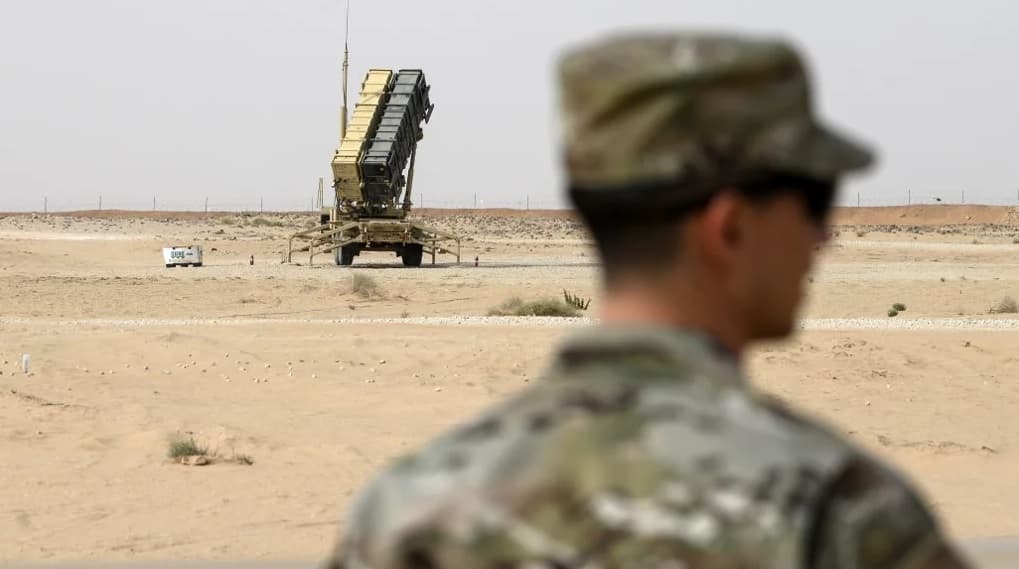
The US redeployment of MIM-104 Patriot missile defense systems weeks ahead of the scheduled September 30 troop withdrawal deadline has substantial ramifications for the Kurdistan Region’s air defense. The autonomous enclave has relied entirely on US and coalition air defenses for protection against more than 900 Iranian and Iraqi militia drone and missile attacks since February 28.
Al-Monitor first reported on the redeployment on July 31, citing sources confirming that “all” Patriot systems have been relocated, but specifying that other systems remained in place. While the advanced Patriots focused on intercepting ballistic missiles, systems such as the C-RAM, Coyote, and British Rapid Sentry intercepted drones and rockets targeting Erbil. Additional reporting by Rudaw English clarified that the US swiftly redeployed eight Patriot batteries to Jordan while Britain transferred its Rapid Sentry to Cyprus.
Freddy Khoueiry, a global security analyst for the Middle East and North Africa at the risk intelligence company RANE, assesses that the Patriot pullout “materially increases” Kurdistan’s vulnerability to Iranian attacks.
Still, he doesn’t think it necessarily gives Tehran an “unrestricted ability to strike anyone, anywhere, and without repercussions.”
“The more likely consequence is that Iran and its militias in Iraq are likely to become more willing to conduct attacks against remaining US assets and Kurdish militias,” Khoueiry told Rudaw English. “Tehran would still have to consider possible US retaliation from outside Iraq, Iraqi diplomatic pressure and the reputation costs of killing civilians.”
While C-RAM and Coyotes, presuming some remain, can provide “useful close-range protection” against drones and rockets, they cannot substitute for the Patriot’s anti-ballistic capabilities and coverage.
“Their effective footprint is limited to specific facilities, and they can be saturated by simultaneous attacks from different directions if high-intensity conflict resumes in the region,” Khoueiry said.
A finite domain
Even before the Iran war, Erbil and the wider Kurdistan Region endured ballistic missile attacks perpetrated by Iran’s Islamic Revolutionary Guard Corps (IRGC). The IRGC first attacked Iranian Kurdish opposition groups in Erbil province with ballistic missiles in September 2018. They then targeted the private residences of prominent Kurdish businessmen inside Erbil city in March 2022 and January 2024.
Khoeuriy believes that while the Patriot withdrawal does increase the likelihood of such strikes, he doubts they will become routine.
“Tehran used the 2022 and 2024 attacks to send political and deterrent messages, not simply because a target was physically undefended,” he said.
Alex Almeida, director of security at the political risk consultancy Horizon Engage, anticipates that some C-RAMs and Coyotes will likely remain to protect the US Consulate and other residual US-operating locations. Therefore, Erbil might retain some anti-drone protection.
“We shouldn’t forget the Patriot deployment to Erbil has been intermittent over the last couple of years,” Almeida told Rudaw English.
“The Patriots were only needed rarely to engage incoming ballistic missiles during the February-April war, and even then they only covered the greater Erbil area, so other sites in Kurdistan have always been exposed to ballistic missile fire,” he said, maintaining that “their withdrawal does mean that the city will be exposed to Iranian ballistic missile fire again.”
“That's not new for Erbil, but Iran is now much more willing to lob ballistic missiles and to do real damage,” he noted.
A projected reduction
Since February 28 and even after the April 8 ceasefire, Iran has constantly attacked Iranian Kurdish groups in the Kurdistan Region. However, that was likely going to be the case regardless of whether or not the Patriots remained in Erbil.
“Most Iranian Kurdish opposition sites in Kurdistan were already outside the Patriot’s Erbil-centered coverage envelope,” Almeida said, “so the withdrawal of Patriots doesn’t meaningfully change the equation for them.”
Caroline Rose, a senior director at the US-based Soufan Center, reasoned that a reduced post-September US military footprint could potentially see a concurrent reduction in Iranian strikes.
“While Iraqi Kurdistan has borne the brunt of many of these strikes in recent years, I think that this was in part due to the higher concentration of American presence as US forces incrementally withdrew, first shifting north into Kurdish areas from federal territory,” Rose told Rudaw English.
“It’s possible that we may now see a reduction in Iranian direct strikes, at least during major escalation with the US that forces Iran to prioritize countering American assets elsewhere in the region beyond Iraq, such as in the Gulf.”
After withdrawal, the Kurdistan Region can expect “periodic strikes,” albeit on a “smaller scale and scope.”
Remaining threats
Almeida assesses that so long as any residual American presence remains in Erbil, including diplomats and US-linked companies, it will be under the threat of attack.
“The US drawdown from federal Iraq hasn’t stopped Iran-backed militias from targeting the US Embassy and the diplomatic annex at Baghdad airport,” he said. “Kurdistan is still the preferred militia ‘dumping ground’ for attacks, and the presence of Iranian Kurdish opposition and Iran’s obsession with a supposed Israeli intelligence presence in the KRI will also continue to draw attacks.”
RANE’s Khoueiry similarly assesses that the immediate threat is “particularly serious” for Kurdistan’s energy infrastructure, airports, and foreign diplomatic facilities.
“Iran and its Iraqi partners do not need to destroy the Kurdistan Region’s energy infrastructure to achieve an effect; periodically forcing operators to suspend production, evacuate personnel or raise security spending can undermine investor confidence and pressure the KRG financially,” he said.
The IRGC has already pursued an “aggressive and proactive posture” toward Kurdistan through maintaining pressure on Iranian Kurdish groups and conducting “recurrent attacks” across the region.
“Tehran therefore isn’t waiting for a US withdrawal to feel emboldened,” Khoueiry said. “However, a complete American drawdown - particularly if the wider regional conflict persists by then - would further lower the perceived risks of escalation and likely encourage more frequent or intensive Iranian attacks.”
A shift in partnership
The RANE analyst anticipates that the US withdrawal is more likely to “transform the partnership” between Washington and Erbil rather than end it.
“Washington will probably shift from directly protecting Kurdish territory toward intelligence sharing, Peshmerga training, arms transfers, counter-Islamic State cooperation and diplomatic support,” he said.
Soufan Center’s Rose believes US-Kurdish cooperation is at a crossroads, in both Syria and Iraq.
“The US and its partners would be wise to sustain engagement and intelligence collection as a way of upholding success levels achieved in counterterrorism operations and deterrence against Iran,” she said.
“This said, I think that given the decades of collaboration and close coordination, the US will serve as an aid if Kurdish areas were suddenly subjected to Iranian strikes and pressure.”
The views expressed in this article are those of the author and do not necessarily reflect the position of Rudaw.