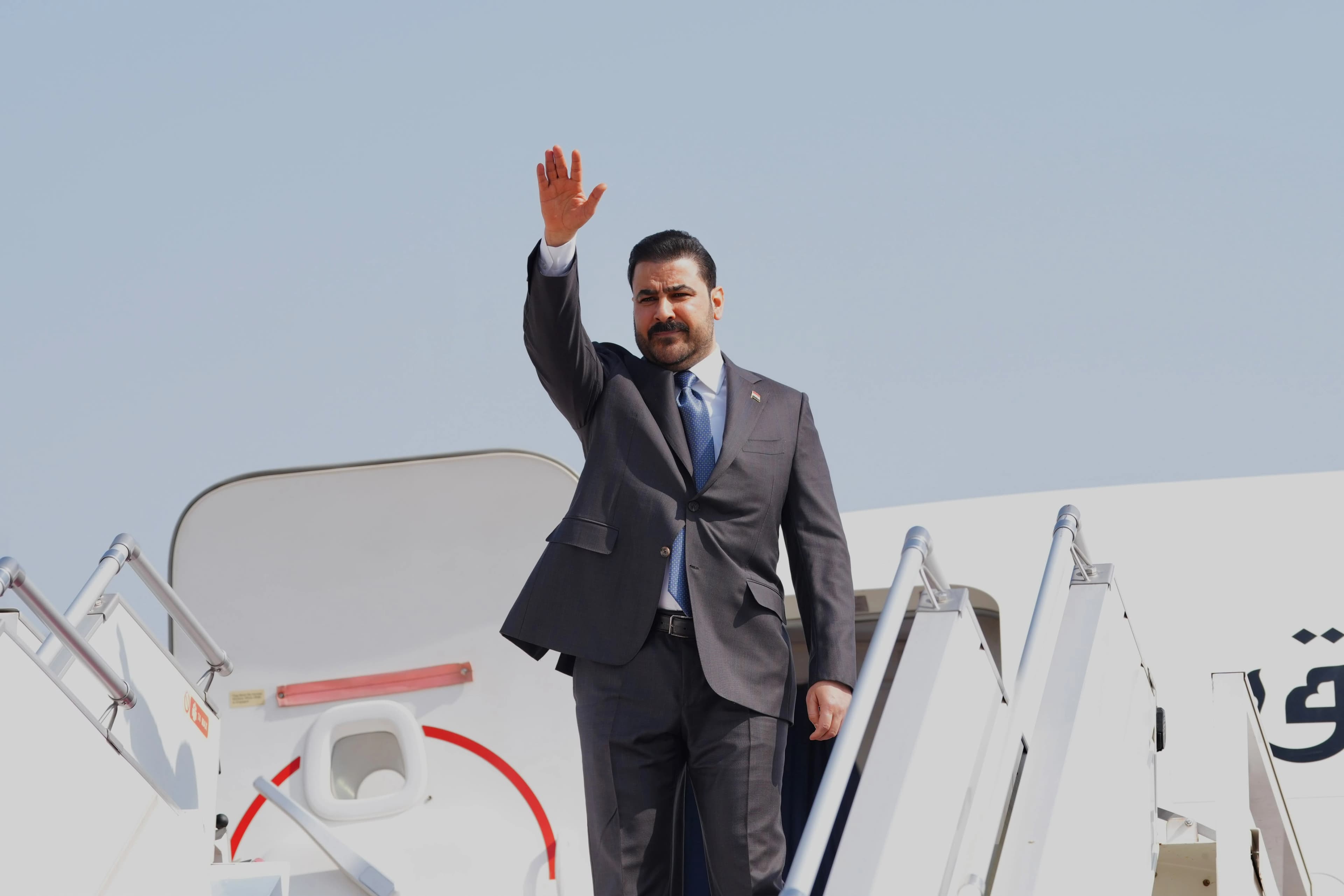
ERBIL, Kurdistan Region - Kurdistan Region President Nechirvan Barzani late Wednesday held talks with Iraqi Prime Minister Ali al-Zaidi in Baghdad that centered on domestic and regional developments, the Kurdish leader said, affirming Erbil's backing for the Zaidi government's agenda, including efforts to confine weapons to the state and "consolidate security and stability."
President Barzani said he "held a productive meeting" with Zaidi, during which "we discussed the overall situation in the country and the challenges we face," as well as "the latest developments at the regional and international levels and their repercussions on Iraq."
“We affirmed the Region's support and joint efforts to ensure the successful implementation of the government program,” the Kurdish leader added in his statement on X, including “confining weapons to the state and accelerating the achievement of national priorities - foremost among them consolidating security and stability, advancing the development process, and improving the level of services,” he said.
In early June, Zaidi ordered the formation of a committee to oversee the disengagement of political parties and armed factions from the Popular Mobilization Forces (PMF), part of a wider effort by the newly appointed premier to bring paramilitary groups and their weapons under state control.
The PMF was established in 2014 amid the emergence of the Islamic State (ISIS) in Iraq, when large parts of the country's north and west fell under the group's control. Formed in response to a decree by Iraq's highest Shiite religious authority, Grand Ayatollah Ali al-Sistani, the PMF began as an umbrella organization of roughly 70, predominantly Shiite, armed groups with some 250,000 members.
Although the organization is a state-funded institution, the PMF includes factions aligned with the Iran-led ‘Axis of Resistance,’ with the core overlap comprising Asa'ib Ahl al-Haq, Kata'ib Hezbollah, Harakat Hezbollah al-Nujaba, and Kata'ib Sayyid al-Shuhada, among others.
While some groups have expressed willingness to comply with Zaidi's push to restrict weapons to state control, others have cited the continued presence of foreign forces - namely those of the US-led Global Coalition to Defeat ISIS - as justification for refusing to do so.
In mid-July, Sabah al-Numan, spokesperson for the Iraqi prime minister, told Rudaw that the September 30 deadline to bring Iraqi armed groups' weapons under state control is "irreversible," affirming Zaidi's "commitment and determination" to conclude the file within that timeframe.
For its part, the Iraqi prime minister’s office detailed in a statement that the meeting with President Barzani was held on the sidelines’ of the Kurdish leader’s attendance of the “periodic meeting of the State Administration Coalition.”
Of note, the State Administration Coalition operates as Iraq's main governing political alliance, bringing together major Christian, Kurdish, Shiite, Sunni and Turkmen parties. Formed in late 2022 to facilitate the creation of former prime minister Mohammed Shia al-Sudani's (2022 - 2026) government, the coalition has since served as a platform for coordinating policy and discussing major national issues.
Zaidi reviewed "efforts to strengthen security and stability, improve services, implement the ministerial program, and confront economic and financial challenges," affirming that "the government places the protection of citizens' interests at the top of its priorities," his office said.
The State Administration Coalition, meanwhile, reiterated its support for Zaidi’s efforts to “confine arms to the hands of the state," while emphasizing the need to "prevent the use of Iraqi territory as a launchpad for attacks on neighboring countries or dragging Iraq into conflicts that do not serve the interests of its people."
"Any side engaging in such behavior is committing a crime" and will be held accountable under "constitutional provisions that prohibit the use of weapons outside the will of the state or the formation of any armed organization outside the official armed forces," the Coalition warned.
The bloc also called for adherence to the September-end timeline, "after which the anti-terrorism law will be applied to any armed conduct outside the framework of the state."