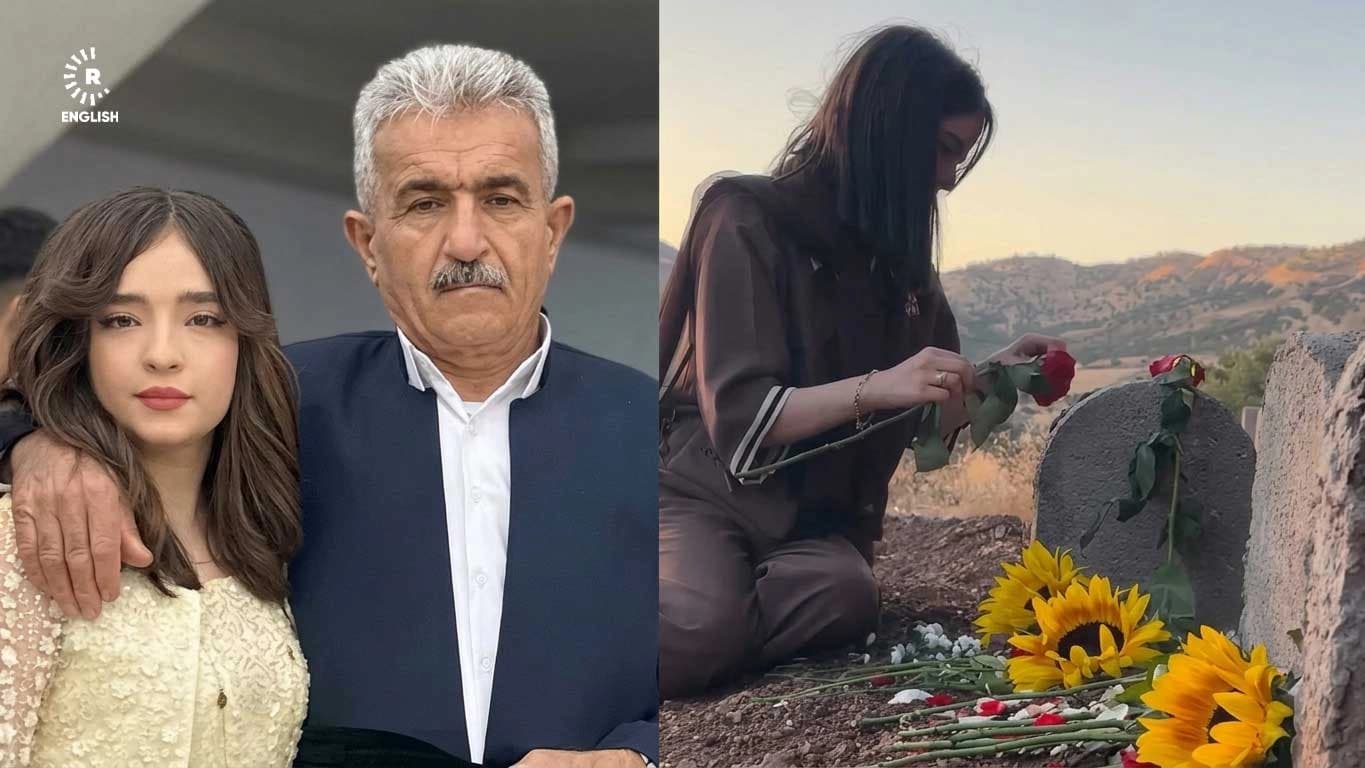

ERBIL, Kurdistan Region - The daughter of a Kurdish kolbar shot dead by Iranian border guards in July has disputed Tehran’s account of his killing, telling Rudaw that her father was fatally struck by the first bullet, contradicting Iran’s claim that officers fired 28 shots, including warning shots, before a bullet ricocheted and killed him.
Soma Rahimi said her 56-year-old father, Vazir Rahimi, was killed around midday on July 3 near Nowsud in Kermanshah province, western Iran, while working as a kolbar.
“Please do not shoot him. He is an innocent and harmless kolbar, and he is carrying nothing,” Soma recalled two other guards on duty at the time pleading with their colleague who fired the shot.
The shooter ignored their pleas and fired 28 bullets at her father, she said.
“My father was killed by the first shot. The remaining shots were fired to create the impression that warning shots had been given,” Soma told Rudaw’s Agrin Mohammadi on Tuesday, adding that this account was also presented in court.
Iran acknowledged the killing in an October 28 response to a joint communication from three UN human rights experts, including the Special Rapporteur on the situation of human rights in Iran. Tehran said Rahimi had been carrying a backpack and attempted to flee after border guards ordered him to stop. Officers subsequently fired 18 warning shots into the air and another 10 shots in a surrounding pattern, according to the Iranian response.
“One of the bullets ricocheted after striking rocks beside the mule track,” the document stated, adding that the bullet struck Rahimi in the forehead, killing him at the scene.
However, his daughter rejected that account, saying two border guards who were present had pleaded with the shooter not to open fire.
She further disputed Tehran’s claim that her father was carrying a backpack, insisting he had no goods or weapons with him when he was shot. “My father was carrying nothing,” she said, adding that kolbars working in the area mainly transported gasoline across the border.
Soma also questioned why the officers resorted to lethal force rather than arresting her father, arguing that they were close enough to apprehend him.
“My father was 56 years old. There was absolutely no need to shoot him. Even if he had fired at him, he should have aimed below the waist,” she said.
Iran said a judicial case had been opened into Rahimi’s death at the Paveh County Court. The investigation included an expert assessment, a forensic medical report, a reconstruction of the incident scene, statements from witnesses and the interrogation of the officer who fired the shot. The case remains under examination by the competent judicial authority, according to Tehran.
It also said judicial investigations had been opened into the deaths of five men identified by human rights organizations as Kurdish kolbars: Rahimi, Soheil Ferdowsi, Sirvan Khosh-Namak, Madeh Kermani and Mohammad Tohidpanah.
A dangerous livelihood
Kolbars are porters who transport goods across Iran’s mountainous western borders, the Kurdish areas known as Rojhelat, often using hazardous mountain routes to earn a living amid limited employment opportunities in the predominantly Kurdish regions.
While some operate through designated border crossings under government-issued work permits, others use unauthorized mountain routes to transport goods without customs clearance.
Iran has repeatedly characterized fatal border incidents as operations against smugglers and unauthorized crossings. Human rights organizations, however, have raised concerns over the use of lethal force against porters, including in cases where they were not shown to pose an immediate threat to life.
According to a UN report last month, at least 12 kolbars "have reportedly been shot dead by Iran’s border forces or Islamic Revolutionary Guard Corps" since the beginning of this year, adding that "deaths at Iran's borders pass largely unnoticed."
The Kurdistan Human Rights Network (KHRN), a France-based organization, submitted a dossier documenting eight alleged killings of kolbars to the UN experts, prompting their joint communication to Tehran.
Recent figures from Oslo-based Hengaw Organization for Human Rights underscore the continued dangers facing kolbars. At least 59 were killed or injured in Iran's western border provinces in 2025, including 25 deaths and 34 injuries, according to data compiled by the organization's statistics and documents center.
“Direct gunfire by Iranian forces accounted for 49 cases, approximately 83% of the total,” Hengaw said in a September 8 email to UN human rights officer, Wahida Omari,adding that four kolbars were killed by natural hazards and three in landmine explosions.
The organization documented another 19 kolbars killed or injured between the beginning of 2026 and September 8, including 12 deaths and seven injuries. Eighteen of those cases involved direct gunfire by Iran's Border Regiment or Islamic Revolutionary Guard Corps (IRGC) forces, while one kolbar was injured in a landmine explosion.
The dangers of the trade have been documented for years. A 2020 Rudaw investigation found that IRGC killed 56 kolbars and wounded another 153 in 2019 alone, while 23 others died from exposure to freezing temperatures.
A report by the US-based United for Iran, drawing on KHRN figures, documented at least 1,042 kolbars killed or injured along Iran's western frontier between January 2015 and March 2022, including at least 221 killed by Iranian border guards and the IRGC.
Despite efforts to regulate parts of the trade, poverty and a shortage of employment opportunities continue to push residents towards the dangerous occupation. In February 2026, Rudaw interviewed elderly men and women who continued working as kolbars to support their families amid soaring living costs.
“What choice do I have? I must come; I am forced to,” one woman, Amina Rizi, told Rudaw.