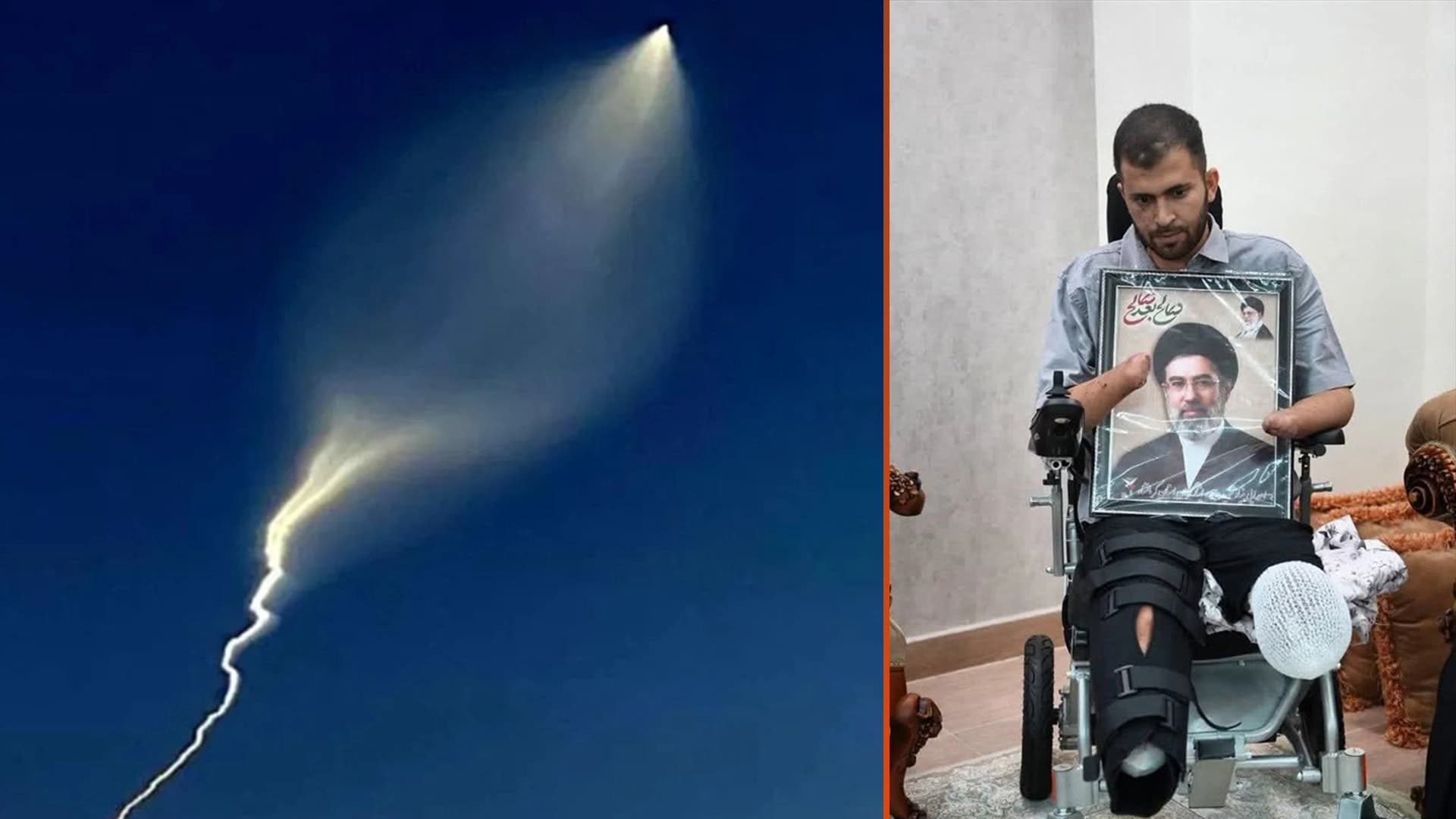

ERBIL, Kurdistan Region – As the sun set over Tehran during the 12-day war between Iran and Israel in June 2025, a spectacular luminous trail appeared across the Iranian capital’s sky that resembled an angel with outstretched wings. Photographers captured the extraordinary sight, while some Iranians dubbed the missile believed to have created it the “Angel of Death.”
But behind the dramatic spectacle lay a story of technical failure, a potentially fatal gamble and the determination of an Iranian missile operator, according to a collection of testimonies from Islamic Revolutionary Guard Corps (IRGC) Aerospace Force personnel the Iranian newspaper Farhikhtegan published on Monday.
The newspaper identified the missile responsible for trail across the sky as the Sejjil, a two-stage, solid-fuel ballistic missile designed to strike targets up to a distance of 2,000 kilometres away.
According to the account, the crew had completed preparations and activated the firing sequence, but the missile's engine failed to ignite.
With the operators close to abandoning the launch, a crew member identified as Ruhollah repeatedly pleaded with his commander, Mohsen, to allow him to approach the launcher to attempt to fire the missile from its cabin.
Mohsen initially refused, fearing that a delayed ignition could burn Ruhollah alive before he reached safety.
Eventually, the commander relented.
Ruhollah rushed to the launcher, entered the cabin and closed the door behind him. Seconds later, the missile roared into the evening sky.
As the missile climbed towards its target, its stage separation created an extraordinary luminous pattern above Iran.
The newspaper described the successful launch as a miracle, adding that another operator, Javad, repeated a similar manoeuvre several days later.
The account was among dozens of testimonies published by Farhikhtegan, documenting the experiences of Iranian missile crews during the June 2025 war and the subsequent US-Israeli conflict with Iran in 2026.
The missile behind the spectacle
The Sejjil-2 is one of Iran's most advanced, domestically developed medium-range ballistic missiles, using two stages powered by solid propellant rather than the liquid fuel employed by some of Iran's older missile systems.
According to the Washington-based Center for Strategic and International Studies (CSIS), the missile is approximately 18 metres long, weighs around 23.6 tonnes at launch and has an estimated range of 2,000 kilometres.
The Sejjil-2 is designed to carry a conventional warhead weighing approximately 700 kilograms over that distance, although its maximum range depends on the weight of its payload.
Its solid-fuel design is particularly important because it eliminates the need to fuel the missile immediately before launch, reducing preparation time and the period during which its launcher is vulnerable to enemy aircraft and drones.
Iran first test fired the Sejjil family of missiles in 2008, followed by further trials of the improved Sejjil-2 in 2009.
The luminous trail observed over Tehran was attributed by Iranian media to the expansion of exhaust gases at high altitude and a phenomenon known as the twilight effect.
As a missile climbs into the thinner atmosphere, its exhaust plume expands. Around sunset, sunlight can continue illuminating the gases at high altitude even when the ground below is dark, creating spectacular glowing shapes.
Iran's Young Journalists Club described the phenomenon in a November 1 report explaining the Sejjil's distinctive appearance.
Death from above
While the Sejjil was celebrated as an “Angel of Death,” the testimonies published by Farhikhtegan suggest that the real and persistent danger confronting Iranian missile crews came from Israeli and American aircraft and drones operating overhead.
In one account, a launcher commander described how an Israeli drone struck his position shortly after another launcher, approximately 200 metres away, fired its missile.
Despite damage to the launcher, the crew continued launch preparations.
A second Israeli missile then struck the position.
The commander said the missile remained intact, allowing him to complete the launch despite damage to the launch vehicle.
Another testimony described two launchers coming under repeated drone attacks, with one burning as its crew struggled to save it.
An operator identified as Mahmoud reportedly managed to separate a towing vehicle from a burning launcher. He then drove it away as an Israeli drone continued circling overhead.
In another incident, four IRGC personnel were killed in successive drone strikes as they attempted to rescue colleagues following an explosion at a missile launching position.
The first victim, Mojtaba, a technical battalion commander, approached the scene in a firefighting vehicle and was struck while attempting to evacuate personnel.
Mohammad Amin, a security officer who arrived in an ambulance to assist him, was also hit.
Two other men, Seyyed Hossein and Mohammad, were subsequently killed as they approached their wounded colleagues.
All four died at the same location, according to the newspaper.
Other accounts described missile crews losing limbs, suffering severe burns and being killed while preparing launchers or attempting to recover bodies.
The newspaper presented these episodes as examples of exceptional sacrifice. Taken together, however, they also reveal the vulnerability of Iran's missile-launching infrastructure to sustained Israeli surveillance and precision attacks.
Hundreds of missile launchers destroyed
Israel made the destruction of Iran's ballistic missile launchers a central objective of its June 2025 campaign.
On June 16, the Israeli military announced that it had destroyed more than 120 launchers, which it estimated represented approximately one-third of Iran's operational inventory at the outset of the war.
By the end of the 12-day conflict, Israeli assessments suggested that approximately 250 launchers had been destroyed or rendered inoperable.
These figures could not be independently verified, and Iran has not disclosed a comprehensive inventory of its launchers or missile stockpiles.
The damage did not inhibit Iran's ability to launch missiles at Israel, and Tehran subsequently embarked on efforts to rebuild its arsenal.
In January 2026, IRGC Aerospace Force commander Brigadier General Majid Mousavi claimed that Iran had repaired the damage sustained during the June war and increased its missile stockpiles beyond their pre-war levels.
When the recent war broke out on February 28, 2026, Israeli and American forces again targeted Iran's missile facilities, manufacturing infrastructure and launch systems.
During the April ceasefire, Mousavi claimed that the IRGC had accelerated work to replenish its missile and drone arsenal.
“During the ceasefire period, our speed in updating and refilling missile and drone launch platforms is even greater than before the war,” Mousavi said, according to the IRGC-affiliated Tasnim news agency.
However, neither the Iranian claims of replenishment nor Israeli estimates of destruction provide a verified picture of Iran's current missile inventory.
Bulldozers inside missile tunnels
The Farhikhtegan testimonies also reveal the extent to which Iranian missile units relied on underground facilities to survive repeated attacks.
One account described a retired engineering equipment operator named Masoud who remained with the IRGC during the war.
Masoud worked inside a missile tunnel complex and operated backhoe loaders whenever strikes blocked entrances.
According to the newspaper, he repeatedly cleared rubble and reopened access routes, sometimes while Israeli drones continued circling above the facilities.
The account suggests that heavy construction equipment was available within the underground missile complexes, allowing operators to clear entrances obstructed by collapsed earth and concrete.
In another incident, a team attempting to recover bodies from under the rubble used a backhoe while an Israeli drone continued monitoring the area.
The remains of two personnel were retrieved and transported away in a civilian vehicle, according to the newspaper.
The human cost behind the launchers
One of the most prominent survivors of the Israeli attacks is 22-year-old Hossein Mohammadi, an IRGC Aerospace Force member who lost both hands and legs in a drone strike during the 2026 war and has since gained celebrity status in Iran, where state media portray him as a symbol of sacrifice and resilience.
“There were around 13 or 14 of us in the area. After completing the mission, we boarded a truck,” Mohammadi recalled in an interview with Jam-e Jam, an Iranian newspaper the state Islamic Republic of Iran Broadcasting (IRIB) publishes daily.
“We were on the road when a missile fired by a drone struck me directly, where I was sitting in the middle. After that, I lost consciousness.” He said he regained consciousness and dragged himself approximately 15 metres before collapsing beneath an electricity pole.
His daughter was born the same day he was wounded. Iranian officials have since celebrated Mohammadi's survival, with Kermanshah's governor visiting him in hospital and praising his willingness to serve in the missile units despite his devastating injuries.
In one account, two missile operators from Zanjan, a city to the northwest of Tehran, were killed when an Israeli drone struck their launcher, causing the missile to explode. Their colleagues wanted to retrieve the bodies but were prevented from leaving a nearby tunnel because the drone hovered overhead.
Another account described a missile operator identified as Aref, who was killed when an Israeli drone struck a launcher as he and a colleague, Amir, prepared to fire. Amir suffered severe burns, while another operator, Hossein, remained trapped near a burning launcher cabin before being rescued.
A separate testimony recounted the death of Habib Bahvandi, identified as a pilot, who returned to a position that had been bombed before to recover surviving equipment and missile warheads for another operational unit.
The site was struck again while he was there, killing him.
The newspaper also described an operator who lost a foot during an Israeli drone strike but managed to reach a telephone and alert colleagues to the attack.
In another particularly poignant account, the wife of an IRGC member identified as Mehdi recalled that she had intended to surprise her husband with the sound of their unborn child's heartbeat.
She never got the opportunity to do so.
After an attack on his workplace, a colleague telephoned to tell her that Mehdi had been killed.
A different picture of the war
The testimonies were published as a tribute to the courage, sacrifice and religious devotion of Iranian missile crews.
Yet beneath the accounts of heroism lies a different picture of the two wars: missiles that failed to launch, repeated drone strikes, burning launchers, personnel killed while trying to rescue colleagues and engineering teams struggling to reopen devastated underground facilities.
The newspaper does not provide a comprehensive casualty count, and the individual accounts have not been independently verified.
Nevertheless, the detailed descriptions, published by an Iranian newspaper sympathetic to the country's military establishment, offer an unusually candid account of the challenges confronting the IRGC Aerospace Force.
The spectacular Sejjil trail above Tehran became a symbol of Iranian military defiance.
For the men operating the launchers below, however, the “Angel of Death” more often arrived from the sky.