
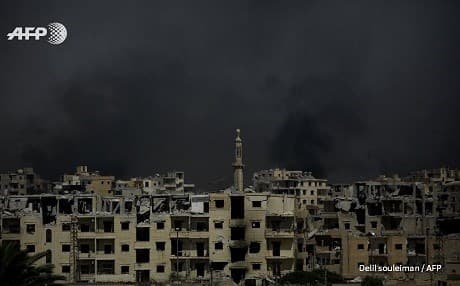

The UK-based Syrian Observatory for Human Rights (SOHR) reported on Thursday recovery operations are underway “to pull out the dead bodies of the civilians who were killed as a result of the international coalition airstrikes.”
SOHR says it has documented “at least 59” civilian fatalities in since Monday in the Old City of Raqqa. Dozens were also reported injured and SOHR cautioned that the death toll is still likely to rise because some of the injured are in critical condition.
"But what distinguishes the operation for Raqqa from all other cities is the degree to which IS thugs use civilians as human shields," Mustafa Bali, a spokesperson for the Syrian Democratic Forces (SDF) told Voice of America. "This fight has become a matter of life and death for both sides.”
Coalition spokesperson Col Ryan Dillon told Rudaw English that ISIS is “baiting” the coalition into carrying out airstrikes that will result in civilian casualties. “In Raqqa, ISIS has posted children outside of known ISIS facilities – car bomb and IED factories,” he said.
The coalition relies on intelligence gathering from the air and the ground in order to avoid civilian casualties, he added, applying “rigorous standards to our targeting process.”
Stephane Dujarric, the spokesman for the United Nations Office for the Coordination of Humanitarian Affairs, told reporters that they are deeply concerned about the safety and protection of the thousands of civilians inside Raqqa city, many of them women and children, who are caught in the crossfire of the ongoing conflict.
The UN estimates that 10,000 to 25,000 people remain trapped in the city, “although exact figures remain difficult.”
“Access to Raqqa is not currently possible for the UN, due to the fighting on the ground,” Mr. Dujarric said on August 9, reminding all military actors of their obligations to protect civilians and ensure humanitarian access.
The US-led coalition reported more than 200 strikes against ISIS this week in Raqqa, “destroying more than 180 ISIS fighting positions, car bombs and other various improvised explosive devices.”
There are two types of airstrike targets, Dillon explained to Rudaw English – deliberate and dynamic.
Deliberate targeting involves days or weeks of observation of daily life and behavior in an “extensive development process.”
Dynamic targeting is responsive, taking out an ISIS suicide car, for example. The decision-making process takes minutes to hours, responding to “emerging and immediate threats.”
The coalition supports the SDF with air and ground strikes. It is fighting an estimated “2,500 enemy forces” in Raqqa, Dillon told reporters on Thursday.
“Fighting in the tightly packed old city is particularly difficult, with ISIS rigging buildings and even corpses with improvised explosives to try to stall the SDF [Syrian Democratic Forces] advance,” the spokesperson explained last week.
The Old City of Raqqa is besieged, and SDF is continuing to fight pockets of resistance in surrounding neighborhoods, according to the Syriac Military Council, a component of the SDF.
“[ISIS] has centralized much of their operations and many of their fighters in the city's main hospital. They have fortified the complex, created tunnels for access and are hiding among women and children who have nowhere else to go,” Dillon told Pentagon reporters via teleconference on Thursday.
Dillon said that about 55 percent of the city has been cleared, “despite the scores of improvised explosive devices emplaced by ISIS and the density of the high-rise buildings in the areas they are fighting in now.”
He explained ISIS as rigged “thousands of fiendishly clever explosives and to dig extensive tunnels throughout the city.”
The SDF is a diverse force comprised largely of the Kurdish People’s Protection Units (YPG), who are optimistic that the city will be liberated quickly.
“Soon we will all celebrate the liberation of the city of Raqqa, this beautiful city that they [ISIS jihadists] made it the capital of terrorism and terrorists,” Brigadier Talal Silo, SDF’s official spokesman, told local ANHA news on Thursday.
The YPG announced 10 recent deaths of three of its Raqqa fighters, including one from the group’s female unit YPJ. Most were from Qamishli or nearby towns.
To hold onto liberated areas in the so-called ISIS capital, Dillon explained that a Raqqa Internal Security Force (RISF) has been formed.
“The RISF, a local partner force comprised of an Arab majority and local Raqqalis, continue to fill in behind the SDF to provide security in cleared areas,” Dillon said, adding that more than 200 female volunteers also graduated from training course this week.
“Another 180 local volunteers completed training this week in security procedures, small arms tactics and the law of armed conflict, and became eligible to join the ranks of the RISF.”
.jpeg&w=3840&q=75)