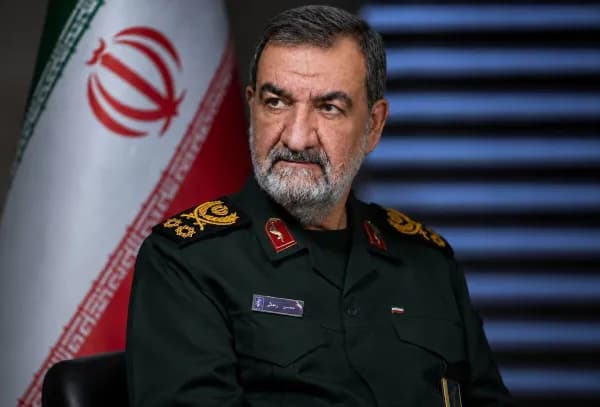

ERBIL, Kurdistan Region - Iran’s Supreme Leader Mojtaba Khamenei on Sunday appointed former Islamic Revolutionary Guard Corps (IRGC) veteran commander Mohsen Rezaei as his representative to the Supreme National Security Council (SNSC), replacing Mohammad Bagher Zolghadr, whom he reassigned as his political advisor.
Khamenei appointed Mohsen Rezaei, who commanded the IRGC from 1981 until 1997 and has served as his military advisor since March, as his representative on the Supreme National Security Council, lauding him as “one of the pioneers of the glorious eight-year period of sacred defense,” in reference to the Iran-Iraq war (1980-1988).
Concurrently, President Masoud Pezeshkian appointed Rezaei as the new secretary of the Supreme National Security Council (SNSC), following Zolghadr’s resignation from the post, according to state-run IRNA.
In a separate statement from IRNA, Khamanei announced the appointment of Mohammad Bagher Zolghadr as his political advisor, who held the SNSC secretary position since March 2026 following the assassination of former secretary Ali Larijani in a joint US-Israeli airstrike.
The Supreme National Security Council functions as Iran’s top decision-making body regarding defense and intelligence, and of late, negotiations with Washington and the Strait of Hormuz.
Senior political appointments come amid divisions in Iran’s political system between the elected government and powerful unelected institutions, particularly the IRGC, which has played a central role in Tehran’s regional strategy since the 1979 revolution.
The appointments of both Zolghadr, who previously served eight years (1989 -1997) as chief of the IRGC joint staff under Rezaee and eight years as deputy commander-in-chief of the Guard (1997 - 2005), and Razaei, who has served as Khamenei’s military advisor since March 2026 and whose tenure spans the founding of the IRGC, cement the regime’s consolidation of power by hardline military figures.
President Pezeshkian on Saturday acknowledged “disagreements” that the government was seeking to resolve following reports of Zolghadr’s resignation, highlighting Tehran’s internal differences within competing entities vying for dominance regarding its response to the conflict with the US and Israel.
Zolghadr, who has taken a firm position on the reopening of the Strait of Hormuz, posted on X on Saturday the conditions for reopening the strategic waterway, including an end to attacks on Iran and its regional allies, the lifting of sanctions and the maritime blockade, the withdrawal of US forces from around Iran, compensation for the two wars and the release of frozen Iranian assets.
The appointments come as Turkey, Saudi Arabia and Pakistan established a collective defense agreement on Friday known as the Mecca Joint Defense Agreement, while Iran engages in talks with Oman over the possible reopening of the Strait of Hormuz amid continued tensions with Washington.