
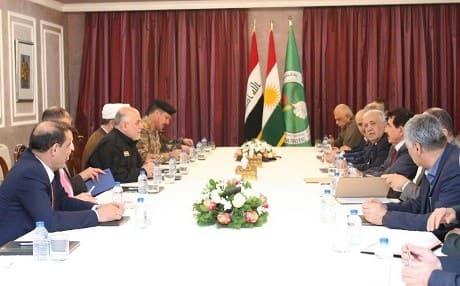

SULAIMANI, Kurdistan Region – The patriotic Union of Kurdistan (PUK), whose forces seized a key oil installation in Kirkuk last Thursday and threatened to stop exports to the international market, has agreed with Iraqi Prime Minister Haider al-Abadi to end the dispute and keep the oil flowing, the party’s deputy chief Kosrat Rasul said.
This comes as the Iraqi oil minister announced Wednesday that they have added a processing unit to Kirkuk’s oil refinery which increases its capacity by 10,000 barrels a day, perhaps as a response to a key demand from the PUK, other Kurdish parties in the city, and the local government in Kirkuk.
"The agreement ended the problem and there is no deadline anymore" to shut the pipeline, Rasul was quoted as saying by Reuters, giving no further details.
PM Abadi visited the PUK in Sulaimani on Tuesday where he met with the party’s leaders headed by Rasul.
Abadi also paid a brief visit to Erbil and met with Kurdish officials, including President Masoud Barzani and Prime Minister Nechirvan Barzani, before heading to Sulaimani.
Jabar al-Luaibi, the oil minister, said in a statement Wednesday that the new processing unit is operational, while promising to add another such unit by the end of the year with the same capacity.
The PUK deployed forces last Thursday to the state-run North Oil Company (NOC) in Kirkuk, which resulted in stopping oil exports for hours in an effort to force Baghdad to commit to an earlier deal agreed between Kirkuk governor and the Iraqi oil ministry.
All Kurdish parties, which also included the two main Kurdish parties, the PUK and the Kurdistan Democratic Party (KDP), showed their unanimous support on Monday to the agreement brokered earlier in January between the province and Baghdad which includes more investment in the oil sector in Kirkuk and employment opportunities for the local people.
The full text of the January agreement can be found at the end of this article.
“With the unanimous vote, we supported the agreement (protocol) between the Kirkuk governor, and the Iraqi ministry of oil,” read a joint statement issued after a press conference following a meeting between the Kirkuk Kurdish parties on Monday.
“[We] demand: the implementation of all the points of the protocol, building strategic projects, employing the people of Kirkuk in the North Oil Company, and the payment of all the petrodollar entitlements to the Kirkuk administration,” the statement continued.
Baghdad has not paid Kirkuk province its share of revenues from oil sold from its fields since 2013.
Asked if they support the act of seizing the oil facility by the PUK forces, the head of the Kirkuk Provincial Council said that the Council supports any move that helps to secure the interests of the people of the province.
“We will support any move that is in the interest of the people of Kirkuk. If Baghdad is not convinced by the language of logic, then the people of Kirkuk make their own decisions,” Rebwar Talabani said on Monday.
Currently, Kirkuk oil is being exported to the world market through the Ceyhan port in Turkey. Two oil fields in Kirkuk are under the control of the KRG and three are run by the NOC.
On January 10, the governors of Kirkuk, Nineveh, and Saladin met with Iraq’s minister of oil, his deputy, a deputy of the finance ministry of Iraq, and a number of other Iraqi officials from the oil ministry. They discussed and then agreed on the following points regarding meeting the oil demands of the provinces, power supply, and the issues of power plants, paying back debts, and investment. The following is the full versions of the points agreed to by all sides, described as a protocol by the Kurdish parties in their Monday press conference:
1. Allocating a certain amount of crude oil to pay back the debts of those companies who are investing in the power plants to add 250 megawatts of electricity to Kirkuk province.
2. Providing 40,000 barrels of oil to Aski Kalak refinery and increasing it in the future to make the refinery function, providing electricity to Nineveh province and Gayara power plant, the revenue of which to be allocated to the provinces of Kirkuk and Saladin.
3. Providing 20,000 barrels of oil to the Qaiwan refinery in Sulaimani province.
4. The ministry of oil with the help of the investors and a Czech company will renovate the refinery of the North Oil Company.
5. The provision of 25,000 barrels of oil from Kirkuk oil fields to the Quds power plant is to be continued.
6. Helping the Kirkuk province to begin expanding the Kirkuk oil refinery and its work with Barham company to install a new refinery.
7. Committing the investor in the Aski Kalak refinery to take into consideration the implementation of law in employing its workers from the people of Nineveh, Kirkuk, and the provinces of the Kurdistan Region.

.jpg&w=3840&q=75)
