
ERBIL, Kurdistan Region - Kurdish migrants living in so-called ‘jungles’ along the northern French coast are risking everything in hopes of reaching the United Kingdom amid a crackdown from both European countries and Kurdish authorities on human traffickers.
“Even if it turns into a storm, we will still go [cross the sea],” a Kurdish migrant told Rudaw’s Hevidar Ahmed on October 5, after French border police foiled an attempt by “more than” 600 migrants attempting to cross the English Channel from the northern French coastal town of Oye Plage.
The passage across the channel is 52 nautical miles to the UK port of Dover.
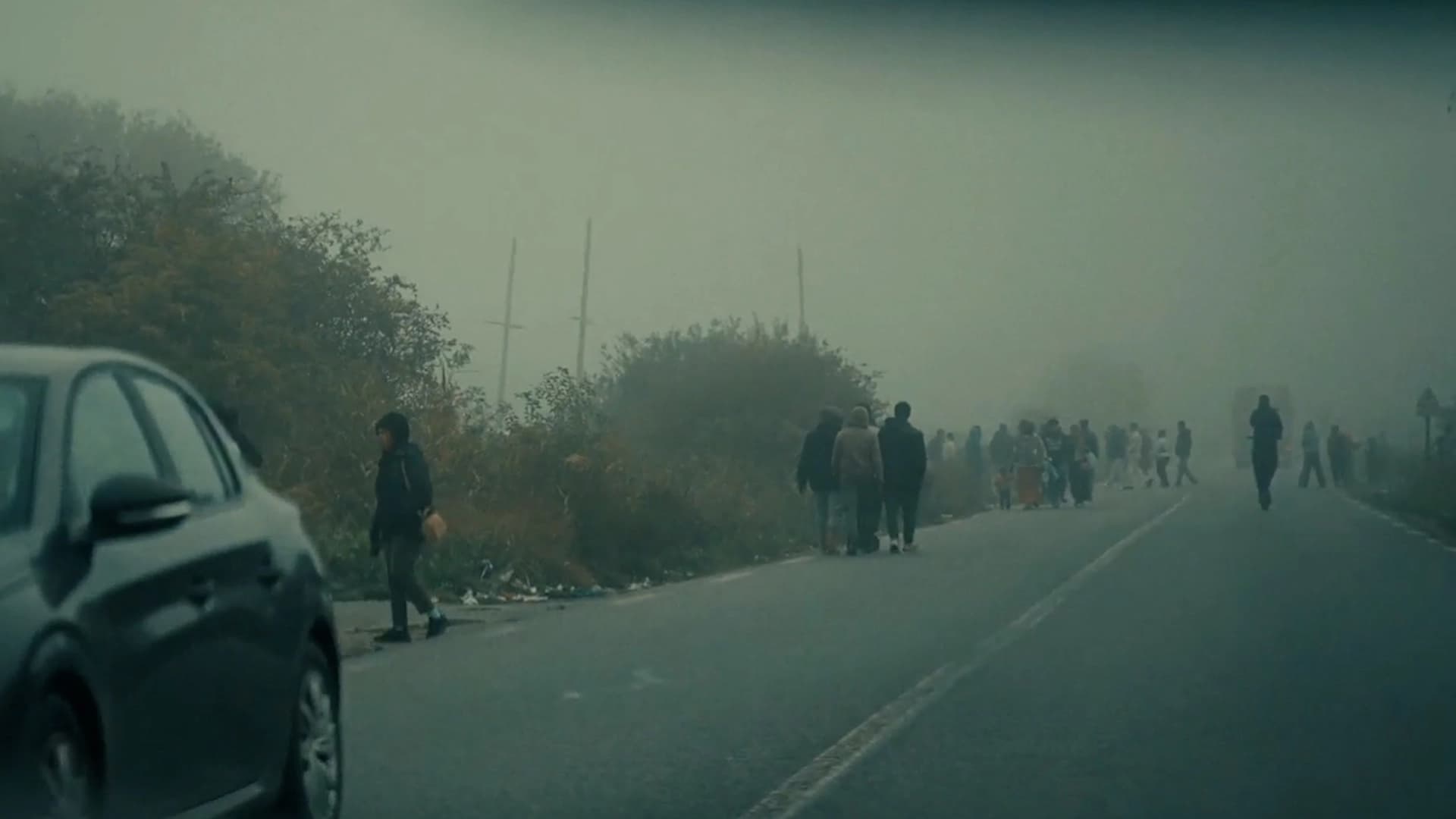
The anonymous migrant is among thousands who have returned to informal, makeshift migrant and refugee camps located in wooded and boggy areas near the French coastal city of Dunkirk, 10 kilometers from the Belgian border, known as Dunkirk ‘jungle.’
These stories were featured on Rudaw’s Unfinished Stories that aired on Monday, following the journeys of migrants from the Kurdistan Region as they navigate life in Dunkirk jungle before embarking on dinghies, inflatable boats, or kayaks to brave the dangerous corridor.
Aland, 15, who is originally from the Sulaimani province’s Qaladiza district, tried to cross nine times throughout his two-month-long stay in the jungle.
“The police don't let us,” he said.
The jungle is divided across several territories controlled by smugglers, who have installed wire fences around the areas they control. Not a single smuggler Rudaw approached agreed to an interview, even anonymously.
Rudaw’s team stayed on Oye-Plage’s shores for three nights. On the final night of October 4, a group of migrants were seen approaching the French police to distract them, enabling another group of around 100 individuals to sneak behind to reach the sea with an inflated dinghy.
Consequently, 84 migrants attempted the passage, leaving more than a dozen people from their group behind.
The UK Home Office’s Border Force data showed 1,739 migrants boarding 23 “small boats” which departed the French coast from October 2 to October 7, 2026 – with 418 on October 4th alone in five boats.
‘We cannot trust easily’
Aside from the risk of hypothermia, the transmission of fatal infectious diseases poses a serious risk to inhabitants of the encampments. In early September, a 20-year-old from the Kurdistan Region died due to a virus despite being hospitalized.
As a result, French health organizations have deployed health workers’ teams to vaccinate the migrants.
Raphael, a health worker, said there are between 2,500 and 3,000 migrants living in tents and temporary accommodation in the jungle.
He noted that most of them were not willing to take vaccination doses.
“We are afraid they will make us insane; we cannot trust [it] easily,” said Govend, a Kurdish migrant who befriended Rapahel, while at the same time acknowledging the risks inherent with transmission of the virus.
‘No oxygen left’
Those that do make it out of the jungles run the risk of drowning and hypothermia in their attempts to cross the English Channel. In addition to capsizing, the overcrowdedness of the dinghies threaten to suffocate and kill those abroad.
Safa, another Kurdish migrant, recounted his crossing attempt to Rudaw. Around 100 people were with him on the dinghy, four of whom died.
“There were so many people, there was no oxygen left, there were so many people they all fell on top of each other,” he noted, adding that one of the passengers who died was a child.
According to Association of Returned Refugees (ARR), approximately 6,500 people migrated from the Kurdistan Region, and 11 people died along the way in 2025.
Overall 41,000 migrants crossed the English Channel in small boats in the same year with Iraqi nationals making up 4 percent of this number according to the Migration Observatory at the University of Oxford.
There has been a concerted effort to crackdown on human trafficking this year. In July, the EU proposed a framework for new sanctions, targeting this issue.
“We have a common goal. To drive them out of business. And to save the lives of thousands of people who dream of a better life,” European Commission President Ursula von der Leyen said in a statement following the proposal.
Previous crackdowns by French authorities dismantling of a sprawling migrant encampment on the edge of Calais in 2016, left 2,000 migrants - including hundreds of unaccompanied children - seeking shelter in wooded areas, in and around disused warehouses, and under bridges in and around Calais with several hundred more in a forest in Grande-Synthe, a city adjacent to Dunkirk.
Human Rights Watch documented in October 2021 that repeated mass evictions from encampments and routine police eviction operations “do not appear to have reduced irregular Channel crossings” despite restrictions on distributions of food, water, and other essentials by humanitarian groups.
Alongside the EU’s effort, the Kurdistan region has similarly been taking a tougher stance on this issue.
In 2021, a dinghy sailing from the French northern coast suffered a breach, leading to the death of 32 migrants, 21 of whom were Kurds. Six smugglers behind the incident were tried by a French court in late September, while the lead organizer’s case was heard more than a week ago in Erbil.
Despite smugglers having been detained in the Kurdistan Region, France, UK and Belgium in recent years, the trade continues.
Although originally from Kurdistan Region, Safa requested to be identified as an Iranian Kurd, claiming asylum cases from Iran have higher chances of acceptance for British authorities.
He said he had paid between $1,000 to $1500 to “buy” an asylum case. “The case is Iranian, and all the people you see here have bought Iranian cases.”
‘People lose themselves’
While some migrants have shown eagerness to reach the British coast, some - including new arrivals - were hesitant to proceed.
Two Kurdish migrants, having just disembarked the train from Paris to Dunkirk, said they are willing to go back if they were given $20,000, the equivalent of what they had spent on their journey.
Another migrant,16, said, “Let go of the losses, I would go back right now.”
Meanwhile, another migrant, known as Mokhtar, has been living in Dunkirk’s jungles since 2022, having found work as a SIM card vendor. He claims that Kurdish migration has notably declined in recent years as increasing numbers of would-be migrants believe that “there is no hope” to be had in Europe.
“It takes five years before you can go back [to visit]. You go back and your mother and father are gone, whoever you lived with before is no longer alive, and a huge part of people lose themselves here - they get addicted to drugs, they lose.”
He also claimed that “80 percent” of families coming to the camp and then crossing the sea would end up divorced.
“I am speaking the truth. They separate right inside the dinghy,” he said.