
ERBIL, Kurdistan Region - The United States evacuated military aircraft from a second airbase in Britain on Monday following a reported threat from Iran, the Wall Street Journal (WSJ) reported Tuesday, nearly six weeks after a suspected Tehran-linked security incident prompted Washington to withdraw its bombers from RAF Fairford.
Two American aerial refueling tankers operating from RAF Mildenhall in eastern England were diverted to Germany early Monday, while several others were relocated to Germany and other destinations later that day, the WSJ reported, citing people familiar with the matter. The precise nature of the Iranian threat and whether it was imminent remain unclear.
The War Zone, a US military news outlet, independently reported unusual aircraft movements from Mildenhall on Monday, including KC-135 refueling tankers departing for Germany and Scotland and CV-22 Osprey aircraft moving to nearby RAF Lakenheath. A US military official confirmed that “enhanced force protection measures are in effect across RAF Lakenheath and RAF Mildenhall,” but did not disclose what prompted the measures or whether they were connected to Iran.
The reported evacuation comes as US President Donald Trump appears increasingly reluctant to resume major military strikes against Iran. Following talks with Qatari Prime Minister Mohammed bin Abdulrahman Al Thani at the White House on Monday, Trump said Qatar, Saudi Arabia, the United Arab Emirates, Bahrain and Kuwait favored maintaining the current situation, including the US naval blockade of Iran, rather than escalating military operations.
He said Washington was seeing “positive momentum” toward ending the conflict while stressing that American forces remained ready to act if necessary.
In a statement on Truth Social, Trump said the United States was “locked and loaded” but suggested that further military action was unlikely. His remarks followed weeks of diplomatic efforts by Qatar and other regional countries to prevent renewed large-scale hostilities between Washington and Tehran.
Meanwhile, the WSJ reported that security at Mildenhall and Lakenheath was at “Force Protection Condition Charlie,” the second-highest level in the US military's security system, indicating that intelligence suggests a terrorist attack is likely. The BBC had previously reported that the alert level at both bases was raised to Charlie following the September incident at Fairford.
A spokesperson for Britain's Ministry of Defence told Reuters that the ministry does not normally comment on other countries' military activities, adding that aircraft and other military equipment are routinely moved according to operational requirements.
The US Air Force similarly declined to discuss specific aircraft movements, saying aircraft regularly move between installations for training and operational requirements.
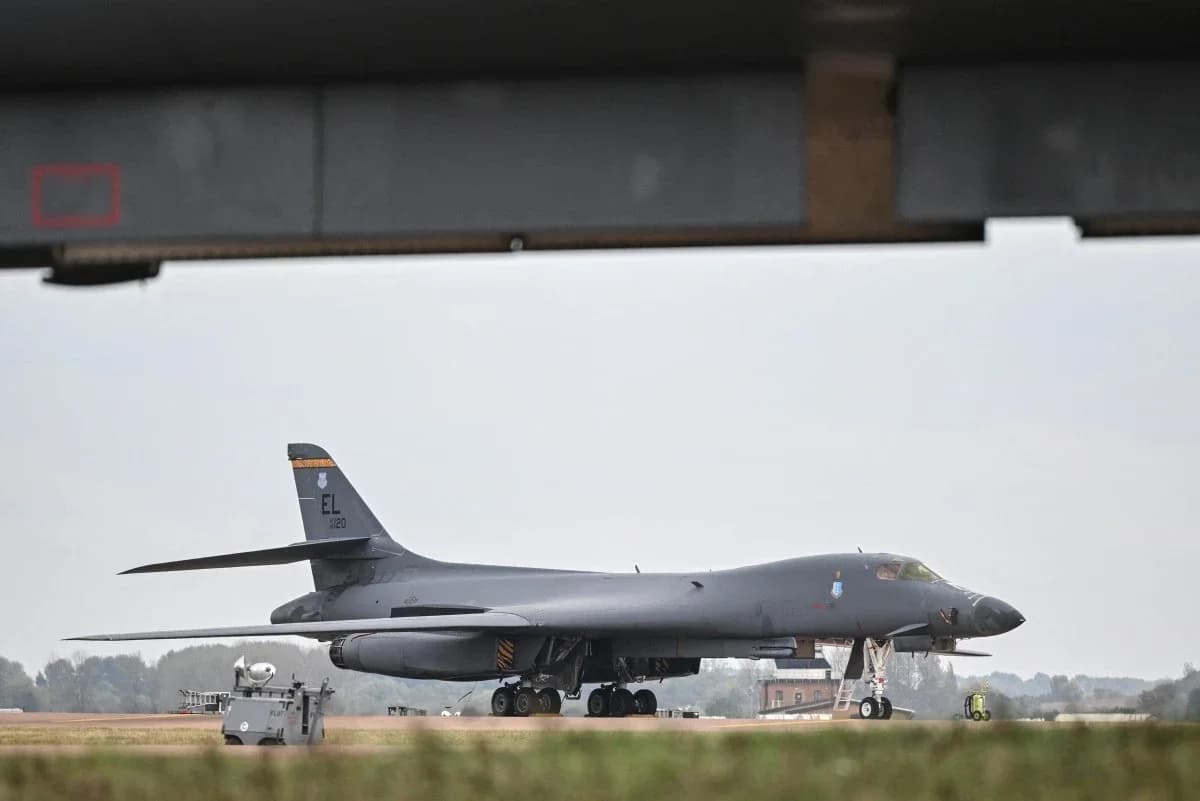
The latest developments follow a major security incident near RAF Fairford in Gloucestershire in late September, when British police arrested five men after receiving reports of three suspicious vehicles travelling toward the base, which had been used by American B-1 and B-52 bombers during operations against Iran.
The incident prompted the US military to withdraw approximately a dozen B-1 bombers from Fairford amid concerns about a possible Iranian-backed drone attack.
British Prime Minister Andy Burnham subsequently accused Tehran of involvement in the suspected operation.
“I can confirm our assessment that it is highly likely to have been coordinated in Iran, almost certainly directed by Iran’s Islamic Revolutionary Guard,” Burnham told parliament in October.
The British government summoned Iran's ambassador and imposed sanctions on two Iranian nationals accused of involvement in hostile activities abroad. A joint statement issued by Britain and dozens of international partners, including the United States and European countries, endorsed London's attribution of Iranian involvement in the Fairford incident.
The investigation has since resulted in criminal charges. On October 27, British prosecutors charged Mohmed Abdulkarim, 24, with assisting a foreign intelligence service, and Nouman Essghir, 24, with entering a prohibited location for a purpose prejudicial to the United Kingdom. Counter Terrorism Policing said investigators believed the foreign state involved was Iran.
Tehran has repeatedly denied involvement in the Fairford incident. In a September 28 statement, the Iranian embassy in London rejected allegations linking the Islamic Republic to the arrests, describing them as unfounded speculation intended to promote hostility toward Iran.
Iran's foreign ministry subsequently summoned the British ambassador in Tehran on October 13, demanding evidence supporting London's accusations and warning that the Islamic Republic could reconsider bilateral relations.
The latest reported evacuation also follows repeated warnings by senior Iranian officials that any renewed American attacks would trigger retaliation extending beyond the Middle East.
At the end of October, Iran's Supreme Leader Ayatollah Mojtaba Khamenei instructed military commanders to prepare for an immediate response without geographical restrictions to any renewed attacks on Iran.
“Any level and type of enemy threat must receive an immediate, effective response without geographical limitation,” Khamenei said, according to Iranian state broadcaster IRIB.
He also ordered the military to expand its database of potential American and Israeli targets and warned that Tehran would determine when and under what conditions any renewed fighting would end.
Last week, senior Islamic Revolutionary Guard Corps (IRGC) official Ali Fadavi warned countries hosting American military facilities that Iran would target any location used to launch attacks against its territory.
“Any point from which an action against Iran originates will be targeted,” Fadavi said in a televised interview reported by Iran's Tasnim news agency.
The IRGC had specifically warned Britain in July that RAF Fairford and other bases used for attacks against Iran would be considered legitimate military targets.
Tensions between Tehran and London escalated further at the beginning of November when Iran announced measures against Britain's foreign intelligence service MI6, the Royal Navy and the Royal Air Force, accusing the British government of assisting American and Israeli military operations against Iran through the use of British bases and logistical facilities.
The renewed concerns about Iranian threats to American facilities in Europe also coincide with fresh accusations of Iranian sabotage elsewhere on the continent.
On Monday, France officially accused an IRGC-linked cyber unit known as Shahid Kaveh of conducting a major cyberattack against refrigeration systems at more than 700 supermarkets across the country on October 11 and 12.
The French foreign ministry said the attacks caused extensive property damage, fires and food losses estimated at tens of millions of euros. Paris announced plans to summon Iran's ambassador and seek additional European sanctions against those responsible.
French Foreign Minister Jean-Noel Barrot described the operation as unprecedented in its scale and aggressiveness, characterizing it as a major cyberattack intended to sabotage civilian infrastructure.