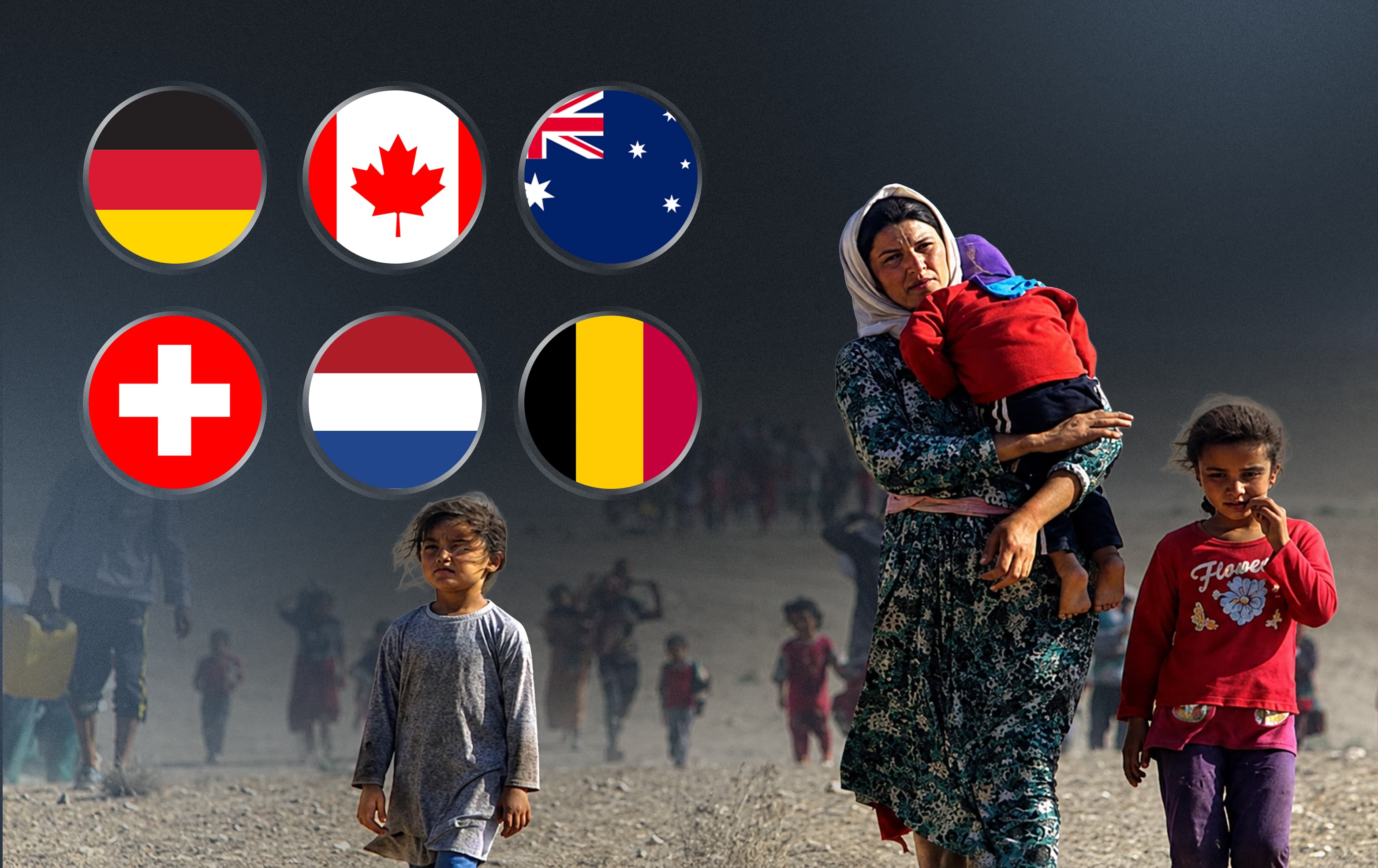

ERBIL, Kurdistan Region - Twelve years after the Islamic State (ISIS) genocide against the Yazidis, Germany, Australia, Canada, Switzerland, the Netherlands, and Belgium have reaffirmed their commitment to supporting the minority in statements to Rudaw, while some acknowledged that asylum policies have shifted as the security situation in Iraq has changed.
In responses to questions from Rudaw's Niyaz Mustafa, German and Canadian authorities said they remain committed to protecting Yazidis but have moved away from policies that broadly recognized members of the community as refugees following the 2014 ISIS assault.
Germany's Federal Office for Migration and Refugees (BAMF) said that during ISIS's takeover of large parts of northern and central Iraq, Yazidis were granted refugee status primarily based on their "membership of the group." Since 2017, however, applications have been examined individually, taking into account "the current situation in Iraq as well as all relevant information relating to the applicant's individual circumstances."
ISIS swept across large parts of northern and western Iraq in June 2014 before launching its assault on the Yazidi heartland of Shingal (Sinjar) on August 3. Although the group was defeated in 2017 after three years of fierce battles, it continues to pose security threats in Iraq and Syria.
However, the BAMF said the present policy reflects the "significant decline" in ISIS's influence in Iraq.
The office told Rudaw it had received 135,603 residency applications from Yazidis by June, while annual applications dropped sharply from 10,782 in 2014 to 1,081 in 2026.
Canada's Department of Immigration, Refugees and Citizenship said the country has welcomed more than 1,400 "Yazidis and survivors of Daesh and their family members," prioritizing vulnerable women and children.
The department said a temporary public policy introduced in late 2023 accepted 400 applications before being paused. Existing applications, however, "will continue to be processed during 2026 and 2027."
Australia stresses continued advocacy
Australia said it remains committed to defending the rights of Yazidis and supporting accountability for ISIS crimes.
"We continue to advocate for the right of Yazidis to live in safety and security, including in bilateral representations and multilateral forums," an Australian Embassy spokesperson in Iraq told Rudaw.
The spokesperson added: "We acknowledge the horrific experiences of sexual slavery, torture, mass murder, and brutality that Yazidi communities endured at the hands of Da'esh/ISIS in Iraq and Syria."
Australia also highlighted its continued diplomatic engagement, noting that its ambassador in Baghdad visited the Yazidi Genocide Memorial in Shingal in October 2025 and met local leaders. The embassy said Australia is now home to around 4,000 Yazidis who are making a "strong and valued contribution to Australian society through rich cultural exchange."
European countries emphasize justice
Switzerland, the Netherlands, and Belgium said they do not maintain asylum statistics based on ethnicity, explaining that residency applications are categorized by applicants' countries of origin.
A spokesperson for Switzerland's Federal Department of Foreign Affairs told Rudaw that Bern "unequivocally condemns" ISIS atrocities, describing them as "grave violations of international law," while continuing to support efforts to prosecute those responsible.
The Dutch Foreign Ministry said the Netherlands "contributes to the ability to prosecute and try the perpetrators, with the aim to help rightful calls for justice and ensure that these horrific crimes do not go unpunished."
Belgium also stressed the importance of accountability.
A spokesperson for the Belgian Foreign Ministry told Rudaw that commemorating the genocide must go beyond remembrance by "clarifying the fate of the missing, ensuring accountability, supporting survivors, protecting the Yazidi community and its heritage, and enabling safe and voluntary return where possible."
The spokesperson noted that Belgian courts have convicted ISIS members for crimes committed against Yazidis but warned that conditions in Shingal "remain very difficult," requiring sustained cooperation between Baghdad, Erbil, and international partners.
Twelve years since the genocide
During the genocide, ISIS militants killed an estimated 5,000 to 10,000 Yazidi men and elderly women and abducted 6,417 women, and children.
According to data provided to Rudaw by Hussein Qaidi, head of the Office for Rescuing Kidnapped Yazidis at the Kurdistan Region Presidency, 3,595 abductees have been rescued, while thousands remain missing.
The offensive displaced about 400,000 Yazidis, most of whom fled to the Kurdistan Region, while thousands more sought refuge in Europe, North America, and Australia.
More than 18 countries, along with the United Nations and the European Union, have officially recognized ISIS's atrocities against the Yazidis as genocide.