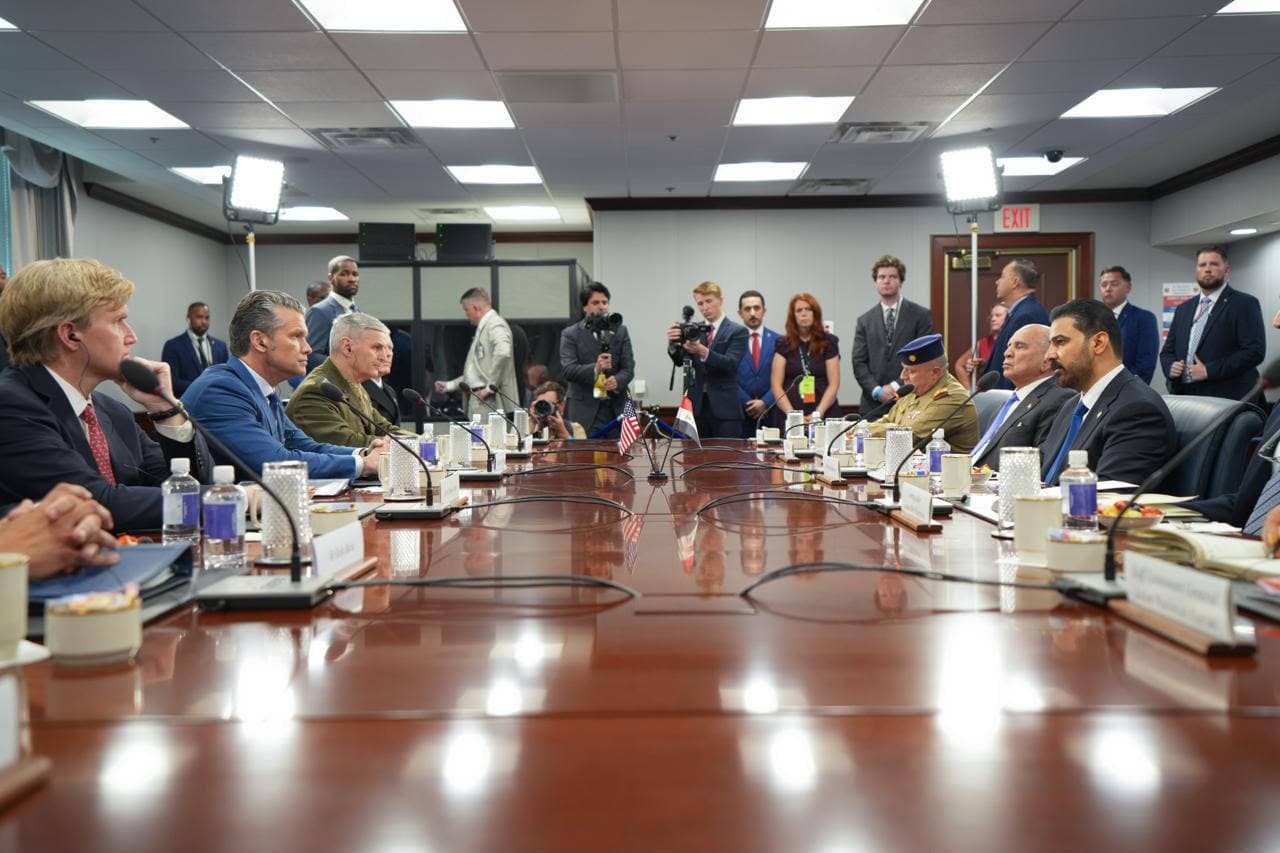

ERBIL, Kurdistan Region - Iraqi Prime Minister Ali al-Zaidi and US Secretary of War Pete Hegseth on Tuesday reached an agreement on a renewed bilateral military framework ahead of the September withdrawal of the US-led coalition, as Baghdad continues efforts to consolidate armament under state control.
Baghdad and Washington “reached agreement on a number of bilateral issues of mutual interest related to their security and military interests," including “the continued exchange of intelligence in support of bilateral counterterrorism efforts and enhanced coordination to dismantle support networks and safe havens associated with terrorist activity,” the prime minister's office said in a statement after talks were held at the US Department of War in Washington.
Following the talks, Zaidi, who is also the Commander-in-Chief of the Armed Forces, directed the formation of a committee tasked with engaging with the US to define the framework of security and military relations between the two countries.
US forces operating within the Global Coalition to Defeat ISIS are scheduled to conclude on September 30 and cooperation is expected to continue bilaterally under the 2008 Strategic Framework Agreement. Iraqi Prime Minister Zaidi’s visit to Washington and subsequent convenings are part of efforts to expand cooperation beyond the security-focused partnership that has dominated ties for more than two decades.
The statement said the two sides agreed to "further develop support and cooperation in training, enhance the capabilities of Iraq's Armed Forces across all branches, and expand technical, technological, and digital cooperation in security and military applications, equipment, and armaments, while safeguarding sovereignty."
The timing also coincides with Baghdad's efforts to consolidate all weapons under state authority. Zaidi has repeatedly described restricting arms to the state as "a sovereign decision" and has introduced measures aimed at separating political parties and armed factions from the Iran-aligned Popular Mobilization Forces (PMF).
During the meeting, US Treasury Secretary Scott Bessent said the Iraqi government had placed "combating corruption and restricting arms to the authority of the state at the forefront of its priorities through a package of important measures," pledging Washington's readiness to help Iraq implement its economic reform agenda.
Zaidi said that Iraqis would "see the results of these measures during the coming year," with improvements expected in "energy and investment, alongside enhanced stability."
The Iraqi premier also met Ben Black, chief executive of the US International Development Finance Corporation (DFC), to discuss financing infrastructure and development projects in sectors including energy, transport, agriculture, the digital economy, and services.
According to a statement, Zaidi highlighted his government's plans to diversify the economy through digital transformation, including expanding electronic payment systems, establishing national data centers, and investing in artificial intelligence and cybersecurity.
Black affirmed the DFC's readiness "to enter the Iraqi market with a package of financing partnerships for investment projects," contribute to Iraq's Development Fund, and support US companies seeking to invest in projects across the country's development sectors, the statement said.
.webp&w=3840&q=75)