
ERBIL, Kurdistan Region – The British government on Monday proscribed Iran’s Islamic Revolutionary Guard Corps (IRGC) as a terrorist organization under new national security powers, citing its involvement in threats to life and the intimidation of individuals on UK soil, reported Sky News.
The IRGC is among the first organisations designated under the National Security (State Threats) Act 2026, alongside the Iran-linked Movement of the Companions of the Right (IMCR) and Russia’s GRU Volunteer Corps.
The legislation was introduced to give the government powers comparable to those used to ban terrorist organisations while addressing the legal difficulties involved in proscribing an official arm of a foreign state.
The law makes it a criminal offence to support or materially assist a designated body, or to obtain material benefits from it. Espionage, sabotage or foreign interference carried out for the benefit of a designated organisation could result in life imprisonment.
In a written ministerial statement submitted to the House of Commons on Monday, Security Minister Dame Angela Eagle said Britain had identified IRGC-linked activity involving “threats to life and intimidation on UK soil.”
The IRGC’s alleged involvement in overseas assassinations stretches back decades. On July 13, 1989, Abdul Rahman Ghassemlou, secretary-general of the Kurdistan Democratic Party of Iran (KDPI), was shot dead alongside senior party member Abdullah Qaderi Azar and Iraqi Kurdish academic Fadhil Rassoul while negotiating with an Iranian government delegation in Vienna.
Mohammad Jafar Sahraroudi, who led the Iranian delegation and was later identified as a senior IRGC and Quds Force figure, was wounded at the scene but was allowed to leave Austria. Austrian authorities subsequently issued arrest warrants for Iranian suspects, but the case never reached trial. Iran has denied responsibility for the killings.
The US government has listed Ghassemlou’s killing among a decades-long series of Iranian assassinations and attacks abroad, saying Tehran has carried out such operations primarily through the IRGC’s Quds Force and the Ministry of Intelligence.
Eagle also cited IRGC Unit 840’s alleged involvement in a plot to assassinate two journalists working for the London-based Iran International television network. Investigations into the plot said the IRGC attempted to recruit criminals to kill the presenters after initially considering their abduction.
The government also designated the IRGC-linked Islamic Movement of the Companions of the Right, known by its Arabic name Harakat Ashab al-Yamin al-Islamiya. The shadowy group has claimed attacks against Jewish and Israeli-linked sites and Persian-language media organisations across Europe.
British authorities and allied governments have linked the attacks to Iranian security services. A joint statement issued by 24 countries in June condemned attacks claimed by the group and warned of Iranian state threats in Europe.
Eagle said members of the IRGC’s Quds Force stood behind the group and “almost certainly” directed its operations across Europe.
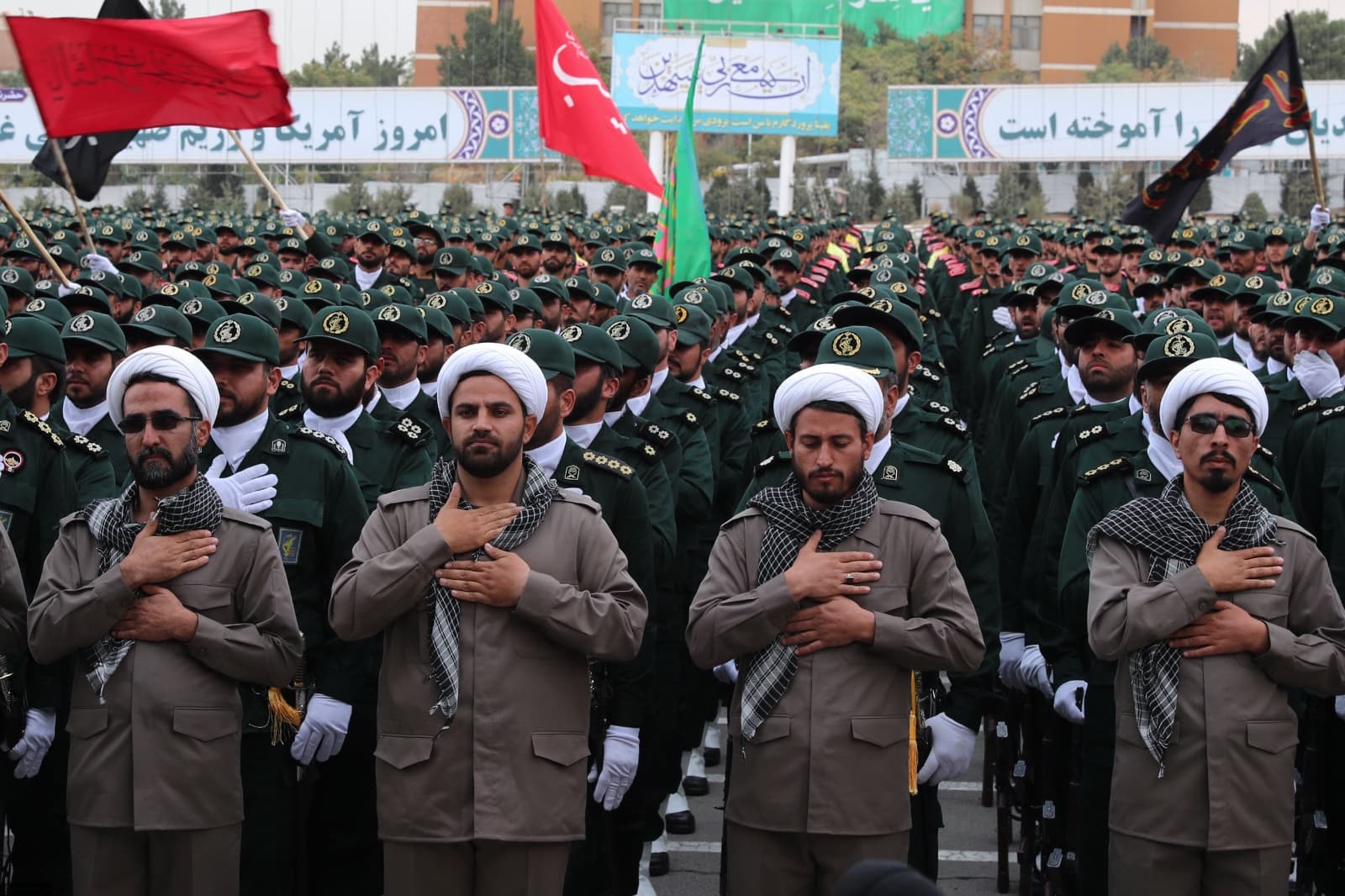
The IRGC and its affiliated Basij militia have also played a central role in suppressing dissent inside Iran. They were involved in the violent crackdown on nationwide protests in January, during which thousands of demonstrators were killed and many more detained as authorities imposed an extended internet blackout.
Outside Iran, the IRGC and its Quds Force have repeatedly been accused of recruiting criminal networks and proxies to surveil, intimidate, abduct or assassinate Iranian dissidents, journalists, Jewish people and Israeli targets.
The United States designated the IRGC, including its Quds Force, as a Foreign Terrorist Organisation in 2019, marking the first time Washington applied the designation to an official branch of another government.
Canada listed the IRGC as a terrorist entity under its Criminal Code in June 2024, while the European Union and several European governments have imposed sanctions and other restrictions on the force, its senior commanders and associated entities.
Established following Iran’s 1979 Islamic Revolution, the IRGC is tasked with protecting the country’s clerical establishment. Its Quds Force oversees Tehran’s foreign operations and its relationships with allied armed groups across the Middle East.