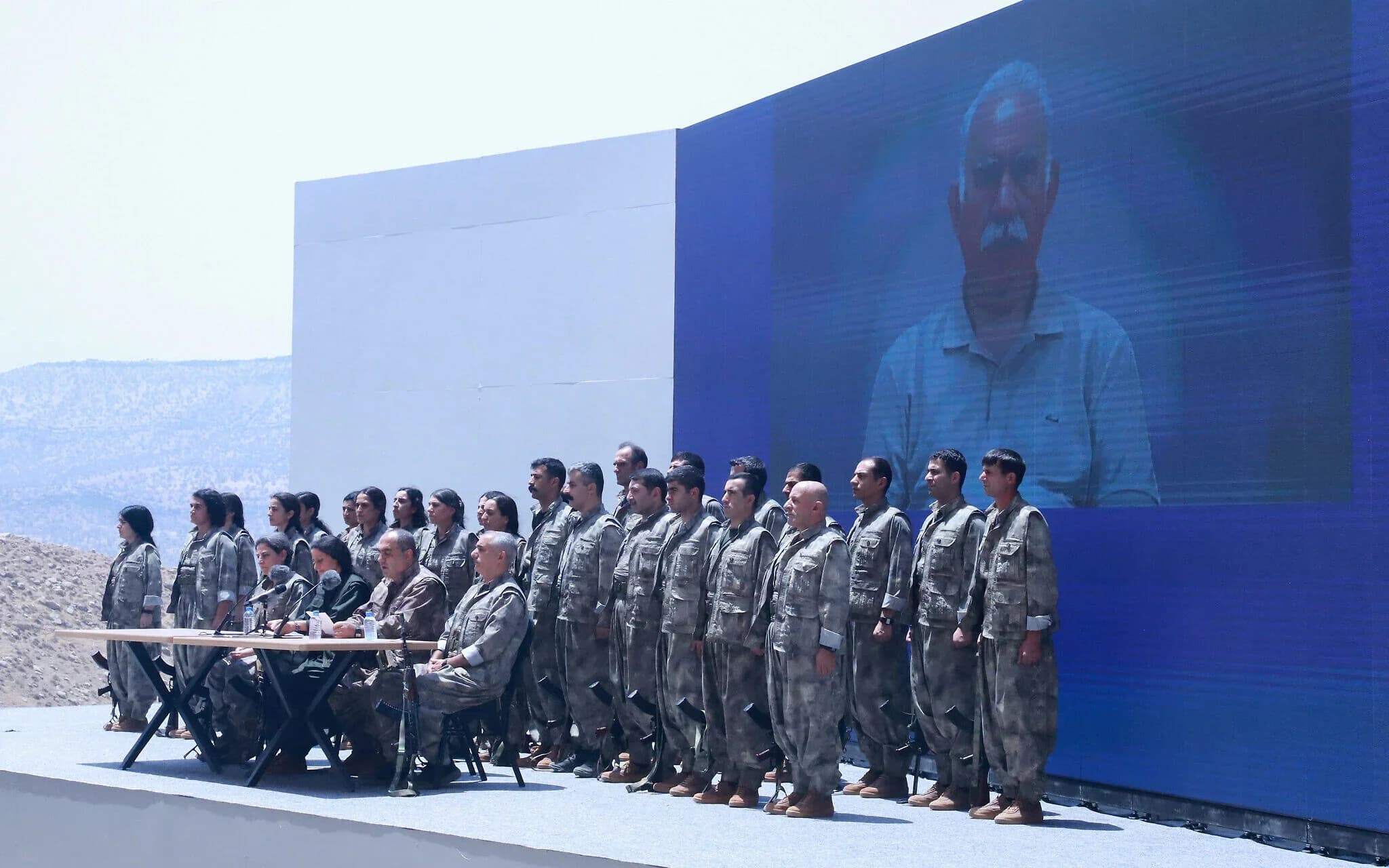

ERBIL, Kurdistan Region - The Kurdistan Workers’ Party (PKK) has criticized Turkey’s proposed peace-process legislation as flawed, warning that its fighters will not lay down their arms unless jailed leader Abdullah Ocalan is granted the “free life and work” needed to lead the process and they are guaranteed the right to engage in democratic politics.
In a Sunday statement issued after Turkey’s parliamentary Justice Committee approved the draft bill on Saturday, the PKK, which adopted the name Kurdistan Freedom Movement following its dissolution in May last year, said the legislation contained “serious errors and flaws” and failed to comprehensively address the Kurdish issue.
“By failing to use the term ‘Kurdish’ and referring to laying down arms, it shows that the issue has not been evaluated in a comprehensive manner,” the statement said.
The draft law, formally titled the Bill on Strengthening National Solidarity and Social Cohesion, was prepared jointly by Turkish President Recep Tayyip Erdogan’s Justice and Development Party (AKP) and the Nationalist Movement Party (MHP), and was also signed by the pro-Kurdish Peoples’ Equality and Democracy Party (DEM Party) and the opposition Republican People’s Party (CHP).
The legislation is expected to be considered by the Turkish parliament later this month. It would establish a legal framework for the next stage of the peace process, including provisions to suspend certain investigations, prosecutions and sentences linked to PKK-related offenses if the group fully disarms and dissolves.
The proposed legislation also provides a framework for the return and reintegration of PKK members who have not been involved in violent acts, while establishing a government body to oversee the process and procedures for registering surrendered weapons and other materials.
However, the PKK said in its statement that the law could not succeed without a central role for Abdullah Ocalan, the imprisoned founding leader of the PKK.
“If a law is to be passed and this process is to proceed, it can only happen under the conditions of the free life and work of Reber Apo [Abdullah Ocalan],” read the statement.
“Steps regarding our movement can only be taken and implemented based on the conditions of Reber Apo's freedom to live and work.”
The group also pointed to comments by MHP leader Devlet Bahceli, who has repeatedly advocated for Ocalan to benefit from the "Right to Hope," a legal principle under which prisoners serving life sentences should have a realistic prospect of release and periodic reviews of their sentences.
“From day one, Devlet Bahceli promised to guarantee and implement the ‘Right to Hope’ for Rrber Apo,” the statement said.
It argued that although BahCeli and AKP officials have described the peace process as state policy, the draft legislation does not clearly define Ocalan’s role.
“Devlet Bahceli emphasized that in the process of peace and a democratic society, Rrber Apo would become the ‘coordinator of the politicization and peace process,’” it said. “State officials also accepted this proposal by Bahceli. However, the role that Reber Apo will play in this process is not defined in the law.”
The PKK said the absence of guarantees for democratic political participation could also prevent PKK fighters from returning to Turkey.
“There is a demand for the guerrillas to lay down their arms and return,” the statement read. “If they go to Turkey and are unable to conduct democratic politics on the basis of freedom of thought and organization - if they are criminalized and arrested based on their past affiliations and statements - then not only will the ‘descent of the guerrillas to the plains’ [disarmament] not occur, but those politicians who were forced to move to Europe will also be unable to return.”
The warning comes as Ankara prepares to move forward with legislation designed to provide a legal framework for the PKK’s disarmament and dissolution.
Under the proposed law, the process would take effect following a National Security Council decision confirming that the PKK and affiliated organizations had ended their physical existence and surrendered their weapons and ammunition, as verified by security institutions.
The bill would allow certain prosecutions linked to PKK membership, leadership, knowingly aiding the organization and propaganda to be postponed. Intentional murder committed as part of organizational activity would be excluded from the provisions.
The legislation follows months of developments in Turkey’s latest peace initiative, which became more prominent after Bahceli’s October 2024 handshake with DEM Party lawmakers in parliament and subsequent meetings between a DEM delegation and Ocalan.
On February 27, 2025, Ocalan called on the PKK to disarm and dissolve, prompting the group to announce a ceasefire. On July 11, 2025, 30 PKK fighters symbolically burned their weapons at a ceremony near Sulaimani in the Kurdistan Region.
Bahceli has continued to publicly support the process, including his recent call for jailed Kurdish politician Selahattin Demirtas to be released and for Ocalan to benefit from the “Right to Hope.”
“This historic step we have taken is the strongest guarantee of social reconciliation and national unity,” Bahceli said on Wednesday. “Our thousand-year-old brotherhood has been reaffirmed once again. In this process, 86 million people will be winners.”
The PKK said the proposed law should instead serve as the beginning of broader democratic reforms addressing the Kurdish issue.
“The law aims to open the way for democratic political work on the basis of democratization,” the PKK said, arguing that political participation could only be guaranteed through “freedom of organization and thought.”
“This law must be a beginning,” it added. “If it becomes a law that opens the way for subsequent developments, it will then fulfill its fundamental and ‘framework’ role.”
The group called on Kurds and democratic forces to organize around further democratization, saying that the proposed legislation alone would not resolve the Kurdish issue.
“For the solution of all issues, foremost the Kurdish issue, the struggle for democratization must be advanced,” it said. “Therefore, our people and all democratic forces must organize and struggle for democratization and a solution to the Kurdish issue.”