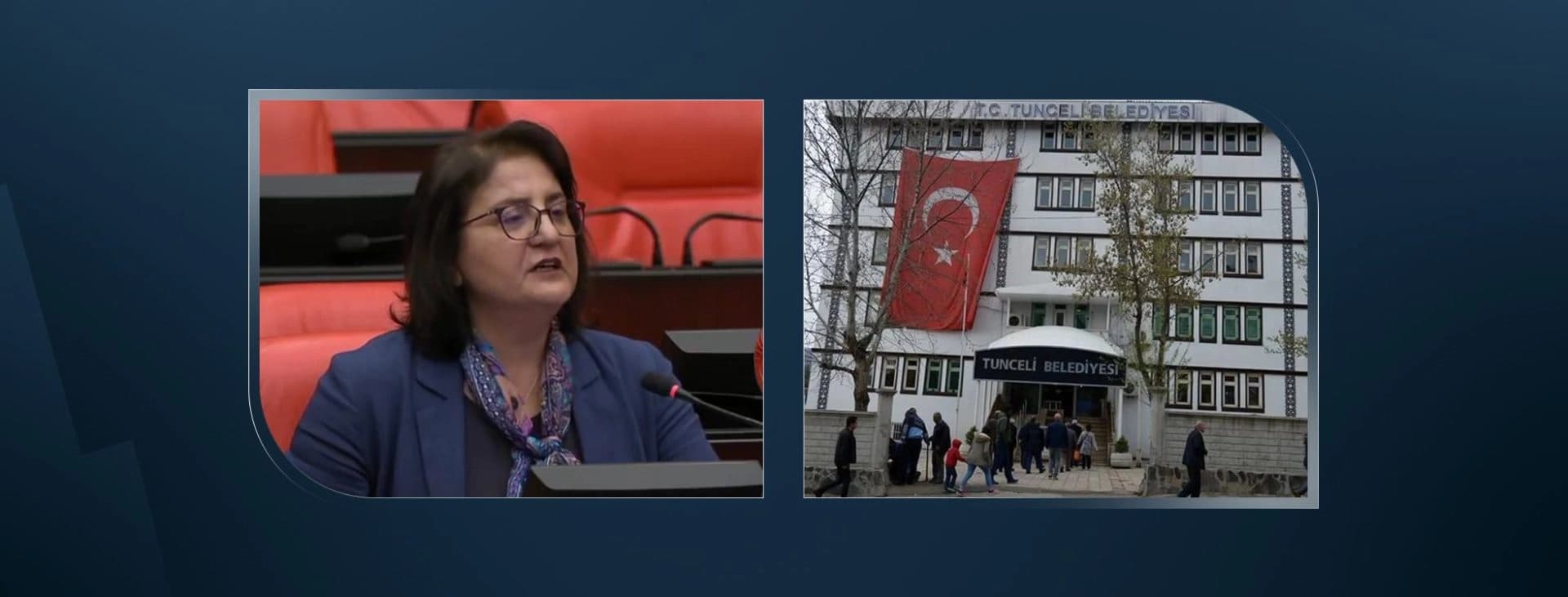

ERBIL, Kurdistan Region - A lawmaker from the pro-Kurdish Peoples’ Equality and Democracy Party (DEM Party) has submitted a bill to the Turkish parliament calling for the restoration of the historic name Dersim, officially known by its Turkish name, Tunceli.
Ayten Kordu, a DEM Party lawmaker representing Dersim in the Turkish parliament, submitted the bill on Monday. It was referred to the parliamentary Interior Affairs Committee two days later, Turkish Birgun news outlet reported on Friday.
The proposed legislation would replace the name Tunceli with Dersim in official records, maps, public signs, population registers and land records within six months.
It also calls for the establishment of an independent commission comprising historians, legal experts, forensic specialists, human rights advocates and representatives of victims' families to investigate the 1937–1938 massacre.
Turkish forces launched a large-scale military campaign against the predominantly Kurdish Alevi population under Mustafa Kemal Ataturk's government. The operations involved aerial bombardments and, according to historical accounts, the use of poisonous gas, killing thousands of civilians and forcibly displacing many others. Estimates of the death toll vary, with some accounts putting the figure as high as 45,000.
Nearly nine decades later, survivors and victims' families continue to demand justice, the disclosure of mass burial sites and full access to state archives, significant portions of which remain inaccessible to researchers.
If Wednesday’s bill is successful, the commission would be tasked with examining state archives and presenting its findings to parliament and the public within 12 months.
The bill further seeks to locate the burial sites of Seyit Riza, a prominent Kurdish Alevi leader, his son Resik Huseyin, and others executed by Turkish authorities on November 15, 1937. Their burial locations remain unknown nearly nine decades later, despite repeated calls for their disclosure.
The proposal comes amid growing criticism of a sign installed near the Halvori massacre site, popularly known as the “38 Cliffs,” where civilians were killed during Turkish military operations nearly nine decades ago.
Speaking in parliament on Thursday, Kordu condemned the installation of a large sign reading “Can Cana Tunceli” (Soul to Soul Tunceli), describing it as “a blatant disrespect to collective memory and the crime against humanity that took place there.”
She accused the authorities of attempting to erase the area's history by treating a site associated with mass killings as a tourist attraction.
“The path to reconciliation lies not in denial, but in confronting the massacres,” she said.
Kordu urged the Turkish Interior Ministry to remove the sign immediately and called for a memorial commemorating the victims of the 1937–1938 massacre to be built in cooperation with local communities.
The Democratic Alevi Associations (DAD) also condemned the installation in a statement on Wednesday, saying it was particularly offensive because it coincided with commemorations marking the 89th anniversary of Seyit Riza's execution.
“Among the foremost demands expressed at the commemorations held every year is undoubtedly the restoration of the name Dersim,” the association said.
DAD argued that countries which confront their past and respect collective memory erect memorials at massacre sites rather than signs promoting tourism.
“The name Dersim must be restored, and the 1937–1938 Dersim Massacre must be confronted in all its dimensions,” the association said.
In 2011, then-Turkish prime minister Recep Tayyip Erdogan apologized for the 1937-38 massacre, citing official records indicating that 13,806 people had been killed. Kurdish and Alevi accounts have put the death toll considerably higher.
The name Dersim remains widely used by local residents, Kurdish political parties and Alevi organizations, despite Tunceli remaining the province's official designation.
The “Can Cana Tunceli” slogan has also been used by local authorities to promote cultural and tourism activities, including the Mameki Festival held in August 2025.
For critics, however, its placement near a massacre site represents a failure to acknowledge the area's painful history.
Kordu's bill remains before the parliamentary Interior Affairs Committee, with no decision yet announced on whether it will advance to a vote.
The controversy comes amid an ongoing peace process between Ankara and the Kurdistan Workers’ Party (PKK), aimed at ending decades of conflict and addressing longstanding Kurdish grievances. The PKK has announced steps toward ending its armed struggle, including its dissolution and the withdrawal of its fighters from Turkey, while Kurdish political parties have called on Ankara to accompany the process with legal and political reforms.
The process has also renewed debate over Kurdish cultural and linguistic rights, historical injustices and demands for greater recognition of Kurdish identity in Turkey. Kurdish political groups and Alevi organizations have argued that confronting the legacy of the Dersim Massacre, restoring the region’s historic name and disclosing the burial sites of its victims would be important steps toward reconciliation and building trust.