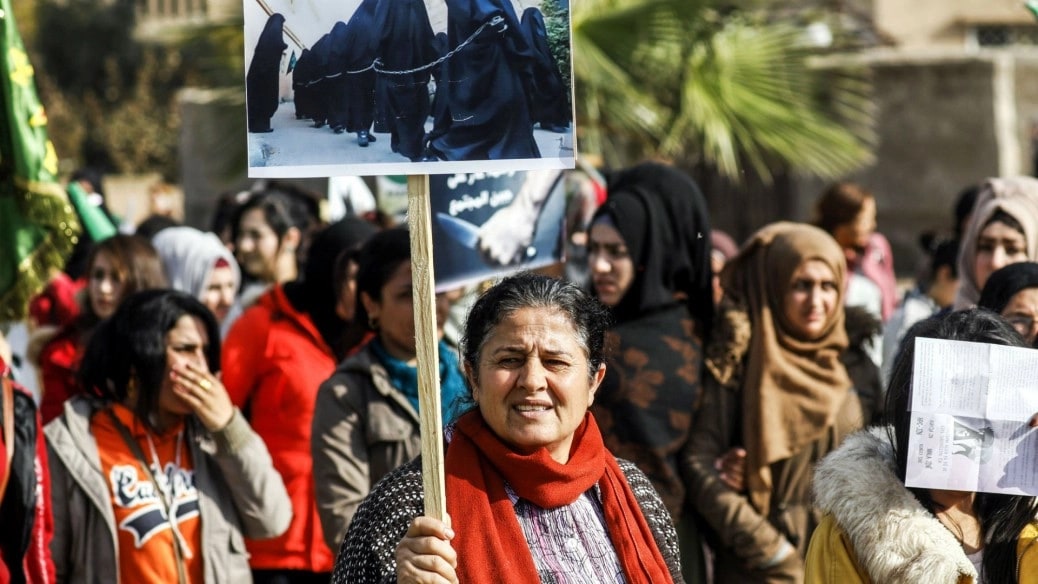

ERBIL, Kurdistan Region - Two separate human rights watchdogs covering Syria have published the rates of femicide, violence and human rights violations faced by Syrian women to mark the International Day for the Elimination of Violence against Women on Wednesday, warning that this “transitional” period continues to threaten women’s safety.
The Syrian Network for Human Rights (SNHR), an independent UK-based watchdog, reported that since March 2011 “at least 29,403 women and girls” have been killed, highlighting that the former regime of Bashar al-Assad was responsible for 75.26 percent of these fatalities.
SNHR’s report added that 118 women and girls were killed following subjection to torture while 10,269 were reported as cases of arbitrary arrest or enforced disappearance.
The annual report also said that there at least 11,583 cases of sexual violence against women and girls, 8,034 of which could be attributed to the forces of the former regime.
SNHR stresses that the figures it had published were to be considered the minimum, meaning that these were the incidents that were recorded and that the figure in each case was probably higher.
The UK-based Syrian Observatory for Human Rights (SOHR) also published its report on Wednesday. The monitor reported that 912 women have been killed since 2024’s International Day for the Elimination of Violence against Women.
SOHR attributed the deaths to a range of reasons, including “murder, remnants of war, stray bullets, infighting, shelling, explosions, extrajudicial killings, and other incidents.”
This report cited that murders could be attributed to murders in Syrian government and Syrian Democratic Forces-controlled areas as well as murders committed by members of the Interim government, sectarian groups, and Turkish shelling.
Similarly to SNHR, SOHR stated that despite the deposition of the former regime, there are “ongoing dangers faced by Syrian women in a country where the wounds of war have yet to heal, and where violations, crimes, and a lack of accountability continue to threaten the lives of civilians.”
SNHR detailed a list of recommendations for Syrian authorities to implement for the ongoing safety and protection of women, including greater female representation in state bodies, revealing of the fates of the forcibly disappeared, and independent investigations into incidents involving the murder, torture, and assault of women and girls.
Both reports highlight the burden borne by women after the fall of the Assad regime in December 2024.
According to SNHR, there are “lasting harms of violations against women and the families of victims, including the loss of sources of income, family dispersal, difficulty in obtaining civil documents, and obstacles related to housing, land, and property.”
Meanwhile, the state-run Syrian Arab News Agency (SANA), which picked up SNHR’s report, chose to highlight only the violations committed under the Assad regime.
SANA, in conversation with members of the Women’s Committee of the Central Bar Association, focused on the “effects of the grave violations committed against Syrian women.”
““Reparation should not be limited to financial compensation, but should include restoring dignity, rehabilitation and addressing the effects of violations on education, work and family rights,” said one female lawyer interviewed by SANA.
Bashar al Assad’s government was toppled by a coalition of opposition forces led by now President Ahmed al-Sharaa on December 8, 2024. Assad’s authorities were documented as using sexual violence, torture, and murder against women and girls as a means of exerting state control.
Fourteen years later, the SOHR report concluded by stating that the security of women remains unimaginable without women.
“A new Syria cannot be built without the participation of its women, and that justice is not achieved through slogans, but rather by protecting women, holding perpetrators of crimes against them accountable, guaranteeing their rights and equality, and empowering them to participate in shaping the country’s future,” the report stated.
“Syrian women have never been outside the struggle for freedom and dignity, and they must not be excluded from decision-making and the future of Syria.”