On the night of August 3, 2014, my phone began to ring, and it would not stop. Twenty calls, then fifty, perhaps a hundred. All of them from Shingal (Sinjar), a town in northern Iraq. Friends were weeping and screaming into the phone: “Something unspeakable is happening here. They are killing people. Can no one help us?” I called everyone I knew. I stayed on the phone for days. And almost everywhere, I encountered the same question: Who are the Yazidis, anyway?
Twelve years later, that question has been answered. It was answered by images of mass graves, of people crucified and beheaded, of enslaved girls. The world knows the Yazidis now. But the real, bitter truth of this anniversary is a different one. The genocide is not over. It has only changed its shape.
In April 2015, I was working in a makeshift office in Duhok, assessing which of roughly 1,000 Yazidi women and children were most urgently in need of evacuation, medical care and psychological treatment. By the afternoon, I had already heard accounts of mass executions, torture and rape.
Then two women came in with a small boy. He was about five years old, and he sat on the lap of one of them. I will call him Cemil. When I asked about the two women, he pointed shyly at one and said: “That is my mother.” Then he pointed at the other: “And that is my mother too.”
How can a child have two mothers? When ISIS fighters attacked his village near Shingal, Cemil was separated from his mother amid smoke and gunfire. Among the captives forced onto a bus was a 16-year-old girl I will call Sara. She had dreamed of studying and becoming a teacher one day. She also knew what ISIS did to unmarried girls and women.
She saw the crying boy. She went to him, lifted him onto her lap, and said out loud, so the fighters could hear: “My son, come here.” What began as an act of survival became the truth. The two of them were sold six times. Sara was beaten, abused, broken. On the nights when she wanted to end her life, one thought held her back: the boy who depended on her. She sang him Kurdish lullabies to drown out the screams of the other girls. Only after eight months did an uncle manage to buy their freedom. When he saw the boy and asked who he was, Sara lifted him into her arms and said: “This is my son. I am alive only because of him.”
I tell this story because it holds both things at once: the full barbarity of this genocide, and the full strength of the people who survived it. Anyone who wants to understand what August 3 is about must know this: behind every number stands a Cemil and a Sara.
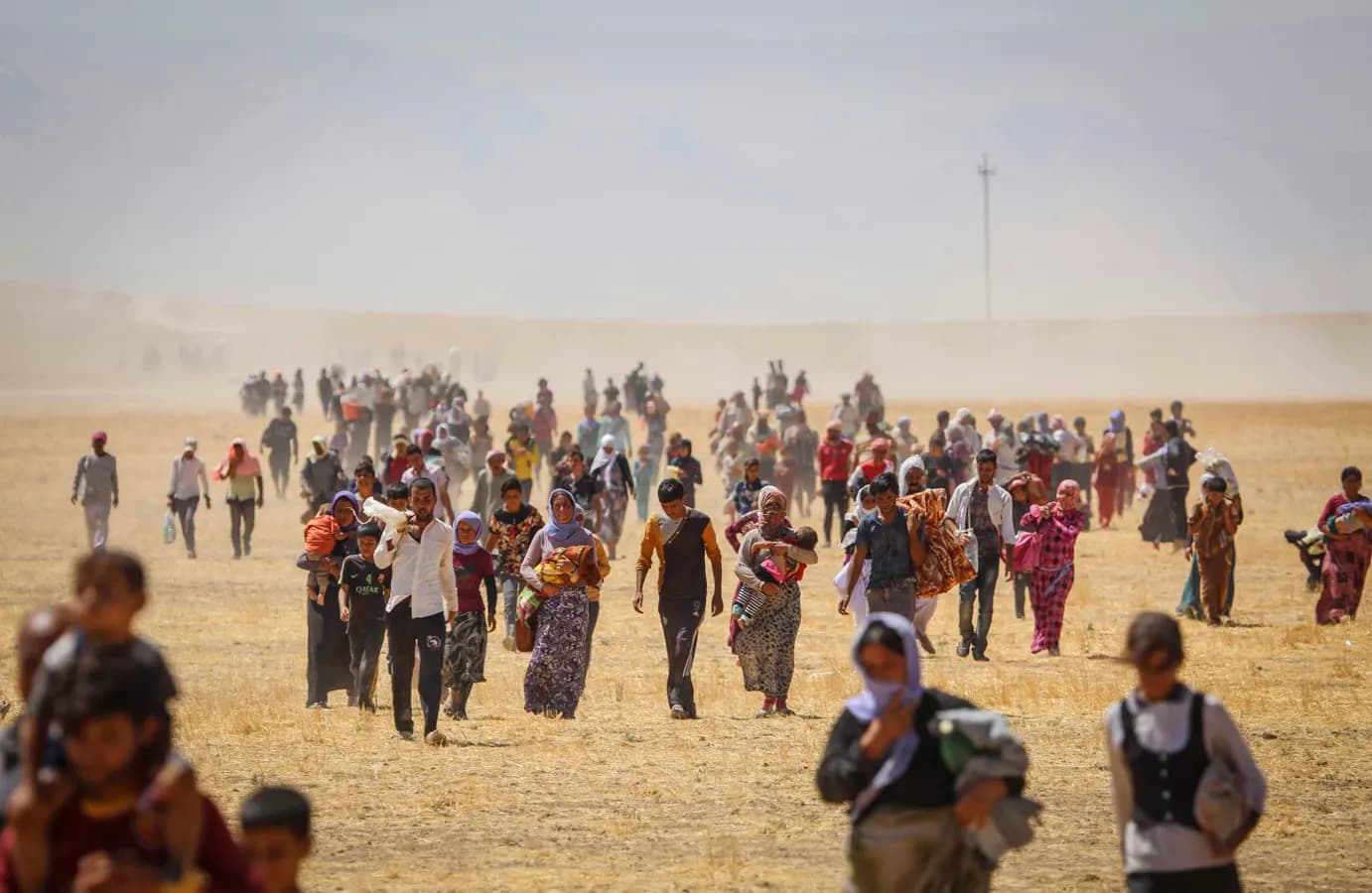
On August 3, 2014, ISIS launched a coordinated assault on the predominantly Yazidi town of Shingal. Thousands were killed. The group abducted 6,417 Yazidis, subjecting women and girls to rape, sexual slavery, forced marriage and trafficking, and separating children from their families. Nearly 2,600 Yazidis are still missing.
On Mount Shingal, families dying of thirst had to watch as the water dropped from the air burst on impact and ran down the slope. The world, as so often, stood by as if paralyzed.
Yazidis remember campaigns of persecution and annihilation as fermans. Many speak of the ISIS attack as the 74th Ferman, order [of genocidal campaigns]. The number is not merely historical bookkeeping. It expresses a collective memory in which every new attack reawakens the old ones. In my work as a psychologist with survivors, I have seen how violence enters not only individual lives but the expectations of an entire community. The fears of grandparents become the nightmares of grandchildren. Trauma does not end with the last shot of a war.
The genocide’s afterlife is visible across Kurdistan and northern Iraq. In reality it is the continuation of the genocide by other means. More than 200,000 Yazidis remain displaced, many still living in camps more than a decade after they fled. Others have returned to Shingal only to find destroyed homes, inadequate schools and health services, contaminated land and a region divided among competing political and armed actors.
This prolonged displacement is not a neutral pause. It erodes families, livelihoods and communal life. In the clinics and camps where my colleagues and I work, we see severe depression, suicidal crises and children whose development has been shaped by captivity, bereavement and years of insecurity.
The danger is not only humanitarian. The Yazidis are an ancient religious community indigenous to Mesopotamia. Their tradition has long been carried through hymns, rituals, stories and communal memory. That is exactly what makes them so fragile. A culture that lives in songs, in rites, and in stories dies when its storytellers die and its community breaks apart. The splitting of their identity and their forced migration achieve what bombs alone cannot: extinction through dissolution.
Shingal is not simply a destination on a map. It is the Yazidis’ homeland: the place of their farms, shrines, cemeteries and family histories. No one should ever have to leave their land. Not their house, not their fields, not the graves of their parents. The Yazidis want to return. But they must neither be left in tents forever, nor driven out of the camps into ruins and danger. Their homeland still lies in rubble. The infrastructure is largely destroyed, the ground is full of mines, the region is fought over by rival militias. Between permanent exile and forced return lies the only thing that matters: a homecoming in safety and in dignity.
That requires more than anniversary speeches. Baghdad and Erbil must resolve their disputes over Shingal and include Yazidis meaningfully in decisions about local administration, education and security. Homes, schools, hospitals, water systems and roads must be rebuilt. Explosive remnants must be cleared. Security must serve residents rather than the interests of rival forces.
The recognition of the genocide by the United Nations and by the parliaments of many countries was a historic step. But recognition that is not followed by action remains an empty word.
Justice is equally essential. A United Nations investigative team concluded that ISIS committed genocide, crimes against humanity and war crimes against the Yazidis. Courts in several European countries have begun to convict perpetrators for genocide. But most survivors still see impunity, not accountability. The search for the missing, the identification of remains and the prosecution of those responsible must continue. Iraq must fully implement the Yazidi Survivors Law, and survivors need long-term access to medical care, education, reparations and psychological treatment.
Mental health is not an optional addition to reconstruction. It is part of security. A family cannot rebuild a home while living in constant terror. A community cannot govern itself when despair has become ordinary. Healing requires justice, stability and the knowledge that another ferman will not be allowed to happen.
I know how such an appeal can sound: sentimental, perhaps even hopeless. But I have learned that a human being is not their past. Not their trauma. Not what was done to them. A human being is always more than that. I have also seen what becomes possible when survivors receive protection and a future. And somewhere in Kurdistan, Sara and Cemil are living. Mother and son, not related by blood and yet a family. They are the living proof that love can be stronger than terror.
If the Yazidis disappear, it is not only Iraq that loses, not only Kurdistan. Humanity loses a piece of its cultural diversity. And the Kurds lose a part of their own identity, for the Yazidis belong to the oldest roots of that culture. August 3 reminds us that “never again” means something only if we act while there is still time. Resilience must never become an excuse for political neglect. Survivors should not have to perform miracles merely to preserve what the world failed to protect.
Twelve years ago, people asked me: Who are the Yazidis? Today the question is different. Will the international community and Iraq act before a people survives genocide only to disappear in its aftermath?
Dr. Jan Ilhan Kizilhan is a psychologist, author and publisher, an expert in psychotraumatology, trauma, terror and war, transcultural psychiatry, psychotherapy and migration.
The views expressed in this article are those of the author and do not necessarily reflect the position of Rudaw.