
ERBIL, Kurdistan Region - The US has acknowledged the possibility of expanding the war against Islamic State militants by deploying military advisors to Iraq’s western Anbar province, US officials said.
The talk of possible expansion into Anbar comes amid criticism of the US-led war in Iraq and Syria reportedly from as high as Chuck Hagel, US Defense Secretary.
Reports emerged in the last few days that he wrote a two-page memo warning that US policy towards Syrian President Bashar Al-Assad was “fuzzy”.
Peshmerga and Iraqi forces have made only modest gains against ISIS, which still controls large swathes of territory in Iraq and Syria.
Much attention has focused on the deployment of Peshmerga in the Syrian town of Kobane near the Turkish border. Militants have besieged the town since September.
But the jihadis have also pushed on in Anbar. The death toll among the Albu Nimr tribe, a Sunni tribe which has been fighting ISIS for months, is more than 200 after they failed to receive military help from Baghdad, according to recent reports
In the last two days, White House and Pentagon spokesmen have been at pains to stress that policy was being constantly finessed for what will be a multi-year effort to defeat the jihadis.
There are 12 US advising teams in Iraq - seven in Baghdad and five in Erbil - working at the brigade and division level, Rear Admiral John Kirby, Pentagon spokesman, told a press briefing on Friday.
“And it's certainly a possibility that those advisers or perhaps even additional advising teams could advise brigade or division-level headquarters that are operating in Anbar,” he said. “There's no plans for that right now.”
General Martin Dempsey, chairman of the joint chiefs of staff, on Thursday called for the first time for the deployment of US advisers to Anbar, on the condition that the Iraqi government back the delivery of weapons to Sunni tribes in the area.
President Barack Obama has ruled out any combat role for American troops in Iraq. Colonel Ed Thomas, Dempsey’s spokesman, stressed the advisers would not enter into battle.
Most Iraqi Sunnis have been reluctant so far to join forces with the Shia-dominated Iraqi government after years of what they call persecution of their community.
The anti-ISIS Albu Nimr tribe has suffered execution of male members and the displacement of large numbers of families in Anbar, creating a humanitarian crisis, said the Institute for the Study of War in its latest Iraq update.
This had prompted local police and members of the Ubaid tribe to launch an operation against ISIS.
“It is important to watch for signs of Sunni tribal resistance against ISIS as a result of this development,” said the ISW. “Such resistance is critical in the fight against ISIS for both the Iraqi and US governments and should be capitalised on to generate anti-ISIS tribal momentum similar to that of the first ‘Awakening’ of 2005-2006 [when the Sunnis helped to defeat Al-Qaeda].”
The ISW also noted that if there was a successful assault by Iraqi forces on Baiji, north of Baghdad, it would be the first urban centre outside Kurdistan to be retaken from ISIS since the fall of Fallujah from Iraqi control at the beginning of this year.
US strategy against ISIS, including in Syria was working, Josh Earnest, White House spokesman, told CNN on Friday. He denied Washington was fighting jihadis at the expense of keeping Assad in power.
Hagel was reported to have written a memo to Susan Rice, national security advisor, saying Obama’s Syria policy was in jeopardy because of a failure to clarify US intentions towards Assad.
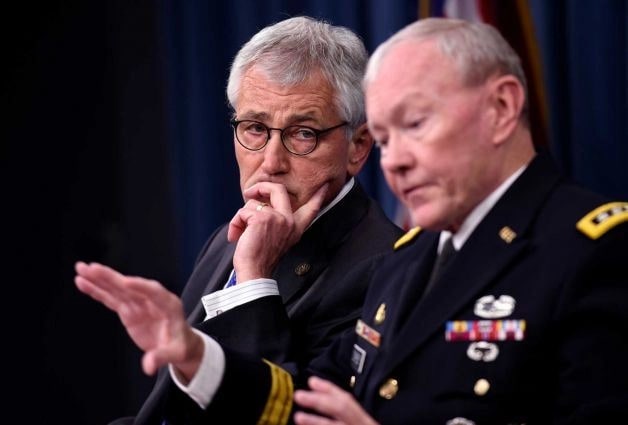
Hagel declined to discuss the memo at a Pentagon news conference on Thursday but he acknowledged that Assad may be benefiting from US attacks on ISIS and said a political solution was needed to stabilise Syria.
At the same press conference, Dempsey also spoke about how close the US consulate in Erbil came to falling to ISIS during their offensive in northern Iraq in August.
“Yeah, well, it was close. I mean, it was close in the sense that there was one defensible terrain feature. The distance doesn't matter. It's what you can do in the distance between the threat or the enemy and the facilities,” he said.
“So there was a river on which the Kurdish forces were defending,” he said in reference to the Greater Zab. “And if that river had been breached then the issue would have been much more difficult to resolve. So, in the sense that they were pressing on the river and the defences along the river, it did have urgency.”
He denied the US was late in responding to the threat but he said there may have been a “timing issue” because the Peshmerga may have waited before communicating any danger.
“Well, that river was being adequately defended by the Peshmerga. And they hadn't given us any indication that they believed that they would -- they are about to fall, until they gave us an indication that they were -- believed they were about to fall,” Dempsey said.
“So, if there was a timing issue, it was in the communications between the Kurds and us.”