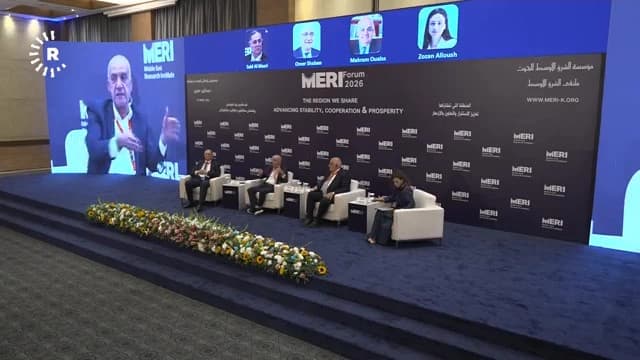

ERBIL, Kurdistan Region - An expert panel from Lebanon, Palestinian Territories and Jordan warned Monday that continuing conflicts, weak state institutions and regional rivalries threaten the Middle East's recovery, calling for political reforms and greater economic cooperation to prevent instability in one country from spreading across the region.
Speaking at the annual Middle East Research Institute (MERI) Forum in the Kurdistan Region’s capital, the experts argued that statebuilding and improving living conditions required confronting domestic political challenges while strengthening cooperation with its neighbors.
"There is no country, including Jordan, that can have a thriving economy in isolation from neighboring countries," said Said al-Masri from Jordan-based think-tank Arab Thought Forum, stressing the need for a regional economic framework.
The panel, titled "The Levant Beyond Conflict: Rebuilding States, Reconnecting Societies," comes as the region grapples with the consequences of successive wars, political instability and economic disruption. The speakers warned that conflicts in Lebanon, Syria and the Palestinian territories have consequences extending beyond national borders.
Masri argued that countries across the region had become trapped in cycles of conflict that undermined development and prevented governments from improving living standards.
"We are in a region that has been determined to live through catastrophes and rivalries. We are all victims of this," he said.
"Whatever harms one inch of the region we live in, affects all of us together," he added, urging governments to move beyond what he described as a narrow focus on individual national interests.
He pointed to Jordan's relative stability as an example of the importance of functioning state institutions, but stressed that effective governance must produce tangible improvements in people's lives.
"For the people to understand governance, it has to see results," he said.
Masri called for closer economic integration, arguing that the region’s potential leverage in capitalizing on Europe's demand for energy supplies, including natural gas and crude oil, as well as infrastructure such as internet cables, to establish shared economic interests.
Makram Ouaiss from the Lebanese Center for Policy Studies think-tank focused on the challenges facing Lebanon, particularly the disarmament of Hezbollah and the reintegration of its members and supporters into state institutions.
He identified three dimensions to disarmament: reaching an agreement with Hezbollah to surrender its weapons, integrating its members, and ensuring that communities dependent on the group's financial, social and political networks receive support from the state.
"This requires an agreement with Hezbollah… Every Lebanese person understands this," he said, rejecting a military solution to the issue.
Ouaiss argued that rebuilding Lebanon also required stronger economic ties with neighboring Syria, saying trade between the two countries had fallen from $800 million to $250 million annually.
However, he suggested that political changes in Syria had created new opportunities for cooperation.
"Today, there are chances that didn't exist in the past, first and foremost due to a new regime that is more open," he said.
He also warned that Israeli military actions threatened Lebanon and Syria's territorial integrity, arguing that further escalation could have repercussions across the region.
Omer Shaban of Palestine's Pal-Think for Strategic Studies offered a critical assessment of Palestinian governance, arguing that the Palestinian Authority had failed to establish effective institutions or a sustainable economy despite receiving substantial international assistance.
"We received a lot of money, and that corrupted the Authority. We behaved as though we were an independent state. We aren't an independent state," he said.
While blaming Israeli occupation for much of the Palestinians' predicament, Shaban argued that Palestinian leaders also bore responsibility “for some of the failures” in governance and institution-building.
Turning to Gaza, Shaban described the humanitarian situation as "catastrophic," criticizing the international response and arguing that diplomatic initiatives had failed to bring lasting peace.
He also questioned the effectiveness of traditional regional alliances, calling for Palestinian political engagement to be guided more closely by practical interests rather than declarations of solidarity.
"We were fooled by Arabic solidarity, and we bet a lot of things on it. In the end, it was not true. I am of the opinion that the discussion should shift to interest-based," he said.
Despite addressing different national challenges, the speakers emphasized the importance of stronger institutions and closer cooperation, arguing that political stability and economic recovery would remain difficult while conflicts and their consequences continued to spill across borders.