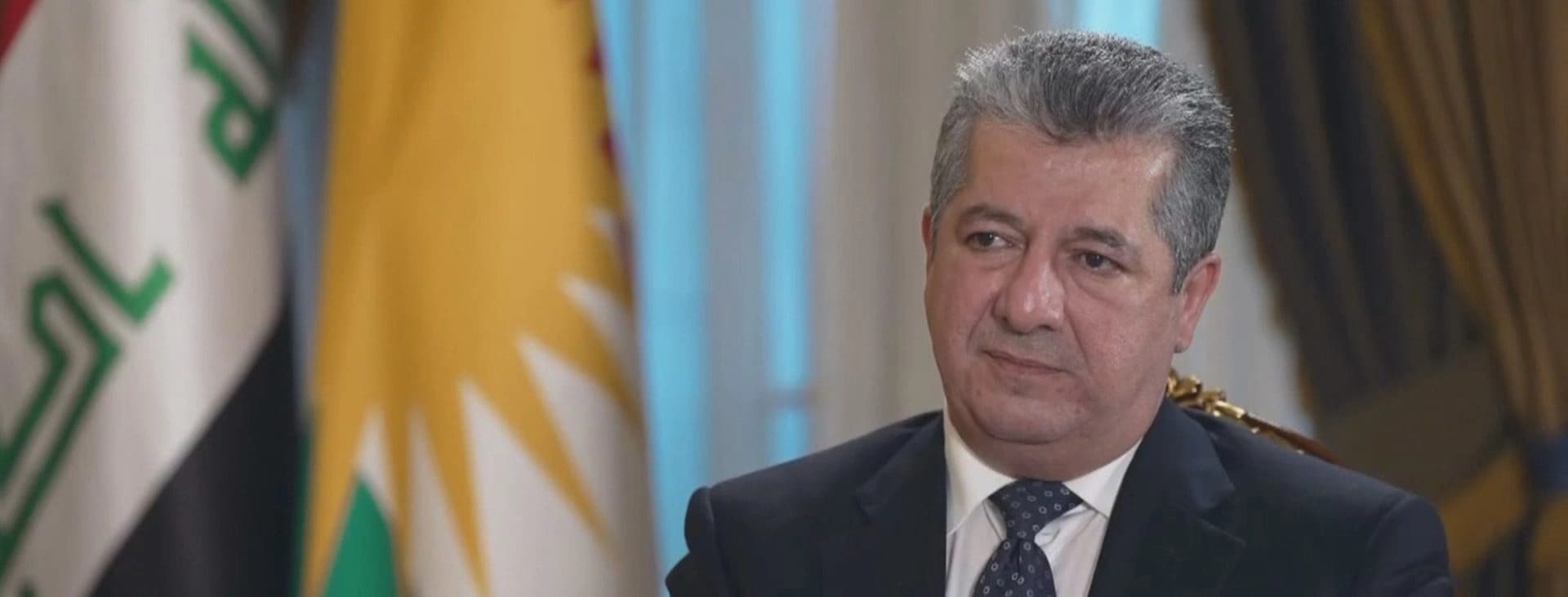

ERBIL, Kurdistan Region - Kurdistan Region Prime Minister Masrour Barzani on Saturday expressed concern over fears that the Iraqi army could attack the Region following the withdrawal of US forces, saying it was troubling that people within one country should feel they need foreign military protection against forces from their own state.
“It is very sad, honestly, that people within one country would be concerned that they would be overrun by a military power, a military force, and they need an external force to come and protect them,” Barzani said in an interview with Shams TV's Elie Nakouzi, responding to a question about Kurdish security concerns following the US withdrawal.
Barzani expressed hope that Baghdad would no longer view the Kurdistan Region as an “alien entity,” but rather as an integral part of Iraq whose stability and economic prosperity benefit the entire country.
His remarks come amid longstanding disputes over Erbil's constitutional authority, oil revenues and budget entitlements, while the federal government pursues an ambitious campaign to bring armed factions under state control. The Kurdistan Region has also faced repeated drone and missile attacks during the regional war involving Iran, Israel and the United States.
Kurdistan Parliament and political divisions
Addressing the deepening political dispute between the Kurdistan Democratic Party (KDP) and Patriotic Union of Kurdistan (PUK), Barzani rejected suggestions that the Kurdistan Region could be divided into separate administrations.
“No one has the right nor the power to divide Kurdistan,” he said, adding that the Region was built through decades of struggle and sacrifice.
The comments follow warnings by PUK leader Bafel Talabani that his party could pursue a separate administration in Sulaimani, amid disagreements over the reactivation of the Kurdistan Parliament and formation of a new KRG.
The legislature reconvened on November 4 through a KDP-led initiative after nearly two years of paralysis, despite a boycott by the PUK and several opposition parties. The following day, Talabani announced his party's withdrawal from the Kurdistan Regional Government (KRG), accusing the KDP of acting unilaterally.
Barzani defended the parliamentary session as necessary to preserve the Region's “institutional legitimacy,” accusing the PUK and its allies of obstructing the democratic process.
“They challenged us not through the process of democracy, but through using force and basically paralyzing the parliament or taking the parliament hostage for two years,” he said.
The premier also rejected the longstanding practice of dividing government positions equally between the two main parties regardless of election results, arguing that political representation should reflect the public vote.
Asked whether the crisis could lead to renewed Kurdish infighting, Barzani replied, “The simple answer is no,” while urging all parties to avoid military confrontation.
He maintained that the KDP remained willing to negotiate an inclusive government, but insisted that any agreement must respect the results of the October 2024 parliamentary elections.
Relations with Baghdad
Turning to relations with the federal government, Barzani argued that Iraq's recurring disputes stemmed largely from a failure by some political leaders in Baghdad to accept the country's federal system.
“The major problem is with the mentality of some people who still don't understand federalism or do not accept it,” he said.
“Federalism is not division. It's not dividing the country. It's basically taking or sharing responsibilities,” he added, stressing that the Kurdistan Region voluntarily accepted the federal arrangement established under Iraq's 2005 constitution.
Barzani said Erbil had extended its full support to Prime Minister Ali al-Zaidi and remained hopeful that his government would resolve longstanding disputes, including the Region's constitutional rights and financial entitlements.
However, he acknowledged that the outstanding issues had yet to be settled.
The two governments have been negotiating provisions of Iraq's 2027 draft federal budget, including the Kurdistan Region's share of expenditure and the quantities of oil Baghdad requires Erbil to hand over.
On the federal government's campaign to restrict weapons to state control, Barzani expressed support for Zaidi's efforts but warned that dismantling armed groups operating outside constitutional authority would be difficult.
“I hope he will, but it's not easy,” Barzani said, citing competing political agendas and the need for caution in implementing security reforms.
He emphasized that the Peshmerga are constitutionally recognized security forces whose status must be respected alongside Iraq's other official armed institutions.
Regional war and Iran relations
Barzani also criticized the continuing drone and missile attacks on the Kurdistan Region amid the US-Israeli war with Iran, saying the Region had been targeted more than 1,050 times.
“Unfortunately, 50 percent—maybe more than 50 percent—of these attacks have come from inside Iraq,” he said, holding the federal government responsible for preventing armed groups from launching attacks from Iraqi territory.
“If the federal government is in control of these groups, then they should hold them accountable. If it's not in control of these groups, then there is a big gap of responsibility and authority of law in this country,” he warned.
The Kurdistan Region has repeatedly come under attack since the war began in late February, with strikes targeting Iranian Kurdish opposition groups, coalition facilities and civilian infrastructure.
Barzani reiterated that the Region would not participate in the conflict or allow its territory to be used to attack neighboring countries, rejecting allegations that Erbil was supporting military operations against Iran.
“Kurdistan is not going to be a part of any confrontation, and is not going to let the Kurdish territories be used against any of its neighbors,” he said.
On relations with Tehran, Barzani expressed frustration over Iranian attacks on the Region, saying Erbil had sought explanations but had not received satisfactory answers.
“Iran's hostile position in attacking Kurdistan during this period of war was very unfortunate,” he said.
Nevertheless, Barzani stressed that the Kurdistan Region continued to seek friendly relations with Iran and its other neighbors, while maintaining its right to defend itself against attacks.