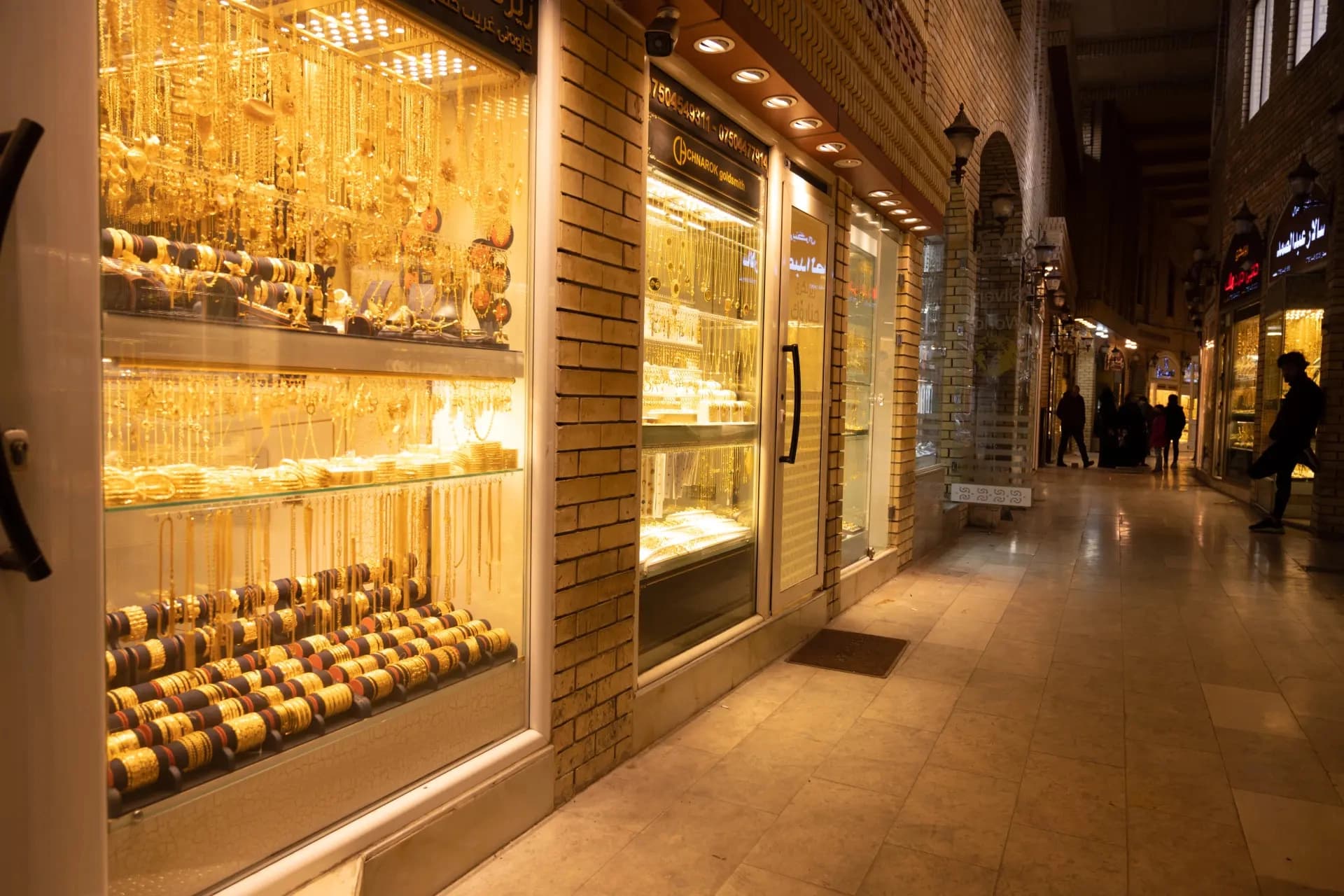

ERBIL, Kurdistan Region - Erbil saw the trade and circulation of over 172 tons of gold and silver, valued at more than $885 million since the start of this year, a top trading facilitator in the Kurdistan Region told Rudaw on Saturday - this despite earlier figures from federal Iraq reflecting a decline in precious metals imports into the country.
Dastan Gold International, a primary trading channel connecting the Region's provinces with international gold and silver hubs in the United Arab Emirates (UAE) and Turkey, shared data with Rudaw showing that from January through August 20, approximately 172.5 tons of gold and silver were imported and exported at a combined value of around $885 million, with imports accounting for the largest share.
During this period, gold trade through Erbil International Airport reached $375 million - $285 million for imports and $90 million for exports. The company's figures show that average monthly gold trade exceeded 312.5 kilograms, with imports averaging 237.5 kilograms and exports 75 kilograms per month.
Silver followed a different trajectory, limited exclusively to imports with no exports recorded. From January through early August, some 170 tons of silver valued at $510 million entered through Erbil International Airport, averaging more than 24 tons per month with no quantities re-exported. The average purchase price stood at $150,000 per kilogram of gold and $3,000 per kilogram of silver.
The Kurdistan Region's trade figures notably stand in contrast to a broader decline in federal Iraq where gold exports fell by nearly 60 percent in the first five months of 2026 compared to the same period last year, a senior official from the state-run quality control body told Rudaw in early July.
"Since the beginning of 2026 and until May 31, a total of 10,247 kilograms of gold were imported into Iraq, whereas during the same period last year the figure was 25,472 kilograms," said Ali Karim Saeed, head of the jewelry department at Iraq's Central Organization for Standardization and Quality Control. His figures exclude imports into the Kurdistan Region.
Saeed attributed the decline in part to new customs procedures - namely the Automated System for Customs Data (ASYCUDA), an electronic customs platform developed by the United Nations Conference on Trade and Development (UNCTAD) in the early 1980s that digitizes and standardizes customs procedures. It is now operational at all 22 federal border crossings in Iraq.
Under the system, merchants must obtain federal approval and pay customs duties before importing goods, though they also gain access to US dollars at the official Central Bank of Iraq (CBI) exchange rate, allowing them to purchase goods abroad at rates lower than those on the open market.
Saeed noted that gold imports are now restricted to airports, and that temporary airport closures - stemming from regional security developments following the US-Iran war, which began in late February and was halted in early April - further disrupted flows.
Accordingly, official data at Baghdad International Airport shows that imports fell from 18,362 kilograms in 2025 to 8,402 kilograms this year. Najaf International Airport recorded a drop from 4,120 kilograms to 200 kilograms, while Basra International Airport saw imports decline from 2,883 kilograms to 275 kilograms.
.png&w=3840&q=75)