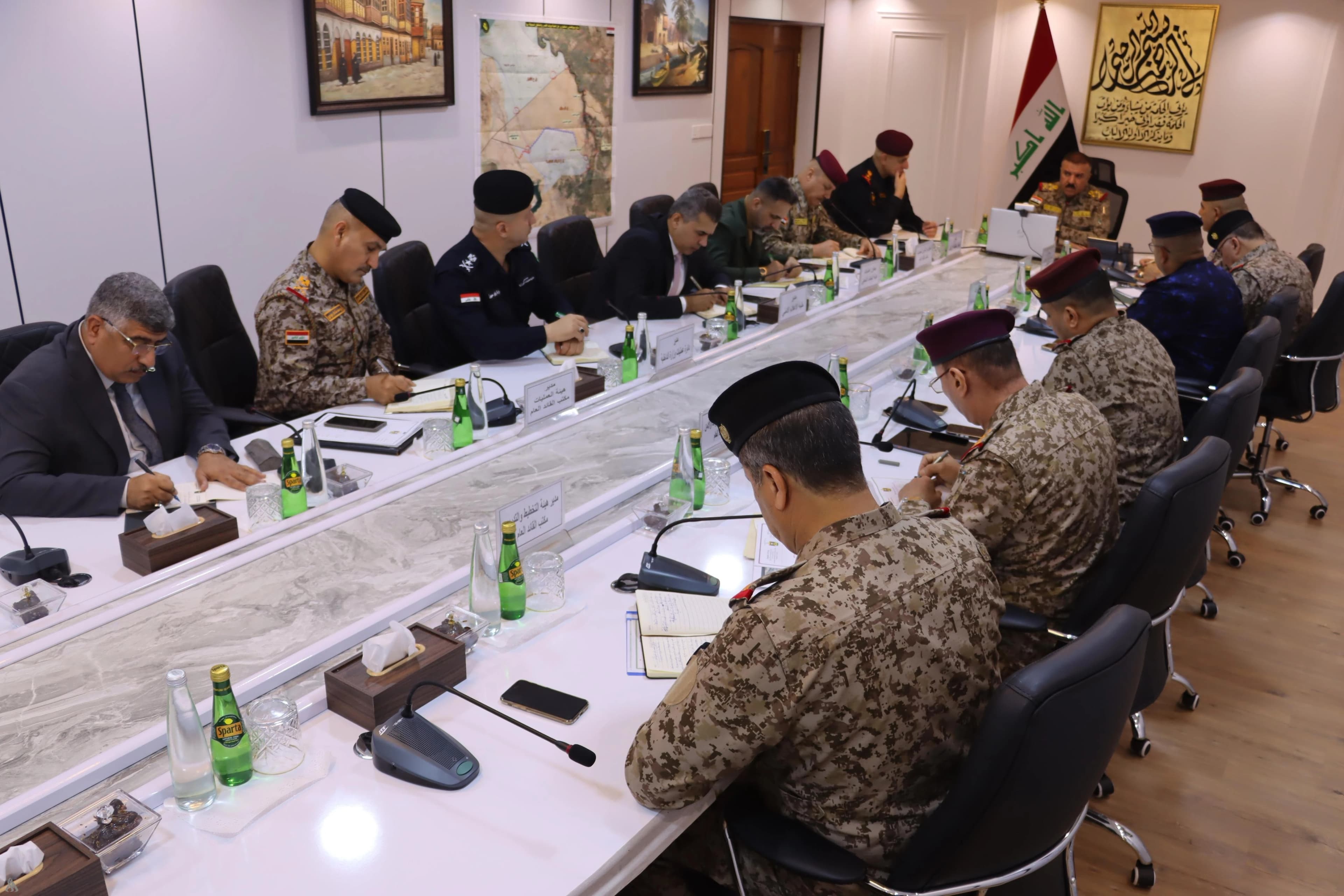
ERBIL, Kurdistan Region - Iraq’s Higher Committee for Security Sector Reform, chaired by Prime Minister Ali al-Zaidi, decided on Wednesday to replace the armed forces currently holding the strategic town of Jurf al-Sakhr, also known as Jurf al-Nasr, deploy the energy police to secure its oil pipeline, and refer pipeline violation probes to the judiciary.
"The committee decided to assign the energy police to protect the pipeline in the Jurf al-Nasr area, and to replace the force currently holding the ground there with another force to be determined by the Commander-in-Chief of the Armed Forces. It was also decided to refer the government's investigations regarding violations against the pipeline to the judiciary to take legal action against the violators," Zaidi's media office said in a statement on Wednesday.
The decision comes days after Zaidi ordered a probe into the town after intelligence reports surfaced last week detailing illicit pipeline activities in the area.
The dispute has triggered a standoff with the pro-Iran paramilitary group Kata’ib Hezbollah - one of the most powerful factions in Iraq - who has maintained effective control over the town, located 60 kilometers southwest of Baghdad, since its recapture from the Islamic State (ISIS) in 2014.
The ruling Shiite Framework said they had reached an agreement with Zaidi to replace the faction’s forces in the area with another Popular Mobilization Forces (PMF) within 10 to 14 days, but negotiations remain over whether the planned redeployment will result in Kata’ib Hezbollah relinquishing effective control of the town or produce a negotiated security arrangement involving other PMF formations.
Wednesday's first meeting of the security reform committee was attended by relevant ministers alongside the heads of Iraq's security and intelligence agencies.
According to the prime minister's office, the committee affirmed that "its meetings will continue to be held periodically to follow up on the implementation of the reform phases, establish security, and achieve stability in a manner that serves the interests of Iraq and its people, consolidates the rule of law, and promotes the principles of accountability and transparency."
Officials also reviewed executive plans from security and intelligence agencies to support stability and restrict weapons to the state, the statement added.
The faction has maintained a firm stance against retreat and denied the smuggling allegations, accusing the government of using the investigation to pressure the faction into surrendering its weapons. The group reportedly has troops stationed along the entrance of the town.
Senior Kata'ib Hezbollah figure Abu Talib al-Saeedi rejected the prospect of a withdrawal during a press visit to Jurf al-Sakhr on Tuesday, stating, "that will not happen, not even over our dead bodies," to Agence France-Presse (AFP).
A military directive dated Tuesday has outlined a joint security deployment involving the Iraqi army, federal police, and the PMF, alongside placing a Counter-Terrorism Service unit on standby and reopening local roads.
Shammari subsequently chaired a high-level security meeting on Wednesday under instructions from Zaidi to discuss enhancing security in northern Babil province and the Jurf al-Nasr sub-district.
RELATED: Iraq assigns Jurf al-Sakhr center to federal police under new security plan