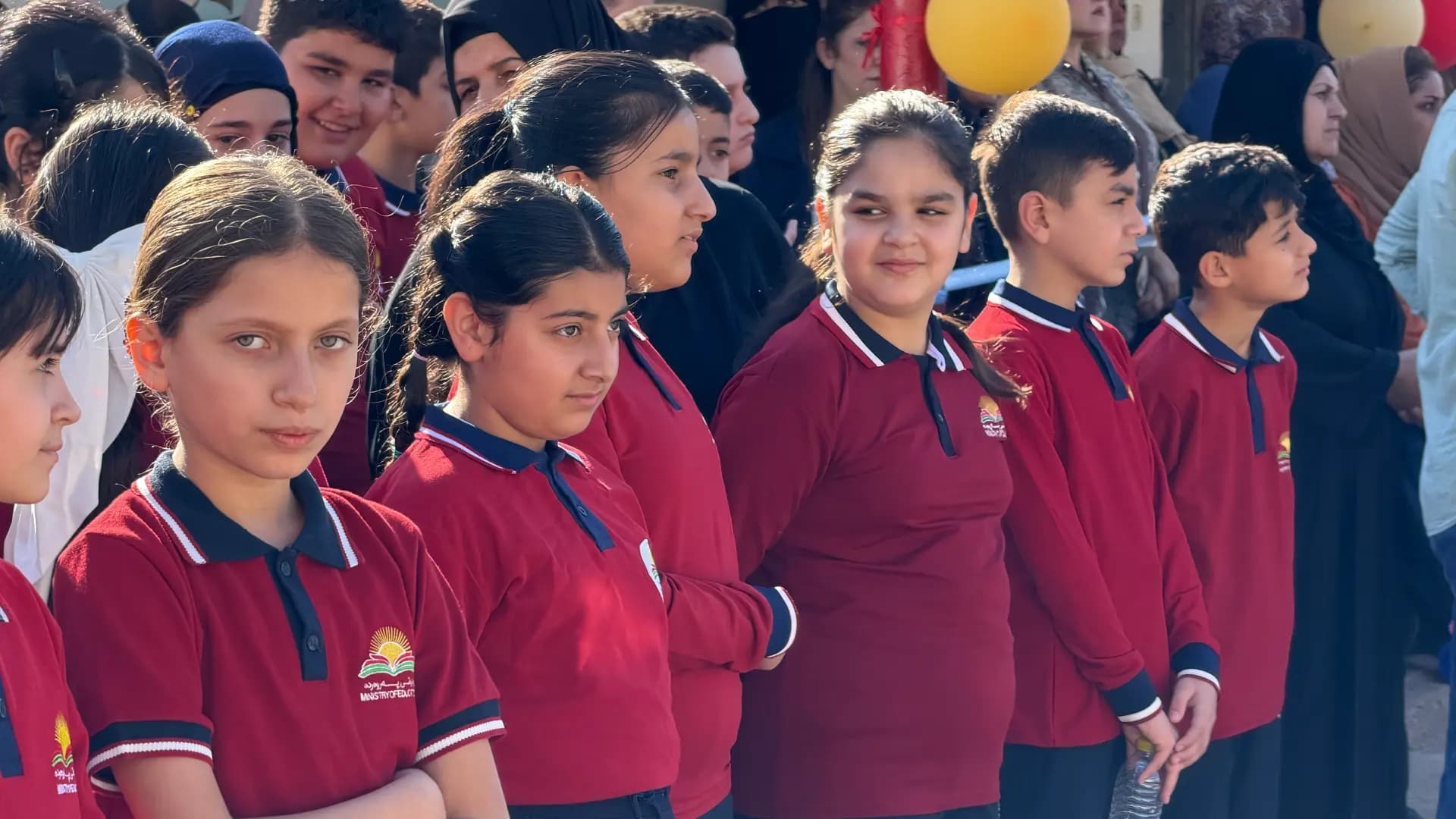

ERBIL, Kurdistan Region - Demand for Kurdish-language education is growing in the disputed areas between the Iraqi government and the Kurdistan Region, with shortages of teachers, school buildings and textbooks continuing to hamper Kurdish schools in Kirkuk, Salahaddin and Nineveh provinces, education officials told Rudaw as the new academic year began on Sunday.
Nearly 125,000 students are enrolled in Kurdish-medium education across Kirkuk, Tuz Khurmatu and Shingal this year, despite deteriorating infrastructure, teacher shortages and schools operating multiple shifts.
Kurdish-medium schools outside the Kurdistan Regional Government’s (KRG) administration rely on the KRG Ministry of Education for teachers, textbooks and other supplies. Officials say disputes over public-sector salaries with Baghdad and limited federal support continue to complicate the process.
Kirkuk has about 105,000 Kurdish-medium students across 562 schools this year. At least 1,050 students have transferred from Arabic-medium to Kurdish-medium education, with more expected to follow.
Kamaran Ali, director of the Kurdish Education Department in Kirkuk, told Rudaw's Hiwa Husamadin on Sunday that the KRG increased textbook supplies this year in response to rising enrollment.
“Annually, the Kurdistan Regional Government's Ministry of Education would send us one million textbooks. However, this year, due to the increase in student enrollment, they have supplied us with 1.2 million books, spanning kindergarten through 12th grade,” Ali said.
But infrastructure remains a major problem. Ali said 100 schools require renovation, including 40 that are severely deteriorated.
“100 of our school buildings require renovation, 40 of which are severely aged. Furthermore, approximately 30 to 40 of our schools operate on triple shifts,” he said.
In Khurmatu, Salahaddin province, about 5,000 students attend 35 Kurdish-medium schools, up from roughly 4,500 in previous years.
Tariq Ahmed, director of the Kurdish Education Directorate in Salahaddin province, said teacher retirements have created serious gaps.
“For three consecutive cohorts, local teachers have retired without a single replacement being appointed. More will retire this year, leaving a shortfall of specialized subject teachers, which leaves some students unable to study those subjects,” Ahmed told Rudaw.
In Shingal, Nineveh province, around 15,000 students attend Kurdish-medium schools. Only 26 of the district’s 70 school buildings are dedicated exclusively to Kurdish education, forcing many schools to share facilities with Arabic-medium schools.
Maysar Haji, director of Kurdish education in the town, told Rudaw's Aziz Sharkani on Sunday that schools operate double, triple and even quadruple shifts. “Most Kurdish students are forced to attend after noon,” he added.
The district has about 1,000 teachers and staff funded by the KRG, but Haji said delayed textbook deliveries remain a major problem at the start of the academic year.
Families return to Kurdish schools
The rise in demand is also being driven by families transferring children from Arabic-medium schools back to Kurdish education.
Shnyar Fuad, whose brother returned to Kurdish schooling after five years in Arabic-medium education in Kirkuk, said Saturday her brother had struggled to understand lessons and needed private tutors.
“From the very beginning, he had comprehension difficulties; we constantly had to hire private tutors. Now, we decided to move him to Kurdish education and restart from the sixth grade of primary school,” she told Rudaw's Hardi Mohammed.
More than 1,100 students in Kirkuk and around 50 in Khurmatu have transferred back to Kurdish schools this year, according to education records.
Hemin Salah, principal of Sonagoli School, said Saturday the trend is continuing.
“Last year, 24 students transferred back, and this year, even before classes have officially started, we have already admitted more than 20 new students,” Salah said.
Rauf Saadullah, head of the Kurdish education supervisory unit, attributed the trend partly to the opportunities available to Kurdish-school graduates.
“Twelfth-grade graduates from Kurdish schools have dual opportunities: they can gain admission to universities across Iraq and Kirkuk, as well as universities and institutes within the Kurdistan Region,” Saadullah said.
More than 8,500 new primary students also registered in Kirkuk’s Kurdish schools this year, highlighting continued demand for mother-tongue education.
.webp&w=3840&q=75)