
ERBIL, Kurdistan Region - The leader of an Iran-backed group operating in Iraq on Wednesday threatened direct confrontation with any US troops who remain after the September 30th deadline for the withdrawal of international Coalition forces, coinciding with doubts over Baghdad's ability to meet the deadline for the disarmament of the factions.
"Let him [Trump] know that we are monitoring September 30th with full preparedness, readiness and enthusiasm to fight a decisive battle with the occupying forces if they renege on their commitment for full withdrawal from the land and the air," read a Wednesday statement by Akram al-Kaabi, the general secretary of Harakat Hezbollah al-Nujaba.
"If [even] one [US] soldier remains [in Iraq] after this date, we will not let them return safely. We will send them back as a lifeless corpse," Kaabi further threatened.
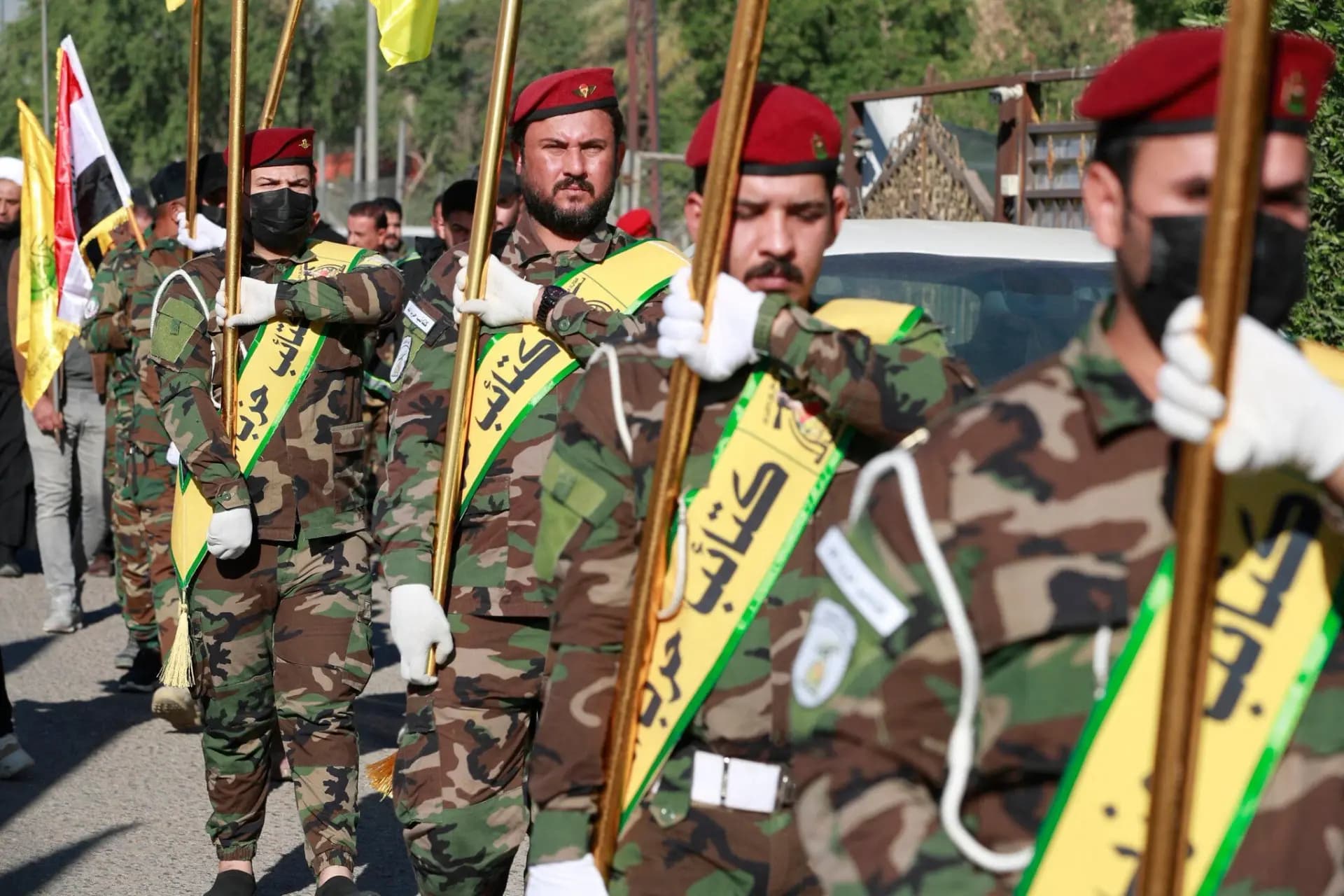
On the same day, under a banner reading "Protector of Sovereignty and Peace Through the Force of Arms" at an event marking the birthday of the Prophet Muhammad, Senior Kata’ib Hezbollah leader Sheikh Abu Talib al-Saaidi affirmed unwillingness to lay arms.
"How can a state that cannot control exam questions [from leaking] restrict arms?" Saaidi is heard saying in a video posted on the Telegram channels of Iran-backed factions on Wednesday.
"A government that cannot provide fuel [to citizens] cannot talk about much larger issues, namely restriction of arms and disarmament,” added the Kata’ib Hezbollah leader.
Kata’ib Hezbollah is one of three prominent Iran-backed factions under the umbrella network of the “Islamic Resistance in Iraq” that has indicated unwillingness to abide by the Iraqi-government deadline for a September 30th disarmament that is fast approaching.
Kata’ib Hezbollah is joined by Harakat Hezbollah al-Nujaba and Kata’ib Sayyid al-Shuhada who have staunchly maintained their refusal to lay down arms and have gradually increased the ceiling of demands to comply with the government’s deadline.
In addition to the withdrawal of foreign troops, they went as far as to insist on the dissolution of Kurdish Peshmerga forces of the Kurdistan Region as a precondition.
Amid increasing demands, officials and political party leaders speaking to various outlets seem to suggest that September 30th is not a firm cutoff date either.
Nouri al-Maliki, currently a member of the ruling Coordination Framework, rebranded September 30th as the start of the process.
In the early days of the war against the Islamic State of Iraq and Syria (ISIS), Maliki, as then-prime minister, issued the initial decree to form the Popular Mobilization Forces (PMF), which sees an overlap with members of the IRI.
In an interview with Iraqi channel al-Sharqiya that has yet to air, in parts which the channel released on their social media, Maliki disclosed that political leaders have now realized that ultimatums or threats don’t produce results.
The reframing of rhetoric has allowed leaders to hold dialogue to resolve the issue without getting embroiled in clashes, argued Maliki.
"We don't use the term 'disarmament' because then the terminology of 'disarmed' gets associated with the other side [PMF], and that has a psychological and practical effect. We call it organization, containment of arms,” Maliki said.
Maliki made a distinction between the PMF, which is officially under the authority of the Iraqi Prime Minister, and the so-called “factions.”
"Hashd [PMF] is something different. They wanted to lump Hashd's name with the factions, with militias, with uncontrolled arms. Hashd embodies none of that. Hashd is a military, government institution that I established based on a decree of my own. Hashd's arms are the state's arms. Their funding is from the government. They act according to the government's order," added Maliki.
Maliki said they are exploring ways to label the process first before defining what the process itself entails, and whether it encompasses the removal of all arms or certain types.
"Does it [the process] include everything? Or only one type of weapon, a 'targeting' weapon, that can be used domestically and externally, too. This is what the committee that has been formed with the brothers in the factions is going to determine,” Maliki added.
Maliki didn’t specify whether he meant rockets or explosive-laden drones. Iran-backed factions have been accused by various parties of attacking Erbil and neighboring countries using both.
On July 27, the US and Saudi Arabia conducted joint airstrikes against bases belonging to Iran-backed militias, killing 20 members and injuring 32 others.
Riyadh claimed the strikes were retaliatory due to attacks launched by Tehran-backed groups in Iraq. Iraq and the factions have denied the claims.
Nevertheless, Maliki admitted that they couldn’t meet the September 30th deadline.
"The question doesn't need to be settled by September 30th. What is essential is to lay the groundwork to contain this crisis. It shouldn't be that Iraq gets subjected to a wave of threats and sanctions if no handover occurs by that date. We want to agree on the framework for now,” he said.
This sentiment was shared by Qasim al-Araji, the former long-time National Security Advisor and current Security Advisor to the Iraqi prime minister.
"September 30th is the date for the withdrawal of Coalition forces. However, it doesn't mean it is the deadline for the organization and removal of arms.
Discussions will continue until a final agreement on handover of weapons to state control,” Araji said in an interview with Saudi-based channel Al-Arabiya on Tuesday.
They are “optimistic,” added Araji, and the government “is serious” with regards to arms restrictions. Araji said that the most likely party to receive arms from factions is the PMF given its status as a formal government institution under the auspices of the Commander in Chief of the armed forces.
"There is no going back on this.…We don't want the Coalition's withdrawal on September 30th being tied with disarmament," Araji said.