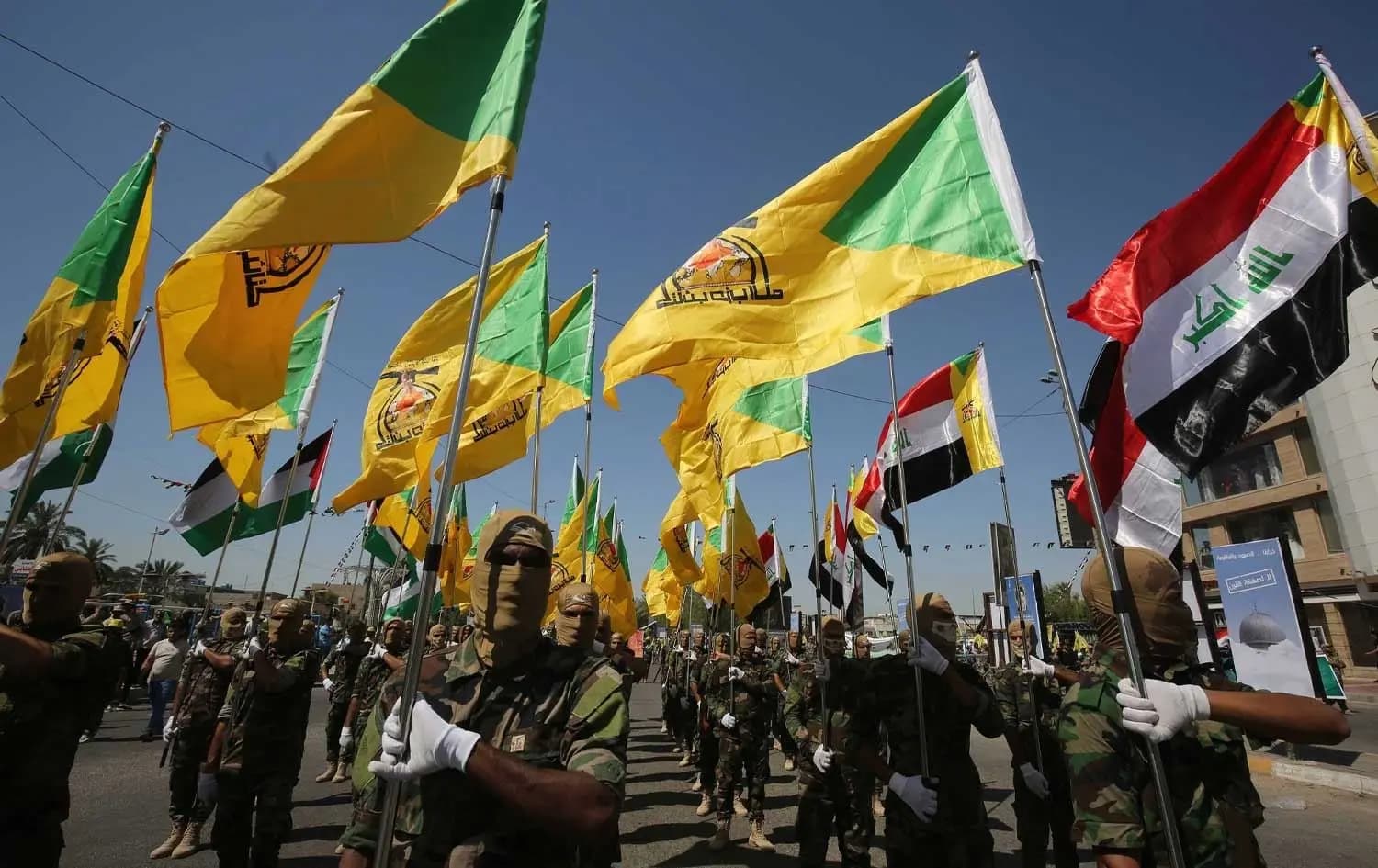

ERBIL, Kurdistan Region - Iran-backed Iraqi armed group Kata'ib Hezbollah has set new conditions for handing over its weapons to the Iraqi state, including the withdrawal of Turkish forces from the Kurdistan Region and the dissolution of the Region's Peshmerga forces.
Abu Mujahid al-Assaf, the group's security official, issued the demands in a statement on Tuesday outlining three prerequisites for engaging with the Iraqi government over its weapons.
The conditions include “complete and actual withdrawal of the American enemy forces from Iraqi land and airspace” in addition to guarantees of an end to American influence over Iraqi decision-making processes, “expulsion of the occupying Turkish forces from northern Iraq,” and the “dissolution of the Peshmerga forces,” the latter of which it categorizes as “the most heavily armed militia and the most dangerous to the unity of Iraq," despite the group’s status as the official armed forces of the Kurdistan Region as recognized under Iraq's constitution.
Kata'ib Hezbollah's demands come as the Iraqi government has issued a mandate to bring all weapons and armed forces under state authority. Prime Minister Ali al-Zaidi has set September 30 as a deadline for armed factions to disarm, coinciding with the scheduled departure of US forces from Iraq.
Kata'ib Hezbollah and Harakat al-Nujaba, both aligned with Iran, have been among the main factions refusing to hand over their weapons, citing the presence of US and other foreign military forces.
The statement comes a day after Iraqi security forces arrested a senior Popular Mobilization Forces (PMF) commander affiliated with the Iran-backed Harakat al-Nujaba movement, one of the factions that has opposed government efforts to place all weapons under state control.
Aqeel Qaraghuli, head of the Security Committee in the Dhi Qar Provincial Council, told Rudaw on Monday that a special force from the Iraqi Counter-Terrorism Service (CTS) arrested Abbas Hussein al-Yaqubi, the intelligence director of the PMF's Baghdad Belt Operations Command, at his home in the Fazliya sub-district of Dhi Qar province.
According to Qaraghuli, the CTS unit was dispatched from Baghdad and carried out the operation “without coordination with the security agencies of Dhi Qar Province.” Yaqubi belongs to the PMF's 12th Brigade, which is affiliated with the Nujaba Movement led by Akram al-Kaabi. He also heads the movement's search and inspection unit.
The PMF later confirmed Yaqubi's transfer into its custody. PMF media director Muhannad al-Aqabi said: “By the grace of God Almighty, the head of intelligence for the Baghdad Belt, Mr. Abbas al-Yaqubi, has been handed over to the General Directorate of PMF Security to undergo legal proceedings with the judiciary.”
Saad Maan, head of Iraq's Security Media Cell, said Saturday that the government was working to unify security decisions and ensure military forces are properly consolidated under state authority.
“The decision of war and peace is exclusively in the hands of the state,” Maan told state-run Iraqi News Agency (INA). “It is not possible to accept multiple decisions or the creation of parallel forces to the official forces.”
Both Kata'ib Hezbollah and Harakat al-Nujaba fall within the PMF, an umbrella network of mostly-Shiite paramilitary groups established in 2014 to fight the Islamic State (ISIS) following a decree from then Grand Ayatollah Ali Sistani.
The most recent attack on the group involved targeted strikes in late July against PMF bases, claiming the lives of at least 20 of its members and wounding 32 others, according to the group.
Maan on Saturday described the PMF as “a constitutional and legal institution” and said armed groups operating outside that framework would be addressed through negotiations and constitutional and legal channels.
He also said the September 30 deadline was “not a source of concern,” adding that dialogue and constitutional, legal and administrative channels remained open.
Maan said significant quantities of weapons had already been handed over by factions responding to government decisions, particularly weapons that were not registered with or under the authority of the PMF.
The government is also registering privately held firearms. Maan said an Interior Ministry committee was registering about 6,000 firearms each week, with approximately 580,000 weapons registered so far.
Concurrently, Zaidi on Sunday, in his capacity as the commander in chief of the armed forces, discussed “the plan to build and develop air defense capabilities and enhance its readiness” to ensure “the protection of Iraqi airspace and the achievement of sovereignty,” according to a press statement from the prime minister’s media office.
Warning to Prime Minister Zaidi
In the second part of his statement, Assaf criticized Zaidi, saying Kata'ib Hezbollah had “endured the empty bravado of the young Prime Minister-designate, Ali al-Zaidi, for more than a hundred days.”
The group said it had expected Zaidi to understand Iraq's internal, regional and international circumstances and listen to veteran politicians, but accused him of worsening the situation.
“However, we have seen no progress from him in comprehending the complex circumstances through which Iraq and the region are passing,” Assaf said.
He also accused Zaidi of listening to those who “harbor animosity toward the Shiites of the Commander of the Faithful [Imam Ali],” as well as Tom Barrack, the US special presidential envoy for Iraq and Syria, whom the statement referred to as the head of the “Levant and Iraq Liberation” organization and a “pickpocket.”
The group also warned that its patience was running out over what it described as government raids on the homes of the families of its “martyrs,” wounded members, fighters and sheikhs under direct US supervision.
“Our patience is beginning to run out regarding the provocative and irresponsible actions of the youth al-Zaidi,” Assaf said, threatening that “We may begin to act on the principle: ‘An eye for an eye, and the initiator of the wrong is the more unjust.’”
Addressing Zaidi directly, Assaf said: “You were busy with trade, enjoying security and luxury, and filling your treasuries with billions, while our blood was being shed to protect the country's sovereignty and preserve the state and the sanctities,” actions the group attributed as necessary to “ensure stability, preserve dignity, and avoid being dragged into what pleases the enemies.”
“Do not forget yourself; you are standing before men who, for the sake of God, do not fear the blame of any critic,” he added.