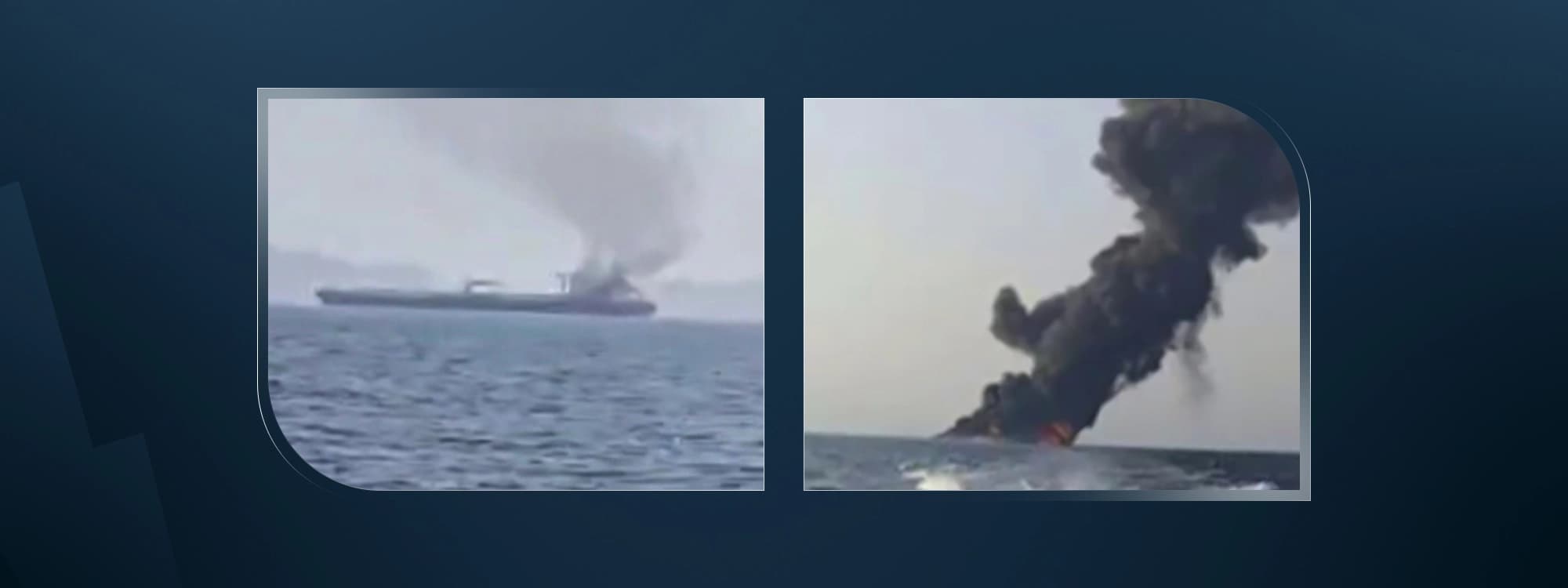

ERBIL, Kurdistan Region - Iran's Islamic Revolutionary Guard Corps (IRGC) said on Friday that two US-assisted oil tankers caught fire and were brought to a halt in the Strait of Hormuz after ignoring navigation warnings, as a British maritime monitor reported an increase in shipping traffic through the strategic waterway despite continued security threats.
The IRGC Navy said the two "offending oil tankers" - one in the eastern part of the strait and the other in the western section - had attempted to pass through an "unauthorized route" while heading out of the waterway.
According to the IRGC, both vessels had switched off their navigation and positioning systems and were attempting to leave the strait with the support of the US military.
"Following several radio warnings and their disregard, these two oil tankers entered an unsafe zone, suffered an incident, and were brought to a halt off the southern coasts of the Strait of Hormuz," the IRGC said.
The incident comes amid a surge in maritime confrontations in the Strait of Hormuz, a vital shipping route for global energy supplies, as the regional war that erupted in late February continues to disrupt commercial shipping.
The United Kingdom Maritime Trade Operations (UKMTO), a British maritime security monitor, said on Friday that it had recorded 88 incidents in the strait since the conflict began.
Despite the security risks, shipping traffic has shown signs of recovery, with UKMTO reporting 122 outbound and 155 inbound vessel transits this week, compared with 114 outbound and 127 inbound the previous week.
However, overall traffic remains approximately 70 percent below pre-war levels.
Meanwhile, US Central Command (CENTCOM) commander Admiral Brad Cooper said on Friday that the strait's main shipping routes were clear of Iranian naval forces, describing extensive commercial activity during a recent flight over the waterway.
“When I [recently] flew over the strait, I saw dozens of commercial vessels transiting, all types: cargo, crude oil, liquid natural gas,” Cooper stated, noting that he also observed “US assets in the air and on the water, including a squadron of advanced sea drones that were on patrol supporting a defensive layer.”
"Here's what I didn't see: I didn't see the IRGC out there at all,” Cooper added, explaining that the IRGC “patrolled the Strait of Hormuz and surrounding waters for decades, harassing and threatening and seizing commercial vessels at will. But they were not out there because Iran's navy is all at the bottom of the sea.”
Cooper also said US forces had reached a "significant milestone" this week by helping Gulf partners export more than 1.5 billion barrels of crude oil since the summer.
The conflicting Iranian and US accounts come as attacks on commercial vessels have intensified since the beginning of October.
According to the Washington Institute, around 30 maritime incidents have been reported in October, making it the month with the highest number of incidents since March.
The renewed maritime tensions coincide with diplomatic efforts to ease hostilities between Washington and Tehran, with Qatar and Pakistan involved in mediation.
US President Donald Trump said on Friday that the Iran war will end soon.
"It's going to get wrapped up soon," Trump told Kansas City radio station KCMO. "We need a guarantee there'll never be a nuclear weapon."
US Special Envoy for Syria and Iraq Tom Barrack, who also serves as Washington's ambassador to Turkey, told CNN on Thursday that regional partners were working to bring the two sides closer to an agreement.
"Qatar and Pakistan and all of our allies have done a good job in trying to bring us into a room where we can have an agreement on a process," Barrack said.
"I think that we're very close on finally getting to a place to say let's just have a time out. Let's have a time out, bring temperatures down," he added.
Washington and Tehran signed the Pakistan-brokered Islamabad Memorandum of Understanding in mid-June, establishing an initial framework for ending hostilities and pursuing a broader diplomatic settlement.
However, the understanding failed to produce a lasting truce. Tensions escalated again in mid-July when the United States resumed its naval blockade of Iranian ports and carried out strikes against Iranian military targets.