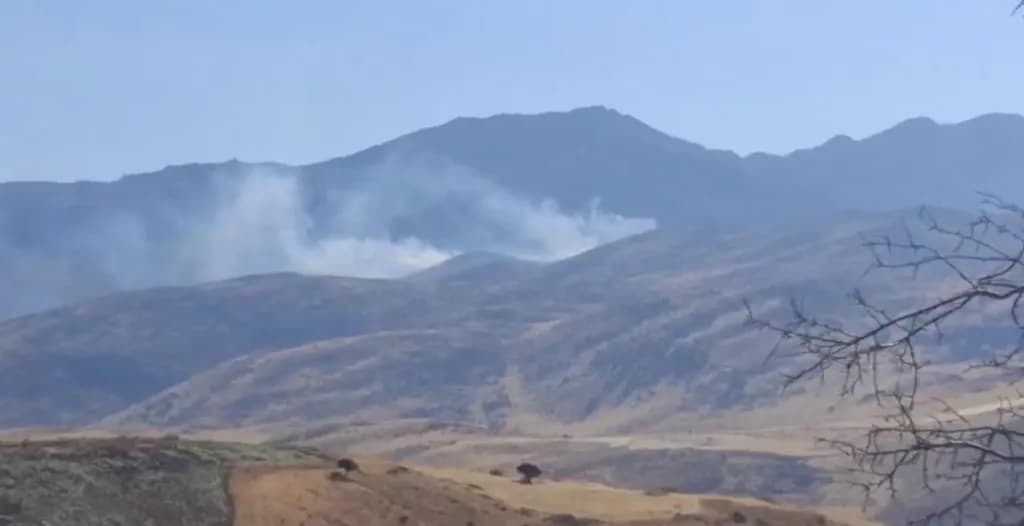

ERBIL, Kurdistan Region - Clashes between Kurdish militants and Iran’s Islamic Revolutionary Guard Corps (IRGC) began on Thursday and have continued into Friday in western Iran’s Kurdish region, particularly around the Shaho mountain range, where Iranian forces have deployed heavy artillery and drones to pound the mountainous area.
The fighting comes as Iran grapples with armed insurgencies on two fronts: Kurdish militants in the west and Baloch armed groups in the southeastern province of Sistan and Baluchestan.
The Kurdistan Human Rights Network (KHRN) reported Thursday that IRGC forces had deployed heavy military equipment and drones around Daleh Marz village in Sarvabad county, launching artillery and drone strikes against the Dasht-e Qalb area of Shaho mountain.
According to local sources cited by the watchdog, the IRGC has also prohibited access to parts of the mountain range and used suicide drones to target the area. The IRGC has not confirmed these claims.
Shaho mountain forms part of the Zagros Mountains range that spans 1,600 kilometers stretching across Kurdish majority provinces in western Iran and the Kurdistan Region.
The protected mountain range has repeatedly come under Iranian bombardment in recent years, causing forest fires and environmental damage. Following similar reports of fire-starting in August in the nearby county of Kamyaran, IRGC forces claimed these actions were intended “to prevent Kurdish opposition party forces from using vegetation cover to carry out attacks.”
These events follow a further expansion of security forces in the Kurdish area since the first quarter of this year and the beginning of the US-Iran war.
Clashes in the Kurdish region and in Sistan and Baluchestan come at a sensitive time when Iran is engulfed in confrontation in the Strait of Hormuz with the US, as the US-imposed blockade since mid-July has depleted Iran’s economic resources and brought oil exports to zero.
Meanwhile, violence has intensified in Sistan and Baluchestan, where Baloch militants have carried out a series of deadly attacks against Iranian security forces in recent weeks.
On September 23, militants killed IRGC Brigadier General Hossein Zarifi, commander of the Shahid Sajjad Operational Base in Saravan, and intelligence chief Ahmad Herati Zera’ati during heavy fighting.
On Friday, Lieutenant Colonel Nosrat Eftekhari Poudineh, deputy for cultural and social affairs at the provincial police command, was killed in a roadside bombing near Zahedan. Five days later, Afsaneh Aqila, commander of an all-female Basij unit, was shot dead in Mehrestan.
The latest escalation in the Kurdish region follows months of insecurity since the US-Israeli war against Iran began in late February.
Iranian missile and drone strikes have killed Kurdish opposition fighters and Kurdistan Region Peshmerga, while a series of killings and armed attacks have heightened tensions across western Iran.
There have been several assassinations in Kurdish areas of Iran with units affiliated with Kurdish opposition groups with an Iranian official threatening camps in the Kurdistan Region.
Iran and its affiliated groups within Iraq have fired hundreds of drones and missiles at opposition camps over the last several months, particularly the bases of the Kurdistan Democratic Party of Iran (KDPI) and Komala in Erbil and Sulaimani provinces.
The latest includes an explosive-laden drone against a Kurdish opposition group east of Erbil in Topzawa, located in the province's Khabat district, prompting some families to flee their homes while others struggle to find safer places to live.