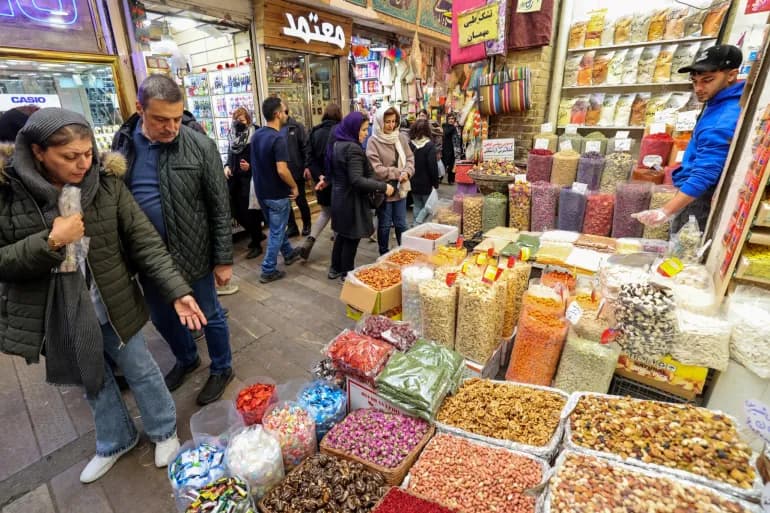

ERBIL, Kurdistan Region – Iran plans to remove around 15 million people who are financially “better-off” from its national food stamp program to fund an increase in benefits for those who remain in dire need, as the country’s economy falters under crippling corruption, high inflation, war and sanctions.
Fazlollah Ranjbar, a lawmaker from Kermanshah and spokesperson for parliament’s Social Commission, said the government was finalizing an increase of between 300,000 and 500,000 tomans ($1.19 to $1.98) in food-coupon credit for some recipients. The semi-official Iranian Student News Agency reported that some beneficiaries could see their monthly credit rise to 1.5 million tomans.
“It had been decided that this scheme would be implemented by removing 15 million people who are in a better financial position, in coordination with the country’s Tax Affairs Organization,” Ranjbar said. He added that 1.5 million people had so far been removed from the scheme and that new criteria were being considered.
Iran’s inflation continued to accelerate in September, with the Statistical Center of Iran (SCI) reporting point-to-point inflation of 89.8 percent, meaning households paid nearly 90 percent more for the same basket of goods and services than a year earlier.
The consumer price index rose to 729.8, up 4.2 percent from August, while annual inflation climbed to 73.6 percent, from 69.9 percent the previous month. Point-to-point inflation stood at 89 percent in August.
The government launched a new version of the food-coupon scheme, known as kalabarg, in January for almost 80 million people out of a population of around 93 million, as a way of easing the impact of the cost-of-living crisis on the most vulnerable sections of society. Labor Minister Ahmad Meydari said the scheme covered around 90 percent of the population, according to Iran’s state-run Islamic Republic News Agency (IRNA).
The government deposited one million tomans per person per month into beneficiaries’ accounts, with four months of credit provided in advance, allowing people to spend the credit at around 260,000 designated shops and supermarkets nationwide.
President Hassan Rouhani’s government was forced to introduce support packages in late 2018 after US President Donald Trump withdrew from the Iran nuclear deal and reimposed crippling sanctions on the country. Several months later, his vice president, Eshaq Jahangiri, began publicly discussing vouchers, rationing and food coupons as a way of providing essential goods.
The first widespread use of food coupons and rationing under the Islamic Republic came during the Iran-Iraq war (1980 -1988), when staples became scarce, prompting the government to provide essential goods such as rice, meat and sugar through rationing as the country fought the eight-year war.
Since 2018, successive governments have provided subsidized foreign currency to importers and producers of essential foodstuffs and other goods in an effort to contain prices.
The system was repeatedly criticized over corruption, misuse of preferential foreign currency and its failure to keep consumer prices down. Some importers received subsidized foreign currency from the government but failed to import the goods they had been allocated the money for.
Pezeshkian’s government has instead moved toward paying the subsidy directly to households through the kalabarg program. IRNA quoted Meydari saying subsidies previously paid to importers and producers were now being transferred directly to consumers.
“In the past, cash subsidies were paid, but with rising prices, people’s purchasing power declined. Under the new plan, the subsidy for essential goods, which was previously paid in foreign currency at an amount equivalent to $10 billion a year, is now allocated directly and in a targeted manner to households so that their purchasing power is preserved,” Meydari said in January, according to state-run IRNA.
“The ultimate goal of this policy is to preserve and stabilize households’ purchasing power in providing essential goods,” the minister added.
When a reporter on Tuesday asked government spokesperson Fatemeh Mohajerani about criticism that the proposed increase in food-coupon credit amounted to little more than the price of a packet of puffed snacks, she replied: “The kalabarg is certainly not provided to buy puffed snacks.”
Mohajerani said the government did not deny the impact of soaring prices on ordinary Iranians. “The kalabarg is meant to help protect people’s livelihoods. We do not deny either the rise in prices or the economic pressure on people,” she said.
“We are fully aware that inflation and economic pressure are hitting people’s tables directly.”