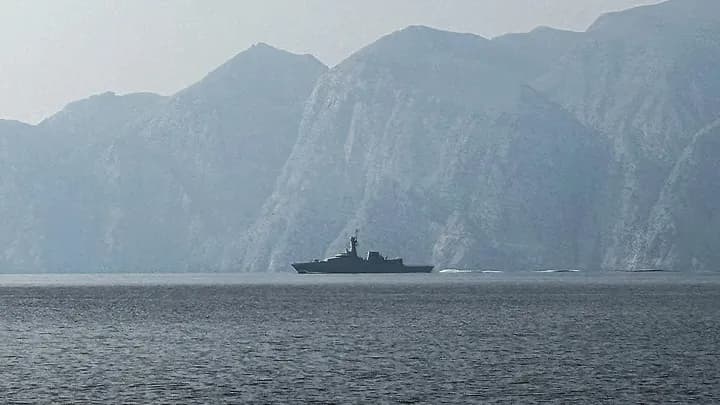

ERBIL, Kurdistan Region - A tanker was struck by three unknown projectiles in the Strait of Hormuz, a UK-based maritime monitor reported early Tuesday, as the US and Iran traded strikes on Sunday in the first round of escalations since July.
“A tanker has reported being struck by 3 unknown projectiles whilst completing an outbound transit of the Strait of Hormuz,” reported UKMTO regarding an incident on Monday 17 nautical miles east of Khasab, Oman, noting an absence of casualties and environmental impact.
This comes as the US and Iran on Sunday traded strikes for the first time in a month after Iranian media reported that American drones were launched in the Strait of Hormuz on Larak Island, situated in the narrowest part of the Strait, in the first known US strikes since hostilities in July.
Larak Island, home to a naval military outpost, lies along Iran's designated route for vessels passing through the Strait of Hormuz, the vital waterway through which approximately one fifth of the world’s crude oil transited before the US-Iran war was initiated in late February.
Tasnim News Agency, an outlet affiliated with Iran's Islamic Revolutionary Guard Corps (IRGC), said late Monday that the death toll from the attack on Larak had risen to three.
The IRGC said in a statement that its aerospace force launched a "punitive counteroffensive," conducting a "synchronized missile-and-drone assault" on alleged US assets at the King Hussein and al-Azraq air bases in Jordan using ballistic missiles, claiming the strikes inflicted "heavy losses," while the Jordanian army said it had intercepted eight missiles early on Monday morning.
The Iranian army said Monday that it "targeted locations housing US military helicopters and personnel at al-Minhad base in the United Arab Emirates with dozens of explosive drones," according to a statement carried by the state-run Islamic Republic News Agency (IRNA).
The army said the strike was carried out "in response to the killing of members of the Islamic Revolutionary Guard Corps [IRGC] and civilians" in a US attack on Iran's Larak Island on Sunday.
The IRGC has also pointed to the threat of mines it claims to have placed along the Strait as a means to coerce vessels into complying with Iranian regulations and transit fees.
According to the US Central Command (CENTCOM), US forces on Monday took "limited, precise action" against Iranian army "minelaying forces" that posed "an imminent threat in the Strait of Hormuz."
The strikes were conducted "to protect civilian mariners, commercial shipping, and the free flow of global commerce," CENTCOM said on Monday, adding that "as of [Sunday] Aug. 30, CENTCOM forces have redirected 83 commercial vessels, disabled three and boarded two to ensure compliance with the blockade."
The US and Israel in late February launched a joint aerial campaign, striking thousands of targets across Iran over six weeks to which Tehran responded with drone and missile strikes across the Middle East, targeting alleged US assets in Gulf Arab states and launching retaliatory strikes against Israel.
The two sides reached a preliminary ceasefire in early April, followed by the Islamabad Memorandum of Understanding in mid-June, which established a truce and set a 60-day window for negotiating a final agreement.
Meanwhile, tensions in the Strait of Hormuz remain elevated, with a US naval blockade on Iranian ports still in effect.
CENTCOM Commander Brad Cooper said Friday that "over the past several months, US forces have assisted nearly 1,500 commercial vessels" transiting the Strait of Hormuz, carrying nearly 750 million barrels of crude oil from Gulf countries to global energy markets.
At the same time, "no ships have entered or left an Iranian port without our permission, and we have only allowed ships to pass through on humanitarian grounds," Cooper said, affirming that Tehran "has exported zero oil from its shores since we resumed the naval blockade in mid-July."
Trump early Tuesday during a press conference at the Oval office ruled out the use of nuclear weapons against Iran, saying “there’s no reason for it,” and that Iran is “totally defeated militarily.”