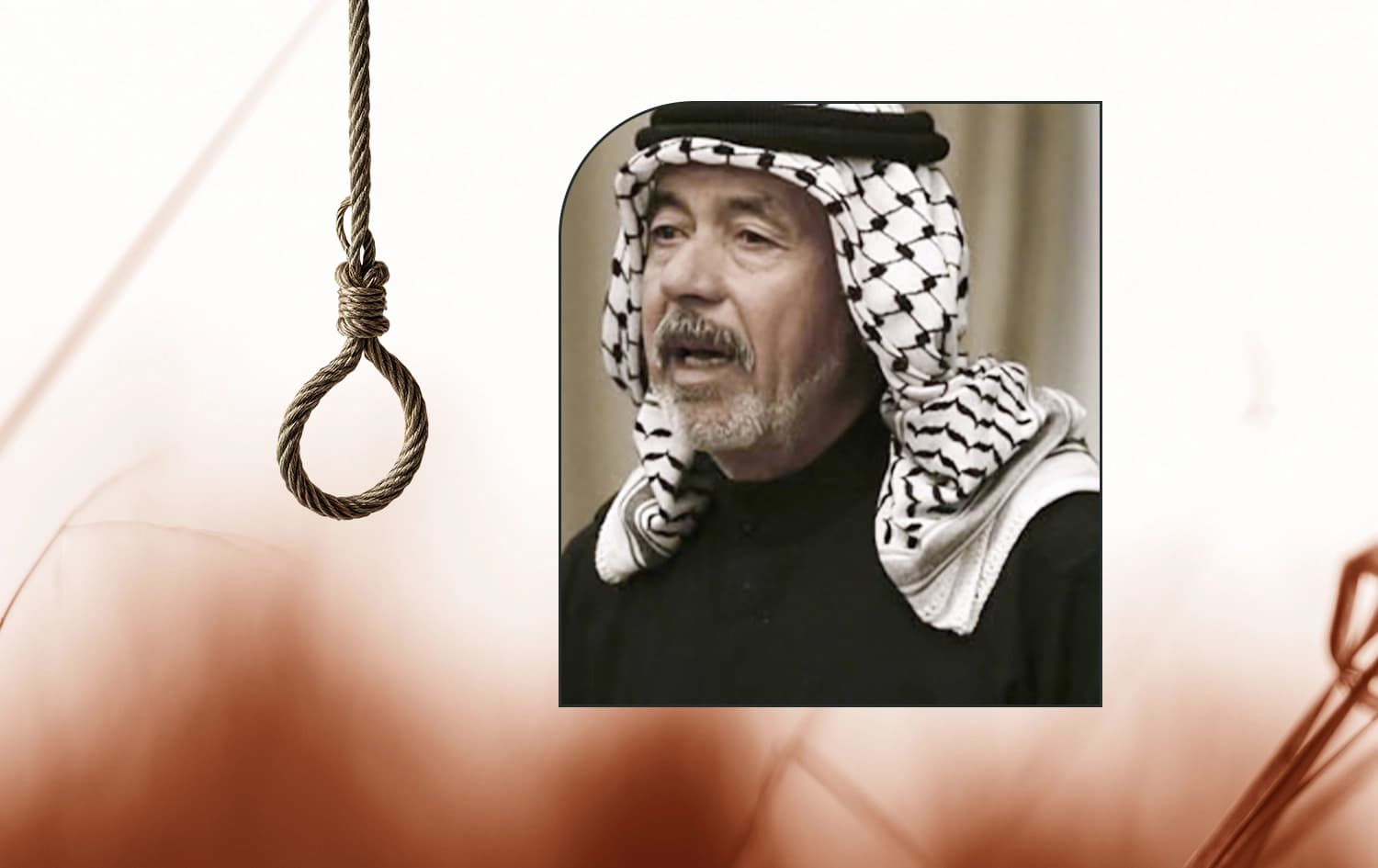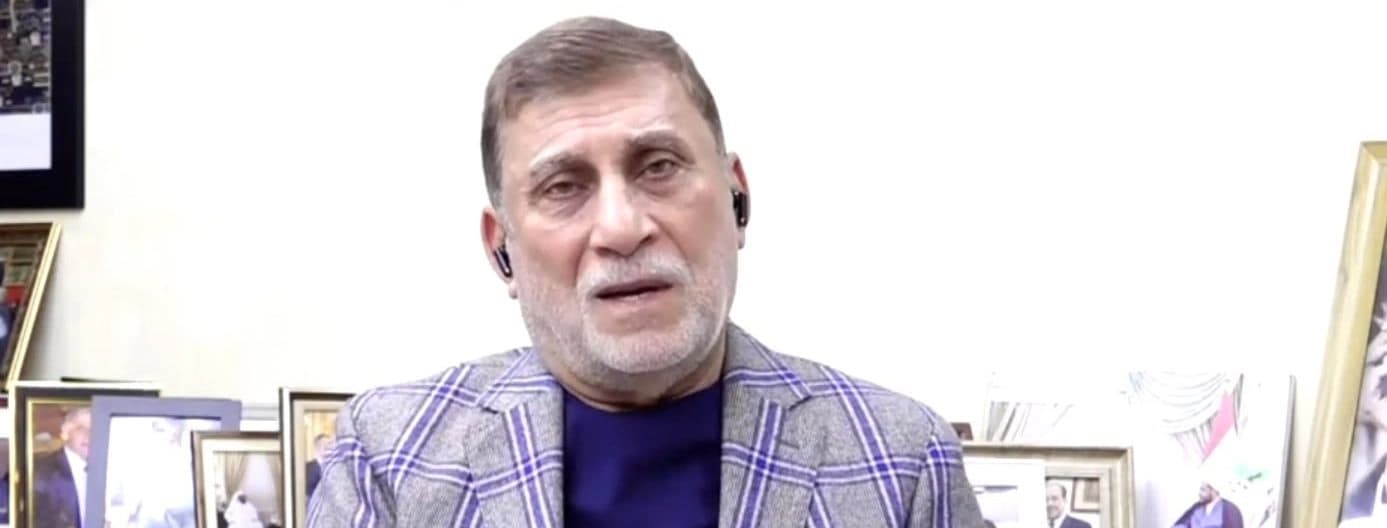

ERBIL, Kurdistan Region - Veteran Iraqi politician Izzat al-Shabandar on Thursday called for a gradual return to centralized governance in Iraq, arguing that the country’s decentralized system, established after 2003, has failed to strengthen national unity.
"Today, in the absence of centralization, what has the country gained from 2003 until now? Increased division, fragmentation, and the squandering of wealth and money," Shabandar told Rudaw’s Nwenar Fatih in a televised interview."That is what we’ve gained from the creation of regions whenever conditions allow for creating one. We are fragmenting the country without benefiting from it, and in the end, everyone loses."
Iraq adopted a federal, parliamentary system under its 2005 constitution following the 2003 United States-led invasion that toppled former dictator Saddam Hussein, distributing powers among the federal government, the Kurdistan Region, and decentralized provincial councils to prevent the concentration of authority that characterized decades of authoritarian rule.
Under the new system, political positions in the country, including the three senior-most positions of President, Prime Minister, and Parliament Speaker, are divided among ethno-sectarian groups.
Shabandar rejected the post-2003 political framework, claiming it was engineered by the US to weaken the country. "This system was drawn by none other than the Americans under Israeli watch because they know the country's future under such a system is fragmentation and partition, where the borders of regions are drawn in blood, God forbid,” he said.
The veteran politician was particularly critical of local governing bodies, stating, "Experience has taught me, by God, that provincial councils are nothing but opportunities for obstruction and theft and nothing more."
Shabandar argued that a centralized state is less corrupt and better equipped to preserve Iraq’s unity, strength, and development, provided authority is shared equitably among all communities rather than monopolized by a single group.
"Erbil can be strongly present in Baghdad, just as Basra can be strongly present in Baghdad, just as Anbar can be in Baghdad," he said. Shabandar admitted that Iraqis equate centralization with the abuses of the former regime.
“The type of centralization that experienced that made us hate it was that power was in one hand, while the others—who make up the majority of the country—were oppressed, with injustice distributed among them equally, while justice in all aspects was missing," he explained. This history has made Iraqis sensitive to a presidential system or a return to central rule that isn’t studied well beforehand, Shabandar admitted.
The Kurdistan Region division
Shabandar’s remarks come amid heightened tensions between the Kurdistan Democratic Party (KDP) and the Patriotic Union of Kurdistan (PUK) over the governance of the Kurdistan Region, particularly at a time when the latter has publicly backed plans to separate Sulaimani and Halabja provinces.
"I believe Baghdad is divided in two directions. There is a trend that does not approve, and there is a trend that may already be preparing—not just approving, but preparing and pushing toward having two Kurdish regions," he said.
While acknowledging that such a split is politically possible, Shabandar said he had not thoroughly studied its legal or constitutional feasibility and voiced support for preserving a unified Kurdistan Region.
"I do not believe Erbil will give up the unity of the Region. In my estimation, Erbil will do everything it can to stop that, and I stand with them," he said.
He added that he expects the wisdom of Kurdish leaders to avert a split. "Furthermore, even the Kurdish public in Sulaimani, before Erbil, will reject it," Shabandar said.
The dispute intensified on November 5, when the KDP reactivated the long-stalled Kurdistan Parliament with the backing of six lawmakers who broke rank with the PUK and its ally the New Generation Movement (NGM), declaring themselves independent to help secure a quorum.
In response, the PUK withdrew its ministers and other government officials from the Kurdistan Regional Government (KRG) and threatened reciprocal measures in Sulaimani if the KDP moves to elect a regional presidency and cabinet in Erbil.
PUK’s advocacy for the separation of Sulaimani and Halabja provinces under the banner of enhancing decentralization would effectively restore the two-zone division that existed in the Kurdistan Region from 1998 to 2006 following the Kurdish civil war.
Under Article 119 of the Iraqi Constitution and Law No. 13 of 2008, forming a new administrative region requires a petition signed by either one-third of a provincial council or one-tenth of the province’s population.
The petition is submitted to the federal council of ministers, which tasks the electoral commission with holding a referendum. Passage requires a simple majority of valid votes cast and a decree from the prime minister.
The procedure has no precedent in Iraq, and the law does not address the separation of part of an existing federal region whose constitutional privileges are legally enshrined. Nevertheless, proposals limited to administrative and financial decentralization—rather than declaring a separate constitutional region—would be subject to federal budget laws and administrative arrangements.
The following is the full transcript of the interview with Izzat al-Shabandar:
Rudaw: Thank you, Mr. Izzat. I believe one of the most important topics in Iraq right now is the issue of Jurf al-Sakhr—the state and the non-state. Jurf al-Sakhr is an Iraqi area, and it is perhaps obvious to ask: why has the return of state institutions to an Iraqi area become a subject of political negotiation with an armed faction?
Izzat al-Shabandar: Thank you, God bless you. What truly answers this question is the history of this area and the groups that directly and effectively contributed to changing the dangerous situation it was experiencing in 2014. Roughly 70 to 80 percent of the car bombs entering Baghdad came from Jurf al-Sakhr. During those same years, hundreds of pilgrims were slaughtered there because this place acted like a checkpoint on the Baghdad–Karbala–Najaf road. Sadly, hundreds of pilgrims visiting the holy shrines fell victim to this situation.
When the Iraqi army moved to enter this area, it was impenetrable to the utmost degree. Groups that responded at the time to the religious authority’s (Marja'iyya) fatwa of sacred and collective jihad (struggle) against terrorism and terrorists stepped up. Perhaps those known as Kata’ib Hezbollah played the largest role in its liberation. When they entered this area—and I visited it myself a long time ago—I found mind-boggling trenches, tunnels, orchards, and hideouts; things that were truly beyond imagination. Therefore, I say this is the history of this area.
No government came forward to negotiate with the Kata’ib, who took near-total control of it, as if it were a piece of land outside Iraq ruled by Kata’ib Hezbollah. There was no seriousness from successive governments to negotiate a possible withdrawal from the area, or the possibility of coordinating its command or administration.
Today, in this atmosphere where the United States—through its president and his envoy—has resorted to blatant interference in Iraqi affairs, and has gone too far, in my estimation, even in shaping the details of democracy and its outcomes in Iraq... in such an atmosphere, negotiating with the groups controlling this area cannot be received or conducted in a positive environment of goodwill and Iraqi interest. When Trump intervenes with a single tweet to remove the Coordination Framework’s candidate for prime minister, and when Trump intervenes to dictate who can be nominated for prime minister, or threatens Iraq with sanctions, and this passes unnoticed as if it were not interference in Iraq's internal affairs...
To repeat and summarize: the control of any non-governmental group over any area of Iraq is indeed a flaw, regardless of the history of that control. However, it must be subject to negotiation, not threats of fighting. From 2014 until today—about 12 years—we have been silent on this issue. Suddenly, serious steps appear to be coming from the Iraqi government, but they coincide with blatant American interference in Iraqi affairs. I believe the atmosphere does not serve in reshaping the situation in Jurf al-Sakhr in a peaceful and safe manner. We need to pause a little, understand, and recognize that this place is Iraqi and subject to the Iraqi state, and that whoever occupies and controls it and its assets is committing an illegitimate and unofficial act.
What I hope from the government and the groups controlling Jurf al-Sakhr is that they exercise restraint in their cries of threats, warnings, defiance, and weapons. Today, I see this issue as a soft, vulnerable spot that gives hope to many leaders or parties lying in wait for Iraq’s unity, who may intervene—or are already intervening in one way or another—to spark a Shiite-Shiite civil war. If that happens, God forbid, it would be far more dangerous than a known Iraqi faction, which has its own history and geography, controlling one of Iraq’s districts or areas. We face two dangers today, and the greater danger is sliding into a Shiite-Shiite war. As for Jurf al-Sakhr being under the control of Kataib Hezbollah, that is a matter that can be addressed—if not today, then tomorrow.
Mr. Shabandar, your words and depth of knowledge on this subject remind me of a verse by the poet al-Rusafi: "When the listener is as perceptive as you, brevity suffices over lengthy speech." So, are we talking about an Iraqi-Iraqi issue, or has Jurf al-Sakhr become somewhat about rebalancing strategic and political power between Iran and the United States? In a way, the Iraqi state has become like a piece on a chessboard—but who controls the board? The United States and Iran. Are we talking about an Iraqi-Iraqi issue, or a rebalancing between America and Iran in Jurf al-Sakhr?
Of course, Iraqi politicians would be mistaken if they go in the second direction—meaning if their meetings, negotiations, disagreements, or agreements are subject in one way or another to the Iranian-American conflict or rivalry on Iraqi soil. For the factions currently embroiled in the Jurf al-Sakhr issue, we hope they prove their patriotism and prove that what is happening is an Iraqi-Iraqi matter, not a spillover of the Iranian-American conflict in Iraq.
Two days ago, I recounted a story attributed to Prophet Solomon, and sometimes to Imam Ali (peace be upon him), about two women who disputed over a child, each claiming to be the mother. When the wise ruler could not convince either woman that the child belonged to the other, he decided and said, "I will split this child in half, giving half to each." One of them cried out in terror and said, "He is not my child; he is the other woman's child." The wise man replied, "By God, you are the boy's mother."
Today, in this conflict between the Iraqi government and an armed Iraqi group concerning the safety and interest of the country, we must not be like those two women. The true mother of the child is the first to cry out and the first to concede so that this country remains united and is spared slaughter and bloodshed. There is a moral dimension here, and it is a test for both the state and the group—a moral dimension in which we hope they compete to prove which of them cares more about this country and its unity.
I want to repeat: there are those lying in wait for Iraq’s unity—truly—Arabs and Kurds, Sunnis and Shiites. Iraq cannot be broken, defeated, fragmented, or weakened except through this malicious division: dividing Iraq along ethnic and sectarian lines. This division will not be a division of friends or allies. If this division is meant to happen, God forbid, it will only end in heavy bloodshed of Iraqis from all walks of life.
There are those today lying in wait over Jurf al-Sakhr, stirring up both sides and urging each side to harden its stance. But thank God, signs of an agreement have appeared on the horizon: that the Kata’ib are not clinging to their presence or imposing themselves in this area, and have agreed or accepted the entry of several brigades of the Federal Police, as well as several brigades of the Popular Mobilization Forces (PMF), with entry and exit controlled by the Federal Police and PMF brigades in consultation with the Kata’ib. Let us accept this now as a prelude to a solution. I believe everyone in time will agree on a solution that satisfies all and returns this piece of land—let us say, usurped for one reason or another—back to the control of the Iraqi state.
Mr. Izzat, we are having a political dialogue, yet I recall verses about patriotism and patriots, and al-Rusafi also tells us: "Do not be deceived by the people's cheers for the homeland; for people in secret are not as they are in public." Who is the patriot? That is also a long story. But is the information accurate, Mr. Shabandar, that there is an agreement for Kata’ib Hezbollah forces to withdraw—while some leaders remain in Jurf al-Sakhr—and that the withdrawal will be toward the Syrian border? Is this true?
Absolutely not. This is completely untrue, not even remotely. There is an agreement within the Coordination Framework on a plan that concludes next June, 2027. This plan goes through three stages, the final stage being that Kata’ib Hezbollah disarms and either transitions to political work or integrates into the Popular Mobilization Forces. So the issue of disarmament is, I believe, agreed upon to a large extent across three stages under the supervision of the Coordination Framework. As for the Kata’ib leaving here and going to the border, there is no such plan at all.
Mr. Shabandar, you criticize both sides, as I understand from your words, for failing to reach a solution. But my question is: isn't it an inaccurate equivalence to equate a government trying to exercise its constitutional powers with an armed faction objecting to government forces entering an Iraqi area?
Yes, I criticize both sides, and I consider that both share the failure to reach a peaceful and amicable solution. However, I do not equate the two sides in terms of legitimacy or entitlement. I have said in more than one interview that the state is the permanent party in this equation, whereas other groups are temporary entities that arise for a reason and end for that same reason. Kata’ib and others were founded for national reasons—to confront terrorism and protect this homeland—and their end must also come if their continued existence creates a flaw in state sovereignty and the country's unity. Certainly, they must be dissolved, hand over their weapons, and step back. So I do not equate the two sides in terms of legitimacy, but I equate them in that neither has succeeded in reaching a solution.
Yes, but regarding your calls for a settlement to prevent a clash—what can the Iraqi state possibly concede in exchange for this?
There is nothing we are asking the Iraqi government to concede, ever. The dialogue is unequal between two unequal parties. However, the one I hold responsible for coming up with an appropriate solution is the state, not the armed groups. And the state specifically right now—in these circumstances where America appears to be controlling the details of affairs in favor of Israel—bears the responsibility of reaching a better outcome through a better path.
The atmosphere right now is thorny. We know Israel has a role in what is happening in the region. This effort to demonize Iran, "cut off its arms" as they say, and suffocate it—to the point that countries' airports neither receive nor send off any plane coming from or going to Iran, and closing borders and crossings between Iran and Iraq—this atmosphere cannot bear trying to force an outcome with groups that I hate to call "Iran’s tentacles"; rather, the accurate description is that they are supported by Iran.
Perhaps that support was welcomed at the time when terrorism was on the rise and occupied two-thirds of Iraq, when the Iraqi government submitted a list of weapons to buy from the United States, and America said, "Yes, we are ready, but we will deliver them in a year." Meanwhile, Iran came with weapons free of charge and armed the Iraqi army and Iraqi groups to defeat terrorism. Am I to reward Iran with this kind of stance now? Pakistan did not close its crossings with Iran; Turkey did not close them; Afghanistan did not close them. Why is Trump's heavy stick—what is wrong with Trump?—why is this heavy stick held only over Iraq's head?
Because Iraq is weak, Mr. Shabandar, and you know Iraq is weak, and its sovereignty is diminished. Let us be realistic before the viewers.
Well said, but it will not remain weak. It will not remain weak before this evil will—the will of "Trump Effendi." It will not remain weak, take it from me, believe me. And with this behavior, the Americans are serving Iran; they are serving Iran greatly.
You spoke, Mr. Shabandar, about civil peace, and pointed to the slide toward infighting and the dangers of such a step. But why does enforcing the law in an Iraqi area become a threat to civil peace, while the continued presence of weapons outside state authority is not seen as a threat to the state itself and to civil peace?
I do see it that way. I told you that the presence of weapons in the hands of groups not subject to the constitution or government control is a temporary phenomenon and must end. The permanent entity is the state, no doubt. However, I say that due to the circumstances of their emergence, and the current atmosphere where America is fighting on behalf of Israel everywhere. The matter is different. It is thorny and requires planning and careful consideration of how we end and resolve this dilemma. My words should never be understood to mean that weapons outside state control are a healthy phenomenon—absolutely not. It is an unhealthy phenomenon and must end. But I say the end does not come through a decree or a threat; the end of these weapons comes through understanding and dialogue.
With whom? Can the government enforce the confinement of weapons to the state and return to Jurf al-Sakhr without a political consensus or agreement with Iran, for example?
It must be without Iran, to be frank. The solution the Iraqi government must reach—the outcome it must achieve—must be reached without Iran. Likewise, it must not be in response to American pressure. This equation is very important, and it is what I try to express in every forum.
The problem with the Iraqi political—or some media—ear is whenever I condemn American interference, they interpret it as me welcoming Iranian interference; and whenever I condemn Iranian interference, it is as if I am welcoming American interference. It is not like that. Both violate sovereignty, each in its own way and to its own taste. From 2003 until now, we have grown accustomed to and learned how the Iranians intervene and strive to steer outcomes in their favor, and how the Americans intervene—especially the intervention of Trump's America.
Obama intervened in Iraqi affairs and reached a formula for a relationship with Iran—even if at Iraq's expense—but he reached a formula. But this strange, bizarre man, who has been a calamity for America before being a calamity for Europe and the Middle East, this man says "either this way or sanctions on your head." Neither Mr. Trump nor his envoy Tom [Barrack], whose approach has begun to change for the better, should expect that this club and this stick will serve what they want—absolutely not. Test my words: they are serving Iran and making it harder for us to block Iranian interference in Iraqi affairs. Let them reconsider; they are fighting on behalf of Israel.
How are they serving Iran?
Izzat al-Shabandar: When the American club is held over the heads of the Shiites in this manner without clear justification, waving sanctions if we do not comply—yes, the Shiites will repeat the history of their recourse to Iran, whether in Iraq or in the region. This has a history. I have discussed this with Arab politicians in neighboring countries: why was Iran allowed to expand to this degree and not others? History, my brother.
In 1979 and 1980, when Saddam Hussein wanted to launch the war, he began liquidating what he called at the time the "fifth column"—meaning the Shiites. He oppressed the Shiites just as he oppressed their Kurdish brothers. The Shiites were either killed, imprisoned, or forced to flee. Who among the neighboring countries took in those who fled? Kuwait? Saudi Arabia? Turkey? Iran took them in. That reception carries a moral obligation. When my brothers escaped with their lives and went to Iran for 25 or 30 years—some died, some married, some were educated, some were born there—when God brings victory and Saddam and his gang are gone, if the Iranian comes and says "Peace be upon you," do I say "No peace and no mercy upon you; I am an Arab country, you have no right to enter"? This has a history and its context.
But moral obligation should not come at the expense of the state, Mr. Shabandar. Why should moral obligation be at the expense of the state? Speaking of the state, I remember a remark you made, perhaps a year ago, about the Iranian state after the revolution. You said they were causing some problems for you as refugees, and some of those officials were from the Shah's era. You complained to the new leadership in 1979, and they said, "We are not going to fire them; these are people of the state. True, they were with the Shah, but the state invested in them." Even the Iranians did not destroy the state or belittle it, even those who worked with the Shah. So why should Iraq's moral obligation toward Iran come at the expense of the state?
That is the responsibility of the Iraqis. When I gave that example—and I thank you for remembering it—we used to tell them, "Folks, the foreign ministry did not treat us politely or kindly." They would ask where, and we would say the prime minister's office. They would say, "Yes, yes." When the Iranians came, they did not destroy the state, because they were the owners of the revolution, the owners of the coup; they only removed the top leadership.
As for us, because we were not the owners of the change, and we were not the ones who toppled Saddam, we came and dissolved the army. We came and dissolved all security and intelligence agencies. We came and handed oil and financial administration to the Americans. We accepted being an officially occupied country at the Security Council and the United Nations. We are different. When we came, we did not care to rebuild the state demolished by America's pickaxes; instead, we accepted a project we are suffering from now called the "power-sharing project." "Hey Kurd, these are your ministries, go do what you want with them. Hey Shiite, hey Sunni, these are your ministries." It became a general culture where the Shiite says, "This is not your ministry, why are you interfering? It is ours, with its budget and employees." And the same for the Sunni and the Kurd. The cause is the Iraqi side—the Iraqi side is the cause, not the Iranian side. We are an orchard without fences.
Mr. Shabandar, the Kurdistan Region as well as Kirkuk are currently suffering from electricity shortages following the recent attack—launched from Salahaddin province, according to reports—on the Dana Gas facility in Khor Mor. Dana Gas is demanding guarantees or pledges that attacks will not be repeated. Why can't the federal government and the Coordination Framework stop factions from attacking the Kurdistan Region of Iraq? These are attacks on people's electricity—not American bases or party headquarters.
It is truly a shameful and condemnable act. The federal Iraqi government must fulfill its duty to stop this deterioration, if one may call it that. This station is in Kurdistan, but it is an Iraqi station providing electricity to the Iraqi people, not to other people. These are condemnable acts, and I can say that everything has been thrown into chaos.
We must admit that there is no tight, complete control over everything happening. Even when we frame the Jurf al-Sakhr issue around oil theft, that too is a weak argument, because oil is stolen everywhere, pipelines are punctured everywhere, and there is theft many times greater than that in Jurf al-Sakhr. Therefore, I say nothing is well-crafted, neither in its production nor its execution. We could list countless violations today. There is no near-term solution unless Iraq's historic leaders sit at a roundtable and find a way out of the situation we are in. I cannot offer you words or a magic solution that can resolve all the observations you raise.
But who is governing now? The prime minister, or the political equation that brought him to power?
I believe that the political equation that brought brother Ali al-Zaidi and granted him confidence to form the government must continue granting him confidence along with support and backing. What is happening now is not that. In my estimation—and this must be recorded for history—brother Ali al-Zaidi is among the few prime ministers who did not seek this position for themselves. Forces and figures pushed him to accept this offer. When he accepted it, he told them in plain Arabic: "Folks, I can provide solutions for economic problems, but as for political, security, and military matters, I have no experience." The men all beat their chests and said, "No, we are with you." Yet this "we are with you"—I personally have not seen it.
Today, who is governing: him, or the equation that brought him? It is a valid and realistic question. And I tell you, I do not know. I personally do not know who is governing or is in control. There are other factors and other parties entering the circle of decision-making, perhaps influencing it more than others. The situation is thorny, not easy. I regret discussing this on screen, but it is the painful truth that refuses to remain locked in our chests.
Mr. Shabandar, your frank admission that you do not know who is governing is evidence of the complexity of Iraq’s conditions. There is the Coordination Framework, and there are many reservations about it—which you call "paralyzed." Yet the Coordination Framework has become like the political and executive kitchen of Iraq. What has the Coordination Framework left for the state and for the prime minister’s will and decision-making? What is left for the parliament, the cabinet, and even the prime minister himself under the Coordination Framework?
It often catches my attention when people say the Coordination Framework is a "decision-making kitchen." The Coordination Framework is neither a kitchen nor a living room—there is nothing. The Coordination Framework has lost even its internal harmony, and its own factions are each singing their own tune. That is why the country is lost. Parliament is in its own bubble, the Kurdistan Region is in another, and the Shiite bloc is in another. There is no centralization of decision-making or governance today. Honestly, it is God who has kept this country standing on its feet. I am not optimistic about the near future, except for God's mercy on the people who are blameless. In the end, I believe something better is awaiting Iraq, God willing. As I repeat, I have no realistic or magic solutions, other than appealing to the mercy of Almighty God.
Mr. Shabandar, what is the role of political factions from the various ethno-sectarian groups? I am not speaking here in sectarian terms, but about the existing political division—political sectarianism, not popular sectarianism, and you know this well. What role do the Kurds and Sunnis play in Iraq's fateful and strategic decisions, frankly?
You know better than I do that the Kurds—may God help them with what they are going through. There is no harmony befitting the Kurds between Sulaimani and Erbil, and there are those lying in wait for them and their unity in the rest of Iraq. Likewise, there is no harmony within the Shiite house, and there are also those lying in wait for this component, its entitlements, and its rights, pushing toward the most dangerous path: a Shiite-Shiite war.
As for the Sunni component, you know and we know that it consists of emerging leaders at all levels who did not live through the bitterness of dictatorship as the Kurds and Shiites did. When Shiites and Kurds disagree on certain positions, the moment they look back, they find themselves in the same place. However, with our Sunni brothers—those currently at the forefront holding top positions—when we, Shiites and Kurds, look back, we do not find them with us at all. Of course, this difference has created a problem or an imbalance among the governing groups of this country. I hope our brothers in the Sunni component learn from the experience from at least 2010 until now. What befell others may befall them. Nothing will befall us except what we have written upon ourselves.
That is a beautiful phrase, Mr. Shabandar.
Today I brought you into religion a lot—"Nothing will befall us except what we have written upon ourselves."
Mr. Shabandar, you referred to internal disputes in the Kurdistan Region. I like my questions to be very direct. If the Patriotic Union of Kurdistan (PUK) demands the formation of a Sulaimani Region, will Baghdad approve this request?
I believe Baghdad is divided in two directions. There is a trend that does not approve, and there is a trend that may already be preparing—not just approving, but preparing and pushing toward having two Kurdish regions.
Is a Sulaimani and Halabja Region politically possible? I am not speaking legally here, Mr. Izzat.
[Repeat] the question.
Do you see the formation of a Sulaimani and Halabja Region as politically possible? Politically speaking, can this new region be formed in Iraq?
That is very possible. Constitutionally and legally, whether it is possible or not, I have not studied that matter thoroughly. However, I do not believe Erbil will give up the unity of the Region. In my estimation, Erbil will do everything it can to stop that, and I stand with them.
The Shiite political forces in Baghdad—do you think they would support a Sulaimani and Halabja Region project? Not out of love for Sulaimani or Erbil, to put it that way, but because of the repercussions of such a project on Basra, and perhaps Anbar and Nineveh. It is very clear that for about ten years, political forces in Baghdad have been working toward centralizing the state. Would they allow the formation of a new region inside Iraq within the Kurdistan Region, or fear repercussions and rising voices in Basra and perhaps other areas in the Middle Euphrates?
To be frank with you, our experience today has proven that state centralization is less dangerous and less corrupt for the country's unity, strength, and ability to develop. Where is the problem? We look at state centralization as unjust, unfair centralization. There is such a thing as just centralization. Why do we reject centralization in all its forms? Today, without centralization, what has the country gained from 2003 until now? Increased division, fragmentation, and the squandering of wealth and money. This has been the result of provincial councils. That is what we have gained from the creation of regions whenever conditions allow for creating one. We are fragmenting the country without benefiting from it, and in the end, everyone loses.
So I am not very afraid of rolling back this situation and moving gradually toward centralization. I am not afraid, especially if centralization is not in one hand—and that is possible. Erbil can be strongly present in Baghdad, just as Basra can be strongly present in Baghdad, just as Anbar can be in Baghdad. We always look at things with one eye and one measure. By God, based on experience from 2003 to today, I am not with the system we are living under. And by God, this system was drawn by none other than the American with Israeli eyes, because they know the country's future under such a system is fragmentation and partition, where the borders of regions are drawn in blood, God forbid.
So I am not afraid of a return to centralization, provided that it is a just centralization in which all groups are present, not just one. What we saw of centralization that made us hate it was that power was in one hand, while the others—who make up the majority of the country—were oppressed, with injustice distributed among them equally, while justice in all aspects was missing. That is why we became sensitive to a return to a presidential system, and sensitive to moving gradually back toward centralization without studying it beforehand. Experience has taught me, by God, that provincial councils are nothing but opportunities for obstruction and theft—for obstruction and theft, nothing more.
Mr. Shabandar, what prospects do you see between the PUK and the KDP? Agreement, or rift and division in the near future, the coming days?
To be frank, I expect what I hope for. I expect that the wisdom of some Kurdish leaders will prevent a split in the way we are hearing about. Furthermore, even the Kurdish public in Sulaimani, before Erbil, will reject it. Therefore, I am not very pessimistic and lean toward optimism that this problem will be resolved soon.