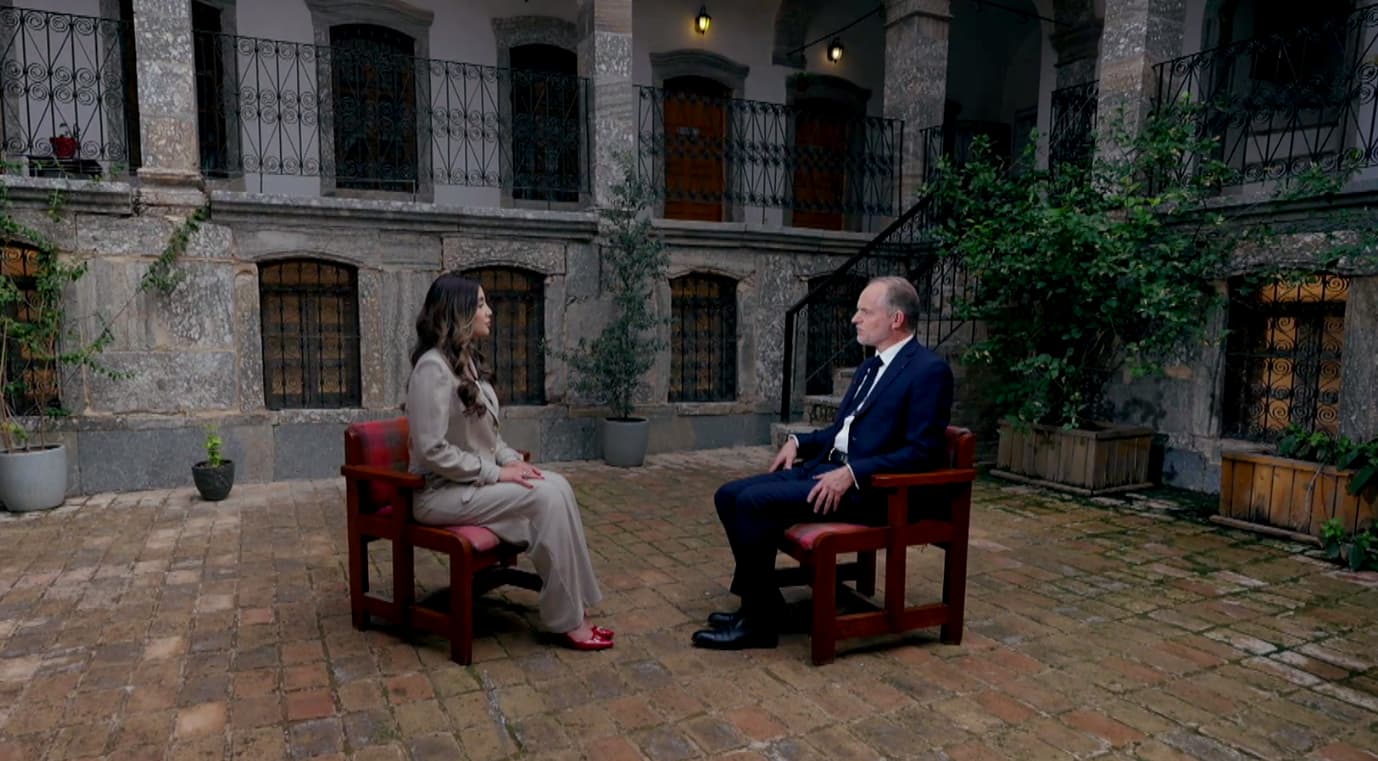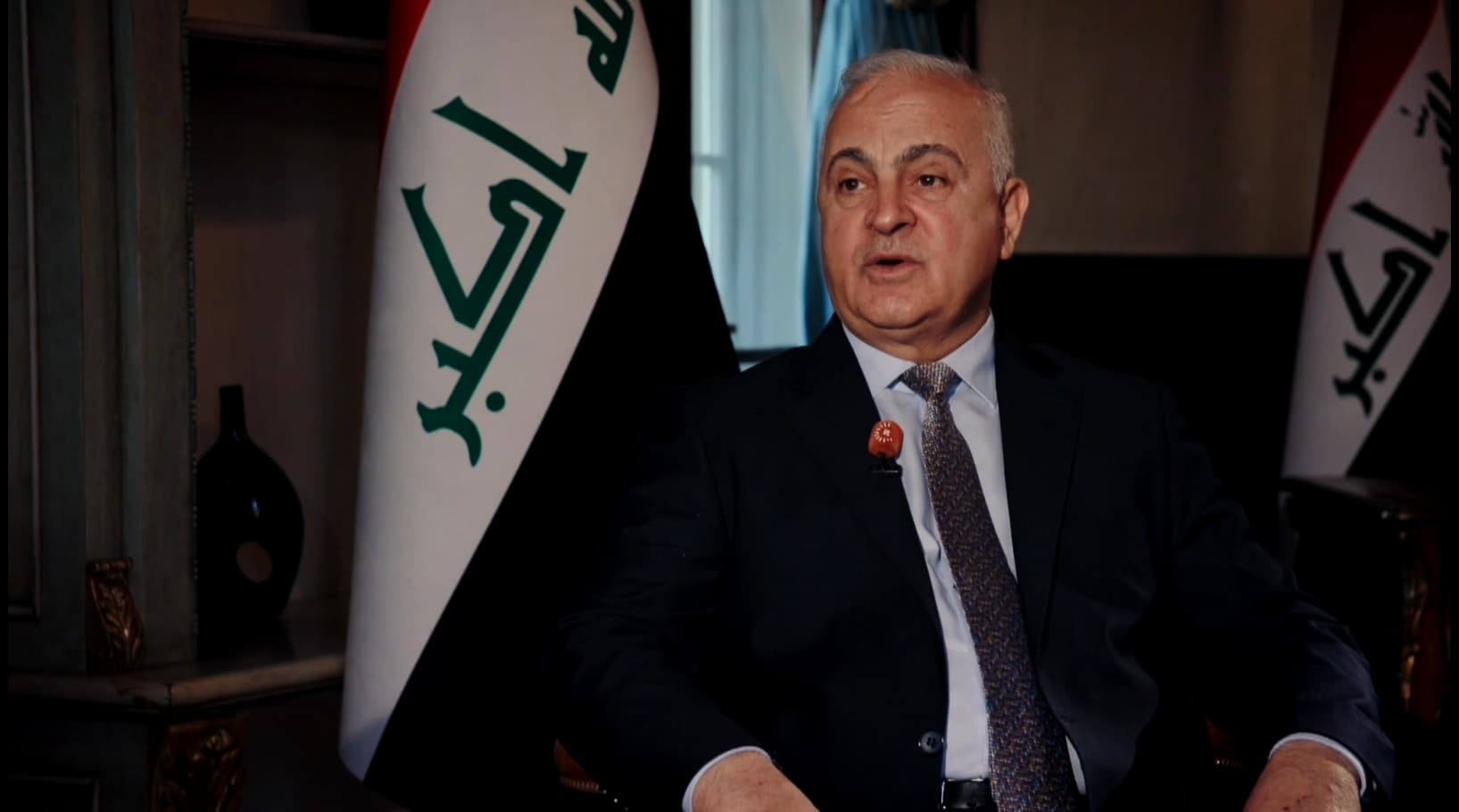

ERBIL, Kurdistan Region - Iraq and Germany are seeking to deepen bilateral relations, with Baghdad looking to expand German investment and cooperation while working with Berlin on the return of Iraqis whose asylum claims have been rejected, Iraq’s chargé d’affaires in Berlin told Rudaw.
Ali Galali said in an interview with Rudaw's Alla Shally in Berlin on September 30 that Iraqi Prime Minister Ali al-Zaidi's recent visit to Germany provided an important opening for stronger economic ties, particularly as Baghdad seeks to attract German companies to strategic sectors.
“Although the duration of the visit was short, it was very beneficial and focused,” Galali said. “I believe we will have a clear and productive beginning with Germany, and I believe Germany is also willing to engage in Iraq, especially to participate actively in specific sectors where they excel above others.”
Last month, Zaidi led an Iraqi delegation to Berlin to hold high-level talks with German Chancellor Friedrich Merz on expanding bilateral energy, trade, and security ties.
Galali said the Iraqi embassy has been maintaining contact with Germany’s Foreign Ministry, Ministry for Economic Affairs and Development, and the German Chamber of Commerce and Industry since Zaidi took office.
A meeting between the Iraqi prime minister and German business leaders was held during his visit, which Galali described as particularly significant for encouraging investment.
“We are actively working on this,” he said, adding that he is due to meet German economic officials to discuss several strategic projects in Iraq.
“The investment sector is crucial for us, because if German firms can invest in Iraq using their own capital, it benefits us greatly, benefits them, and binds the future of both countries together,” Galali said.
He added that Baghdad hopes German companies will expand their involvement in Iraq, while the embassy is working to facilitate contacts between German businesses and Iraqi institutions.
Galali also said Germany’s minister for economic cooperation and development has expressed readiness to visit Iraq in the coming months.
Migration and deportations
Migration remains another important component of Baghdad-Berlin relations, particularly following an agreement between the two countries in 2023 on the return of Iraqis who do not have the legal right to remain in Germany.
Galali said the issue extends beyond Germany and has been a longstanding point of contention between Iraq and the European Union.
“Since 2011, the European Union has been asking us to take back those citizens whose asylum claims were rejected,” he said.
According to Galali, the issue intensified in 2022, when European governments argued that Iraq was sufficiently safe for rejected asylum seekers to return.
He said an agreement reached during then-Prime Minister Mohammed Shia al-Sudani’s visit to Germany established that Iraq would accept both citizens whose asylum claims had been rejected and Iraqi nationals convicted of crimes in Germany.
“Any citizen who failed to convince the Germans and was denied asylum must return to Iraq,” Galali said, describing one of the provisions of the agreement. “Those who have committed crimes here and are convicted criminals—we will also take those criminals back.”
Galali stressed that the Iraqi government cannot legally intervene to prevent deportations ordered by German authorities.
“Legally speaking, we cannot interfere in this matter in any way, because under international law, every country can enforce its own domestic laws within its territory,” he said.
Security ties entering a new phase
Galali said Iraq’s security relationship with Germany is also changing following the conclusion of the international coalition’s main military mission in Iraq.
He said Iraq now needs to consolidate its own security institutions while maintaining the possibility of foreign advisory assistance.
“The second phase is for Iraq to stand on its own two feet,” Galali said.
He argued that domestic stability and economic development are now closely intertwined.
“What Iraq needs to do in this phase is to unify its forces. Iraq must focus on domestic security,” he said. “The second point is focusing on the economic sector to build a decent and prosperous life for the people, because we believe the economy creates security.”
Galali said foreign military forces should no longer remain in Iraq, although advisory roles could continue.
“It is possible to benefit from advisory expertise with any country; that is entirely distinct from having foreign military forces stationed on your soil,” he said.
He added that Iraq’s future relationship with Germany should therefore increasingly encompass economic, developmental and institutional cooperation.
“If the economy thrives and people enjoy peaceful, normal lives, no one can exploit them,” Galali said.
The following is a transcript of the interview with Ali Galali:
Rudaw: Mr. Ali, let us start with the problems. Many Iraqis residing in Germany have complaints regarding the Iraqi Embassy about delays in renewing their passports or obtaining their official documents. What are you doing to speed up this process, or what steps have you taken to accelerate it for citizens—especially those visiting the Iraqi Embassy from distant locations?
Ali Galali: Yes, of course, I would like to highlight a few points. One of the issues embassies in Europe have faced—and ours in Germany has faced even more—is that both passports and national identity cards are issued here in Germany. Passports are issued by us, and national ID cards are in Frankfurt, which also falls under our authority.
In fact, one of the issues that complicated the situation was that previously, the German government did not demand Iraqi documents from Iraqi citizens. Over the past two years, an enormous influx rushed toward Iraqi embassies in Europe requesting documents, particularly passports. This put immense pressure on the embassy.
The second part of the issue was that we, as the Iraqi Embassy in Germany, along with the consulate in Frankfurt, are the only ones capable of issuing Iraqi passports and national ID cards. Germany and Frankfurt alone are not enough for 22 European countries, as people from all over Europe come to us here.
In the past, we actually had only two machines/systems for issuing passports here in Berlin, and three in Frankfurt. If we operated two shifts—both mornings and evenings—these two machines could produce 80 passports a day. Producing 80 passports is simply not enough for that many people; it is very little.
Because of this, we worked with His Excellency the Minister of Foreign Affairs, with members of parliament, and with the esteemed ministers who visited here. We constantly discussed this issue, emphasizing that it requires a solution. Fortunately, recently the matter moved in a very positive direction. His Excellency the Minister met with the Iraqi Ministry of Interior, and it was decided to send 10 systems to France for issuing national ID cards, 10 to Sweden for national ID cards, and they sent staff and 8 more systems to Frankfurt.
This will alleviate the burden, and in the near future, the pressure on citizens will decrease. Although we may not be able to solve the problem completely in the short term, it is an important step forward.
Yes. So, has the issue of the electronic system and citizen appointments in Berlin and Frankfurt been resolved now, or is it being resolved?
We cannot say it has been completely resolved. Sometimes, when we open passport appointments—especially in the past, when we used to open them monthly—they would be fully booked within an hour. Within one single hour, the entire quota of around 800 passports that we could print in a month would be reserved.
However, right now, because fewer people hold the national ID card, passport appointments are in a better state than before, because people lack the national ID card. Currently, our main bottleneck is the national ID card. For that very reason, the Iraqi Ministry of Interior has now sent national ID card machines to Europe, as people need that more urgently.
Specifically, what are the most common issues that Iraqi citizens face—both Kurds and Arabs?
The problems are truly diverse. One of the primary issues is that our citizens have limited legal awareness. For example, a person comes here, books a passport appointment, provides fingerprints, and the passport is approved, but they don't check the embassy's website to see whether it has been printed or not. Or, for instance, if there is an issue with their application, a notice is posted on the website saying: "You have an issue; please come resolve it so we can print your passport." This is genuinely one of our challenges.
Our second problem is that a citizen often has lost all their documents along the way. They don't have original documents. Without original documents, you cannot officially prove someone is Iraqi unless they possess proof of Iraqi nationality.
Another issue is when a child is born here, but the parents do not have an official marriage contract.
Well, without a marriage contract, it cannot be done. What proof do I have that this child belongs to you? Under Iraqi law, this person must register a marriage contract here so we know the couple is legally married.
Another issue is when someone has a marriage contract, but they don't know how to obtain the birth certificate from the hospital, translate it into Arabic, mail it to Brandenburg to be authenticated by the German Ministry of Foreign Affairs, and then bring it to the embassy. Sometimes a person travels directly from Kiel—covering 600 kilometers—without having complete information on what to do. They arrive and are told it cannot be processed. When it cannot be done, many assume the embassy employee wants to create problems for them.
An embassy employee's job is not to cause problems for citizens. They explain: "Brother, you did not carry out your paperwork legally. You must fulfill these steps: one, two, three."
Furthermore, one of the truly unsolvable issues we face is that during the previous regime, people changed their names. Changing names is something we genuinely cannot fix. If someone only changed their own first name, they can change it legally through the courts in Iraq or the Kurdistan Region to match the name they adopted here. But some have changed their own name, their father's name, their grandfather's name, and even their birth year. We cannot resolve that.
Then what is the solution for those individuals?
As the Iraqi government, there is nothing we can do about it. I have suggested that we hold meetings with European countries and say, for example: "This person is named Abdulrahman Mohammed Salih here, but their original name is Hawkar Ahmed Salih. Let us reach an agreement with the Germans; we will take legal responsibility, bring this person's original documents, hand them over, and let them change the name back here." But will the other side accept that? Because there are legal issues here too—the person owns property under that name, has a bank account, and all their past records are under that adopted name. It creates a problem for them as well.
Mr. Ali, through Rudaw, what advice do you give to Iraqi citizens visiting the Iraqi embassies? How should they prepare? What can facilitate their visits so they don't face these obstacles upon arrival—such as missing documents, confusion, or not understanding why their procedures cannot be completed?
We have a few essential requirements, Ala Khan. Anyone requesting an Iraqi passport from us must have a national identity card.
Whoever comes here needs to bring their national ID card, their old passport, and a bank card—nothing else is required.
What if they don't have a national ID card?
If they don't have it, they must either return to Iraq—if possible—and obtain it there, or go to Frankfurt and book an appointment there. There is an electronic booking system. For example, we announce that on the 25th of the month, for example October, electronic booking opens from 12:00 pm until 6:00 pm. The person must log into the system and register an appointment.
At that point, they must have their original documents with them. They must have an original Iraqi civil status ID and nationality certificate; photocopies are not accepted. They take them to their appointment, and their national ID application is processed. Once the ID arrives, they book another appointment to have their passport issued.
That is regarding passports. As for birth registration, as we mentioned, they must follow the exact procedures outlined earlier.
Regarding another matter: we also issue a travel document known as a transit laissez-passer. A transit laissez-passer is for someone who lost their passport here or wishes to return to Iraq on a one-way trip.
If they present any Iraqi document to me, we have no issue; we issue them a travel document so they can return to Iraq and complete whatever paperwork they need there.
Very well. Mr. Ali, let us move to the issue of migrants, which is a very heated topic in Germany. Recently, there was an agreement between Iraq and Germany regarding the return of individuals or Iraqis who do not have the right to remain in Germany. Have a number of them been returned so far? How many people have returned to date? Will others be deported to Iraq? Can you tell us?
Of course, that was an issue concerning the European Union in general, not just Germany. Since 2011—His Excellency the Minister once mentioned in a joint meeting: "Since 2011, the European Union has been asking us to take back those citizens whose asylum claims were rejected." We managed to stall the matter with them from 2011 until 2022.
In 2022, the European Union's patience ran out. They stated that Iraq is now considered a safe country with no major security problems, and that we must take back our citizens. At that time, His Excellency the Prime Minister, Mr. [Mohammed Shia] al-Sudani, visited Germany. A memorandum of understanding was signed between the Iraqi government and the German government, and we agreed on two points: First: Any citizen who failed to convince the Germans and was denied asylum must return to Iraq. Second: Those who have committed crimes here and are convicted criminals—we will also take those criminals back.
So far, according to that decision, the German government legally states that those without asylum status must return. From a legal standpoint, we cannot prevent this, because it is the domestic legal decision of their own country, and we have no authority to obstruct it.
Meaning you cannot help those individuals who are currently facing the threat of deportation and wish to stay in Germany?
Legally speaking, we cannot interfere in this matter in any way, because under international law, every country can enforce its own domestic laws within its territory.
However, we have spoken to them regarding specific humanitarian cases—for instance, individuals with severe medical conditions whose lives would be at risk if returned. Or, for example, families, where we told them: "A family must not be separated or torn apart. A family must stay together; either the entire family returns, or the entire family stays."
Regarding families and sick individuals, they genuinely cooperate with us and listen to our requests so far. But that is based on their own conviction. They do it out of conviction, based on our humanitarian appeals.
So in those cases, how can you assist?
Meaning they assisted us, not that we assisted them. Because the decision lies in their hands, not ours.
Let us turn to the visit of the Iraqi Prime Minister to Germany. Can we now say what the foundation of bilateral relations between Berlin and Baghdad is, or in what direction they are heading? How significant was that visit?
In fact, right after the election of His Excellency the Prime Minister in Iraq, we were in contact with the Germans—with the Foreign Ministry, with the Ministry for Economic Affairs and Development, and with the German Chamber of Commerce and Industry. We held several preliminary meetings regarding this matter.
They had high hopes following the Prime Minister's election in Iraq because they were pleased that he possessed an economic background. Upon the invitation sent by the German Chancellor to the Prime Minister, His Excellency visited Germany.
Although the duration of the visit was short, it was very beneficial and focused. We organized a very important event with the Chamber of Commerce, gathering all major German business leaders and industrialists. The Prime Minister was very pleased with it. I believe we will have a clear and productive beginning with Germany, and I believe Germany is also willing to engage in Iraq, especially to participate actively in specific sectors where they excel above others.
As we all know, Germany possesses massive industrial giants like Siemens and many others. How is the Iraqi Embassy working to encourage German companies to invest in Iraq and the Kurdistan Region? Also, I would like to know what happened to the contract between Siemens and Iraq. That is also important.
Very well, let us talk about Siemens first. The contract signed this time with Siemens was its fourth phase, related to the energy sector—foremost among them, electricity. Siemens is currently working in Iraq, and its projects are progressing. We are pleased and look forward to them undertaking larger and better work in the future. That is regarding Siemens.
Regarding what we have done to encourage capable German companies to go to Iraq: just today, I met with the Minister of Economic and Development. During our discussion, I said: "We have invited you to visit Iraq."
She replied: "I am ready, and with pleasure, I will visit." It is likely that she intends to visit Iraq in the coming months. We had already planned this visit beforehand, but she herself—having previous ties and affection—genuinely holds goodwill toward Iraq and wishes to visit.
That is the first part. Second, I am scheduled to hold a meeting with their Ministry for Economic Affairs in the coming days. There are several strategic projects in Iraq that we will discuss with them, particularly in the field of investment. The investment sector is crucial for us, because if German firms can invest in Iraq using their own capital, it benefits us greatly, benefits them, and binds the future of both countries together.
We are actively working on this. We maintain continuous contact with the Chamber of Commerce, particularly here. I have a commercial attaché—a very sharp, active woman who does excellent work. We enjoy very good relations with companies, and we hope to see tangible results in the near future.
Very well. Let me ask another question, Mr. Ali, which is also important and relevant to today: the formal timeline regarding the conclusion of the international coalition's mission in Iraq. How will the security relations between Baghdad and Berlin be framed? Will Iraq request Germany to maintain a presence or provide military assistance? Will assistance continue to be provided to the Peshmerga? Did you discuss this with the German Chancellor?
Look, Ms. Alla, to be honest, I was not present in the closed meetings where that specific topic was discussed. However, we must recognize two points: The first phase, which consisted of the coalition forces assisting Iraq—led by the United States, alongside Germany and all participating nations—has come to an end. We thanked them for assisting us in confronting terrorism. The second phase is for Iraq to stand on its own two feet. Standing on its own feet.
Has Iraq managed to do that?
It has its own forces; yes, it has its own forces. What Iraq needs to do in this phase is to unify its forces. Iraq must focus on domestic security. Internal security is vital for Iraq today. I believe the Prime Minister is working on that matter right now: maintaining internal security.
The second point is focusing on the economic sector to build a decent and prosperous life for the people, because we believe the economy creates security. If the economy thrives and people enjoy peaceful, normal lives, no one can exploit them.
Meaning relations between Germany and Iraq will remain confined to an economic and framework, or can Germany still assist Iraq militarily?
In the military domain, all foreign forces must leave Iraq today. Today, the timeline dictates that foreign troops should no longer remain in Iraq. What remains may be advisory roles in certain areas. It is possible to benefit from advisory expertise with any country; that is entirely distinct from having foreign military forces stationed on your soil.
Mr. Ali, I would also like to ask this: Germany has a major academic and scientific standing. Does your embassy or government have any initiative to connect with or organize the potential of Iraqi postgraduate students and academics in Germany, so that Iraq can benefit from them in education and science? Do you have any programs?
Certainly. Here at the embassy, we have a cultural section. One of the primary duties of the cultural attaché is opening academic files for students studying in Germany—tracking their fields of study and programs. When they complete their degrees, we authenticate their diplomas here and send them back. That is the first part.
The second part—whether the embassy or the Iraqi government can utilize these talents—in my personal view, depends on the overall conditions in Iraq. If the situation in Iraq progresses toward greater stability and economic development takes place, Iraqi citizens will naturally return to their homeland. At that point, the Iraqi government will certainly welcome them with open arms. The government would be delighted to see its own specialized citizens working in various sectors rather than relying on foreign expertise.
Very true. Well, how is your connection with the new generation born here? What do you do for them? For instance, do you have programs to preserve their language or maintain their ties to their homeland? Do you have any initiatives?
In fact, that is also one of the important duties of the embassy. But to be completely candid, the current period we are living in is economically challenging, and that requires a budget. Otherwise, it is on our agenda.
In the future, for those who naturally show interest and willingness to learn their mother tongue, remain connected to their culture, and identify with their country—at least culturally, linguistically, and historically—we have plans for that. We hope to be able to implement them in the future.