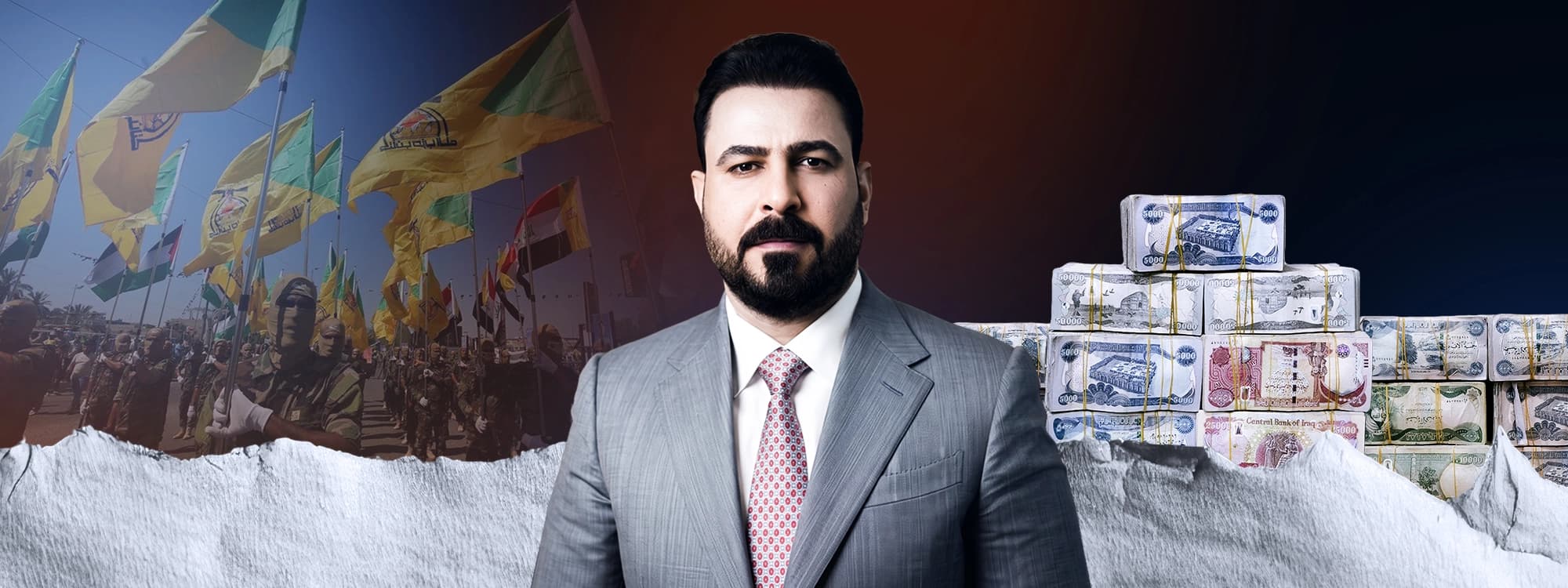

ERBIL, Kurdistan Region - Iraqi Prime Minister Ali al-Zaidi’s efforts to dismantle the economic networks of powerful Iran-aligned armed factions have triggered an escalating confrontation with Kataib Hezbollah (KH), which has retaliated by questioning the origins of his personal wealth and scrutinizing his family’s business interests.
The standoff comes as Baghdad faces mounting US pressure to curb Tehran’s influence in Iraq, where armed groups such as KH have become deeply embedded in state institutions while maintaining military capabilities outside government control. Some Iran-backed factions have also been implicated in drone and missile attacks against neighboring countries, drawing Iraq further into the regional confrontation between Washington and Tehran.
The dispute intensified over the weekend after Zaidi cancelled three commercial contracts at Mosul International Airport over suspected militia links and moved to eliminate intermediaries from government defense procurement. KH responded with allegations that the premier and his associates had amassed fortunes worth trillions of dinars. The confrontation coincides with a broader American campaign to squeeze Iran’s regional networks, including pressure on Baghdad to close most of its border crossings with Iran.
On Saturday, US Central Command announced the establishment of Task Force Iron Gate, aimed at disrupting the movement of advanced weapons, sanctioned goods and illicit revenue across Iran’s land borders. For Zaidi, the challenge is increasingly one of asserting state authority over armed factions whose political, military and financial influence has become deeply entrenched in Iraq. Iran-backed armed factions have developed extensive political and commercial networks over the past decade, deriving income not only from government contracts but also, according to research institutions, from border crossings, checkpoints, and other economic activities.
The timing of the accusations, the institutions being targeted, and the involvement of media aligned with pro-Iran factions suggest that the confrontation is extending beyond the government's efforts to bring weapons under state control to a contest over economic interests and political influence.
Government moves against militia-linked contracts
On Thursday, Zaidi directed Iraq's Defense Industries Commission to deal directly with manufacturing companies rather than commercial intermediaries, in an effort to improve transparency and reduce opportunities for corruption in military procurement.
The London-based, Saudi-owned newspaper Asharq Al-Awsat reported on Friday that some intermediary companies were linked to the economic interests of armed factions, citing “informed” but unnamed sources.
The newspaper reported allegations that some businesses were associated with al-Muhandis Company, an economic enterprise established under the Popular Mobilization Forces (PMF), or with companies operating within its wider network.
One source alleged that such businesses provided armed factions with two sources of financing: revenues from government contracting and money laundering involving proceeds from illicit activities, including oil and drug smuggling.
Rudaw English could not independently verify claims by the Saudi outlet.
The following day, Zaidi ordered the cancellation of three contracts at Mosul International Airport, involving Sky Plus, which leased passenger counters; Sama al-Matar, which operated the airport's uncovered parking area; and al-Faisal al-Shamikh, which held a taxi-service concession.
The government cited alleged links to armed groups and directed that the services be contracted to international companies. Neither the government nor Nineveh's provincial authorities publicly identified the factions allegedly benefiting from the arrangements.
The Federal Commission of Integrity had separately begun examining airport and Transport Ministry contracts amid suspicions that some financial arrangements benefited armed groups, according to information attributed to an unnamed source by the Iraqi News Agency (INA).
From militia accusations to parliamentary scrutiny
The latest government decisions were followed by a sharp response from KH, one of Iraq's most powerful pro-Iran armed factions.
On Saturday, the group's security chief, Abu Mujahid al-Assaf, questioned how Zaidi had allegedly accumulated a fortune of nearly 21 trillion dinars (approximately $14 billion), demanding an investigation into the prime minister and his brother Hassan al-Zaidi, a senior official in the Prime Minister's Office.
"How was your massive financial empire built ... amounting to nearly 21 trillion dinars?" Assaf asked in a statement published on Telegram.
He questioned whether the alleged fortune had been accumulated through contracts involving Iraq's public food distribution system, military catering, or other government business.
The security chief also denied that KH controlled airport contracts, describing allegations about the faction's commercial interests as an attempt to discredit it.
The next day, Saud al-Saadi, deputy head of the KH-affiliated Huquq parliamentary bloc and a member of parliament's Integrity Committee, formally raised similar questions.
In two sets of parliamentary questions addressed to the prime minister and the Federal Commission of Integrity, Saadi sought clarification of the widely circulated 21 trillion dinar figure and demanded details of Zaidi's financial interests before and after assuming office.
"How true is this information, and has your Commission investigated them?" asked the parliamentarian, requesting disclosure of the prime minister's total wealth before his nomination for the premiership and his financial disclosure form submitted to the commission itself.
The documents, dated November 8 and bearing Saadi's signature, also sought information about companies, commercial projects, universities, banks, and shares registered to the prime minister and his immediate family.
The lawmaker specifically raised questions about al-Oweis General Trading Company and South Islamic Bank, including their capital, ownership, and commercial relationships with government institutions.
He asked whether contracts involving al-Oweis and the Ministry of Trade represented conflicts of interest under Iraq's Federal Commission of Integrity and Illicit Gains Law No. 30 of 2011, as amended.
The law, amended in 2019, requires senior officials, including the prime minister, to disclose their financial assets and prohibits conflicts between public duties and private financial interests. It defines a conflict of interest as a situation in which an official, their spouse, children, or relatives up to the second degree have a financial interest that conflicts with their public position. Under Article 20, officials found to have such a conflict must either relinquish the conflicting interest or leave office within a period specified by the Integrity Commission. The law also provides penalties for illicit enrichment, which is set at a 20 percent increase while holding office, and deliberately concealing financial information.
Saadi also requested clarification of whether Zaidi had submitted his financial disclosure within the legally prescribed period and whether any conflicts of interest had been addressed.
The parliamentary questions are significant because they move accusations initially circulated by an armed faction into a formal oversight process.
However, the 21 trillion dinar figure remains an allegation rather than an established valuation of the prime minister's assets.
Zaidi's office announced on May 21 that he had submitted his financial disclosure to the Federal Commission of Integrity and pledged to resolve legally prohibited conflicts of interest. The announcement did not publicly disclose the value of his assets or the details of his business holdings.
Media campaign scrutinizes Zaidi's business interests
The confrontation has also extended into social media, where platforms sympathetic to Iran-aligned factions have circulated increasingly personal allegations about Zaidi's wealth.
Sabreen News, a prominent Telegram channel associated with Iraq's so-called resistance factions, published an infographic comparing Zaidi's alleged wealth with that of US President Donald Trump.
The graphic claimed that Zaidi began his business career in 2009 at the age of 23, spent just 10 years in commercial activity, and accumulated $13 billion. It contrasted those claims with Trump's longer business career and a stated fortune of $6.3 billion.
The accompanying post asked how such fortunes were accumulated and invited comparisons between the two men's business histories.
The figures were presented without independently verifiable financial records establishing Zaidi's net worth. The comparison itself is part of the attempt to portray the prime minister's alleged wealth as extraordinary and deserving of investigation.
In another post, Sabreen News alleged that a digital real estate platform was owned by the National Information Technology Company, which it said was registered under file number 69536 in the name of Alaa Shaghati Kazim al-Zaidi, whom it identified as a cousin and relative by marriage of the prime minister.
The Telegram channel further alleged that the businessman held interests in the National Holding Company for Glass Industries, registered under file number 66657, alongside several individuals, including Hassan Faleh Kazim al-Zaidi, the premier's brother.
Sabreen questioned whether the alleged business relationships constituted conflicts of interest, particularly because real estate platforms can involve sensitive information relating to property ownership and official transactions.
It called on the Supreme Judicial Council and Federal Commission of Integrity to investigate the ownership structures, partnerships, and contracts involved.
The allegations come as Zaidi has championed the Watan (homeland) initiative, which aims to distribute one million free residential plots for eligible Iraqi families, alongside plans to provide supporting infrastructure.
The government has said the initiative would rely on electronic registration and property databases to determine eligibility and prevent multiple allocations.
The Justice Ministry announced in July that its Real Estate Registration Department had begun preparing ownership records to support the project.
There is, however, no verified evidence that the company mentioned by Sabreen operates the Watan initiative's registration system or benefits from its contracts.
Separately, the militia-affiliated Naya for Iraq Telegram channel circulated a claim attributed to Instagram account “Iraq Co” that Zaidi had been seen using a specially equipped BMW M-series vehicle worth approximately $190,000, bearing the distinctive registration number "1 Dhi Qar."
The post alleged that such a registration plate would cost at least $1 million. The post illustrated how the campaign has expanded from scrutiny of commercial contracts to the prime minister's personal possessions.
Videos showing the prime minister driving a BMW through Baghdad without a convoy have circulated on social media.
Economic networks of armed militias
Research by international policy institutions provides broader context for why government contracts and border crossings are politically contentious.
In a 2021 report titled Networks of Power, Chatham House researcher Renad Mansour documented how PMF-linked networks generate revenue through state institutions, contracts, internal checkpoints, and border crossings.
The report cited former finance minister Ali Allawi's estimate that Iraq should collect approximately $9 billion annually in customs revenues, while only around $1 billion reached government coffers at the time. The remainder, Mansour explained, was captured by overlapping networks of political parties, armed groups, businesspeople, and state officials.
A separate 2019 Chatham House study identified KH, the Badr Organization, Asaib Ahl al-Haq (AAH), and Saraya al-Salam among powerful groups benefiting from checkpoint revenues.
Meanwhile, a 2022 Carnegie Middle East Center report documented the influence of Iran-backed armed groups around the Shalamcheh border crossing with Iran.
The researchers found that armed groups maintained influence through security personnel and commercial relationships even where the crossing was formally administered by the Iraqi government.
The dispute over economic control has also emerged at the Sheeb border crossing between Iraq's southeastern Maysan province and Iran.
Baghdad closed the crossing on October 21, citing inadequate technical and security infrastructure. Reuters reported that authorities intended to install detection equipment to prevent the smuggling of prohibited materials.
The closure prompted protests by traders and truck drivers, while Maysan Provincial Council head Mustafa Daeer Mohammedawi, who is affiliated with AAH, threatened civil disobedience unless the crossing reopened.
Zaidi's office subsequently filed a complaint over the threats, and an Iraqi court issued an arrest warrant for the provincial council chief. Mohammedawi was briefly detained.
The controversy also became diplomatic after an adviser to Zaidi alleged that narcotics and counterfeit currency were entering Iraq through the crossing. Iran's embassy rejected the accusations.
Iran-aligned political groups have increasingly challenged the closure. On Sunday, the Badr parliamentary bloc demanded the reopening of crossings with Iran and rejected what it characterized as American pressure on Baghdad.
The AAH-affiliated Sadiqoun bloc separately called for a clear timetable for reopening Sheeb and compensation for those affected by its closure.
The economic confrontation has unfolded alongside Zaidi's efforts to bring weapons outside state control under government authority, a process resisted by several Iran-aligned factions.
Washington has publicly supported the latest measures. On Sunday, US envoy Tom Barrack praised the cancellation of the Mosul airport contracts, describing it as "sovereignty in action" and saying militia influence had no place in Iraqi institutions.
Barrack visited Zaidi in Baghdad on Thursday, with the meeting focusing on bolstering bilateral relations.
For the armed factions, losing access to government contracts and commercial arrangements could carry consequences beyond financial revenue. Economic networks also provide employment, political patronage, and influence within state institutions.
For Zaidi, the dispute presents a test of whether his government can enforce restrictions on armed factions' economic activities while maintaining the support of a ruling political coalition that includes parties closely associated with those groups.
The struggle between Baghdad and Iran-aligned armed factions is no longer confined to weapons and security. It is increasingly extending to government contracts, commercial networks, border revenues and the financial interests that underpin political power in Iraq.