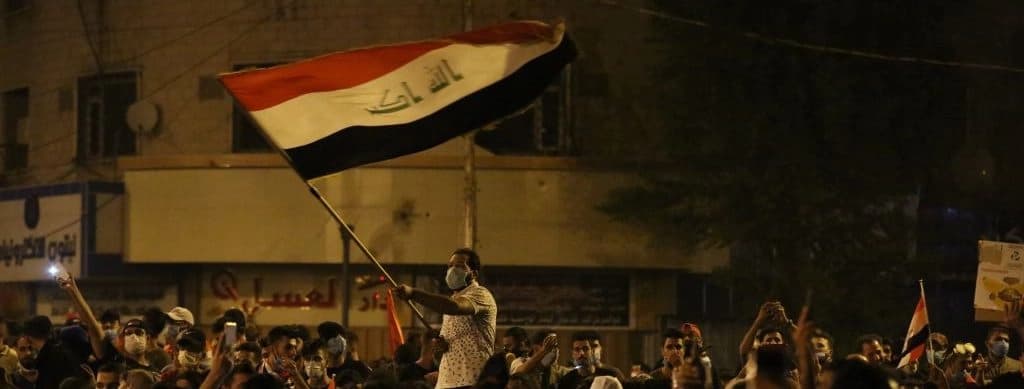

In less than a decade, the Iraqi government rather than the Central Bank of Iraq (CBI) has changed the value of its currency against the dollar three times. On October 7, it brought the value of the dinar back to the levels seen in the immediate aftermath of the fall of the Baath regime. Beyond raising questions about the independence of the central bank, covering the government’s spending capacity, and eroding citizens' purchasing power, the depreciation of the dinar triggers severe consequences. These include sluggish trade and market activity, rising poverty and unemployment, a decline in foreign exchange reserves, and the withdrawal of investors.
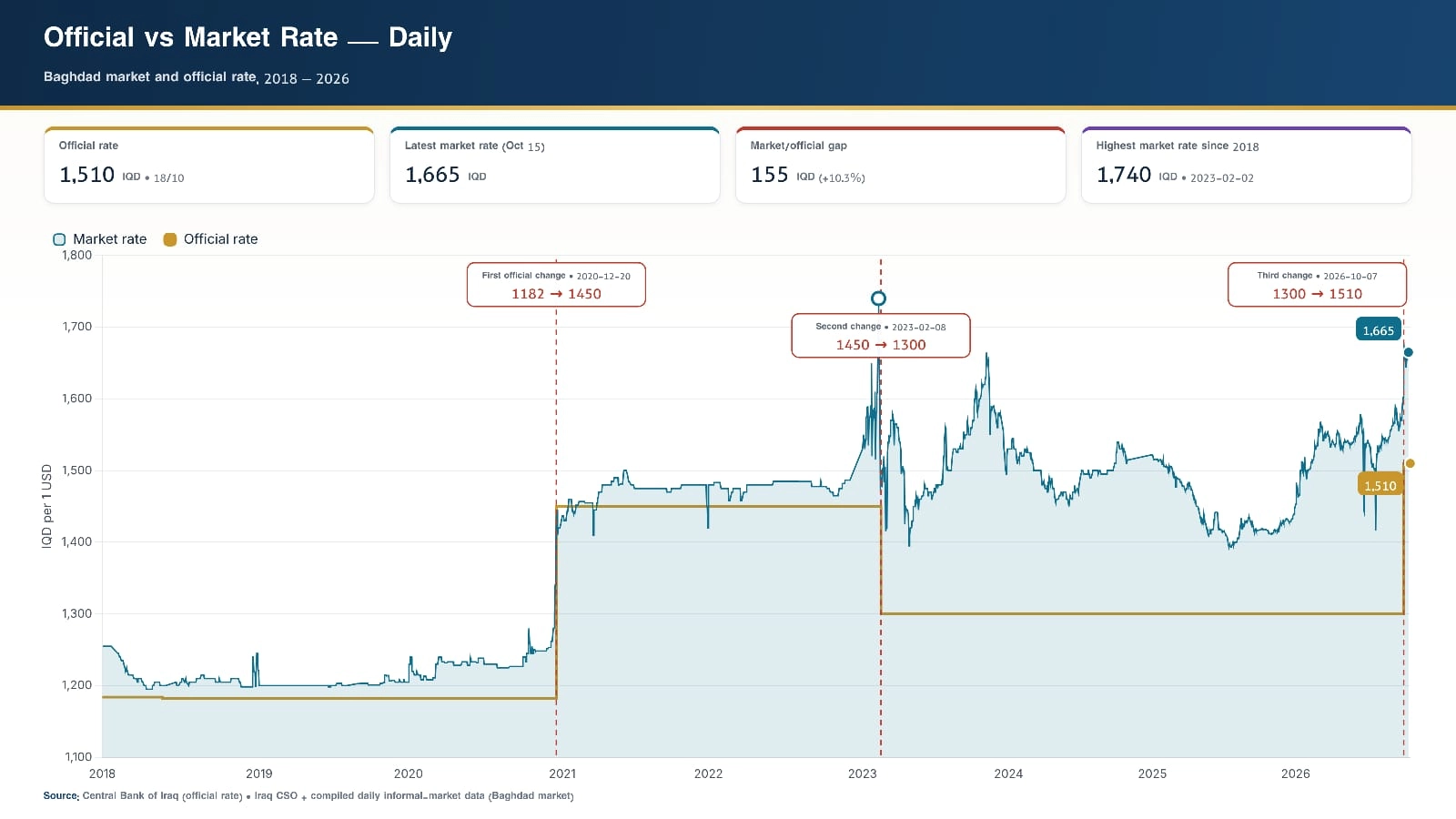
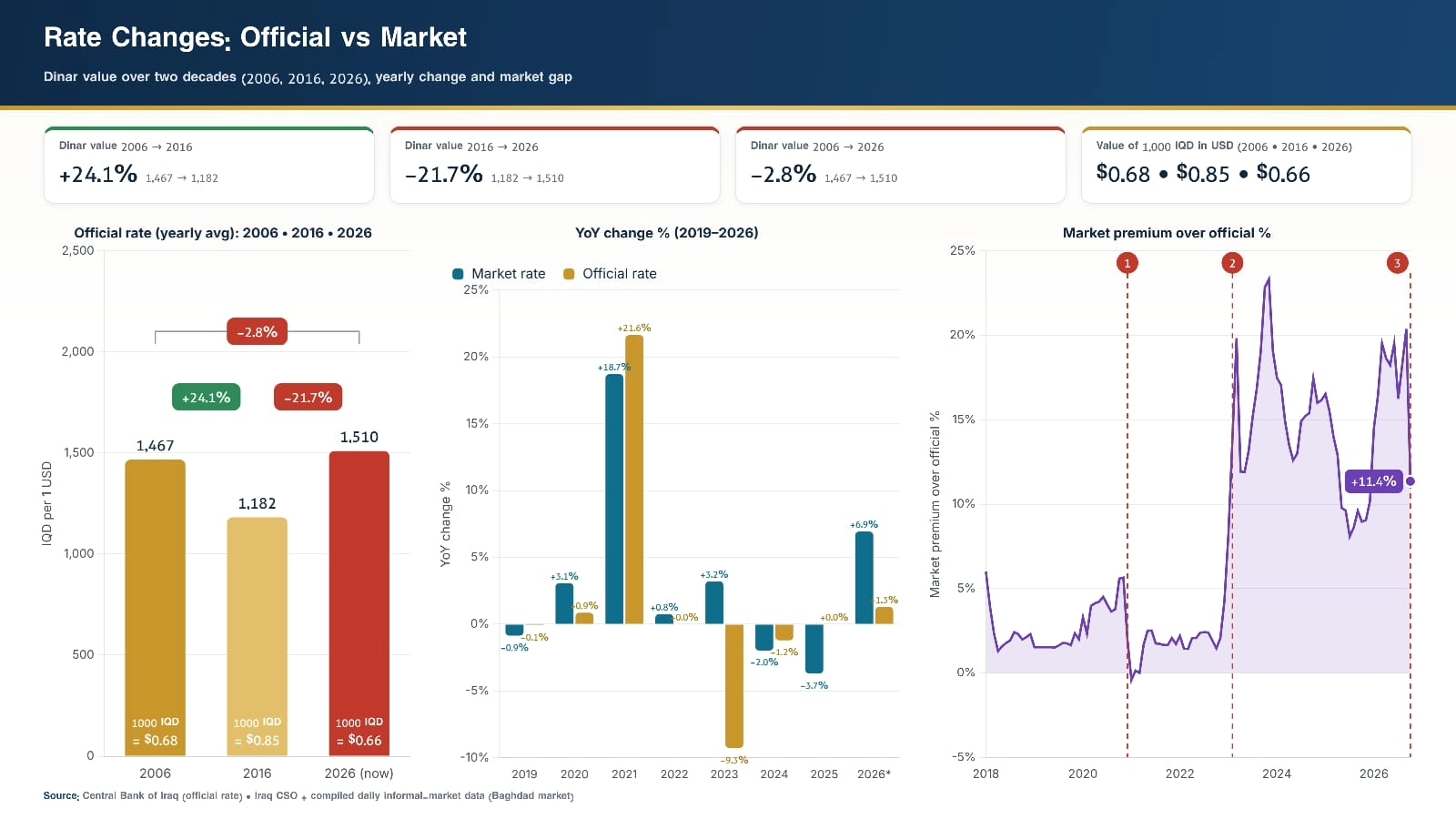
In the early years between 2004 and 2007, the exchange rate of one US dollar hovered between 1,450 and 1,500 dinars. Later, changes occurred; from August 2008 until 2020, the rate stayed between 1,150 and 1,200 dinars. In July 2020, the rate was raised, setting each dollar at 1,450 dinars, marking the emergence of a gap between the official and market rates. Subsequently, in February 2023, the rate was lowered to 1,310 dinars, but on the 7th of this month, the official rate was once again raised to 1,510 dinars. This roller coaster of dinar valuations by the government has not stemmed from a clear economic strategy; instead, it is tied to oil revenues. When oil revenues drop, the dinar's value is depreciated, and when revenues rise, the dinar's value is appreciated. But will this policy be sustainable indefinitely?
According to data from the CBI and the Central Statistical Organization, the gap between the official and market rates was very narrow during the first- and second-rate adjustments. However, starting with the 2023 adjustment, this gap has widened significantly and remains uncontrollable to this day.
The International Monetary Fund (IMF) measures countries' currency indexes against five major global economic currencies (US dollar, Japanese yen, Chinese yuan, British pound, and euro), known as the Special Drawing Rights (SDR). This index reveals the weakness or strength of national currencies, and Iraq is among the countries whose currency has drifted toward weakness.
Now, the core question is: Does this depreciation have only short-term dimensions, or does it carry long-term ones? What dangers does this currency manipulation based on oil revenues create, and what will its short- and long-term ramifications be on the Iraqi economy?
Short-term dimensions
Currently, the market rate of one dollar is around 1,685 dinars, while the Central Bank rate stands at 1,510 dinars. Compared to the previous period, the gap has narrowed by 10 percent because prior to this new change, the official rate was 1,310 dinars and the market rate was 1,550 dinars. It is true that this latest depreciation has halved the gap between the official and market rates so far, but can the government sustain this and prevent the gap from widening further?
In reality, the figures from official and market rate data show that this instability has caused the percentage gap between the official and market rates to grow year after year. This poses the greatest threat to market control and monetary policy. In short, the relationship between the central bank and the market is unhealthy, and a robust parallel market has emerged in the country—something unseen in any nation where the government fixes its currency's value, with the closest examples being Iraq's neighboring Gulf states.
On the other hand, there should not be a gap between the central bank rate and the market rate because the Iraqi dinar is not like the Turkish lira or the Iranian rial, where the market system determines the rate. Rather, ever since the fall of the Baath regime, the central bank—or more accurately, the government—has directly set the rate.
First dimension: The leaking of the decision to change the dinar's value first from parliament, then in official government publications, and subsequently from the central bank has raised a critical question: Is the CBI an independent institution, or is it part of the ruling power's administrative structure?
Under the law, the CBI is an independent financial and administrative institution. The 2005 Iraqi Constitution (Article 103) explicitly states that the central bank is independent and accountable to the House of Representatives (parliament), not the executive branch. Furthermore, Central Bank Law No. (51) of 2004 granted it independence to manage monetary policy, control inflation, maintain currency stability, and supervise commercial banks.
Past shifts—whether in 2020 when the dollar was moved from 1,180 to 1,450 dinars, or currently when it was shifted from 1,310 to 1,510 — dinars were primarily government maneuvers to increase domestic revenues (in dinars) rather than pursuits of sound economic policy. On both occasions, the decision followed a drop in oil revenues: once due to the COVID-19 pandemic and falling oil prices which dragged revenues down to $41 billion, and another time due to regional tensions and threats surrounding the Strait of Hormuz, which reduced Iraq's exports and revenues. Conversely, the appreciation of the dinar in 2023 (from 1,450 to 1,310 dinars) was likewise driven by oil, but this time oil revenues surged to $115.7 billion, rather than resting on structural monetary reforms.
Second dimension: Past experience has demonstrated that when revenues fall, instead of pursuing structural reforms such as cutting expenditures, diversifying and increasing revenues, and reorganizing taxation, the government takes the easiest route: altering the value of the dinar against oil dollars. This allows it to boost dinar revenues by 200 to 400 billion dinars for every billion dollars.
Third dimension: When a currency's value is depreciated by over 14 percent, it means inflation surges. In an economy like Iraq, where even domestic production relies on importing raw materials from abroad, this directly leads to skyrocketing commodity prices and a shrinking of citizens' purchasing power.
Long-term dimensions
Depletion of Iraq's Foreign Exchange Reserves: At the outset of regional tensions and uncertainties surrounding the Strait of Hormuz, which caused a drop in oil exports, Iraqi officials spoke of reserves exceeding 130 trillion dinars (roughly $100 billion). However, according to the central bank, these reserves dropped to 98.8 trillion dinars by the beginning of this month. At the new exchange rate, the real value of these reserves further shrinks to $65 billion. In the event of a halt in oil revenues, Iraq would be unable to rely on them even for a single year, let alone invest them for future generations.
Sluggish trade activity: Iraq spends between $50 billion and $75 billion annually to import 1,100 to 1,200 types of goods. When the cost of imported goods rises by 15 percent at the official rate and up to 25 percent at market dollar rates, demand for goods drops. This directly translates into sluggish commercial activity.
Capital flight and losses for traders: This instability drives away investments and harms merchants because these fluctuations inflict heavy losses on companies. For example: If a company needed 130 billion dinars on November 6 to remit $100 million, but its transaction fell on November 8, it would need 151 billion dinars. This difference (21 billion dinars) represents a direct loss of corporate capital, weakening the investment climate and discouraging investors.
Surging poverty and unemployment: When purchasing power falls and prices rise by 15 percent to 25 percent, families that recently crossed above the poverty line fall back below it, as government salaries and aid remain fixed while the cost of living escalates. Simultaneously, market stagnation and the high cost of raw materials, fuel, and administration impair local factories and companies from competing with foreign goods, forcing them toward production cutbacks and shutdowns. This significantly ramps up unemployment, compounding the fact that Iraq's unemployment rate is already double that of most Middle Eastern and North African countries, sitting above 15.5 percent.
Impact on the banking sector and financial trust: Beyond all the above, these decisions directly erode citizens' trust in the domestic banking system. When citizens feel that the value of their dinar savings in banks is declining, they resort to financial hoarding (holding foreign currency or gold at home). This drains dinar liquidity away from the central bank and commercial banks, thoroughly crippling their capacity to extend credit and investment loans.
Currencies worldwide and Iraq: why are most in decline?
According to the latest statistics and data from the International Monetary Fund (IMF) and the World Bank Group examined and evaluated changes in 227 global currencies between 1950 and 2026 the global financial and monetary system has faced a profound collapse in real value. Out of the total currencies, 186 currencies (approximately 69 percent of all global currencies) have lost a major portion of their value and trended downward. In contrast, only 45 currencies managed to preserve their stability or strength.
Furthermore, the IMF relies on a special calculation metric known as SDR. The value of the SDR in dollars is calculated using the following scientific equation to measure the strength or weakness of national currencies against the global economy as a whole:
{SDR in Dollars} = sum (Amount of each currency} * {Its value in dollar})
Based on this metric, the fluctuations in the Iraqi dinar's value over past years indicate a decline in the currency's real weight against global currency baskets, posing a genuine threat to future purchasing power and monetary stability in Iraq.
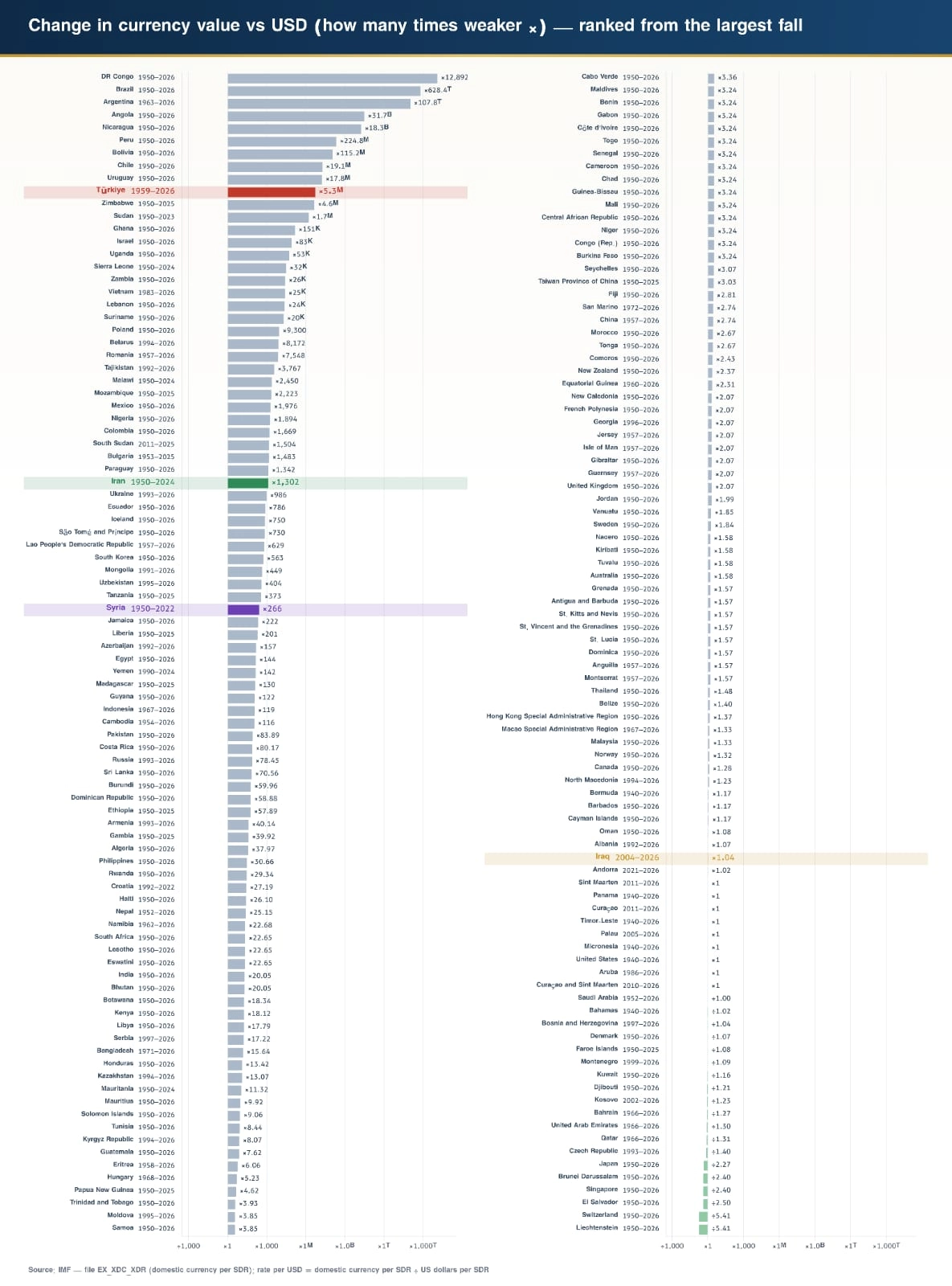
Data also highlights various reasons behind currency depreciations worldwide, demonstrating that currency collapses are not merely domestic phenomena, but rather continuous processes driven by global inflation, central bank policy errors, and political instability. For instance, since the beginning of this period, the Democratic Republic of the Congo has recorded the largest currency collapse in history, with its currency dropping more than 12,000-fold. Conversely, the Swiss franc has stood as one of the world's strongest financial fortresses, offering a successful model by multiplying its value.
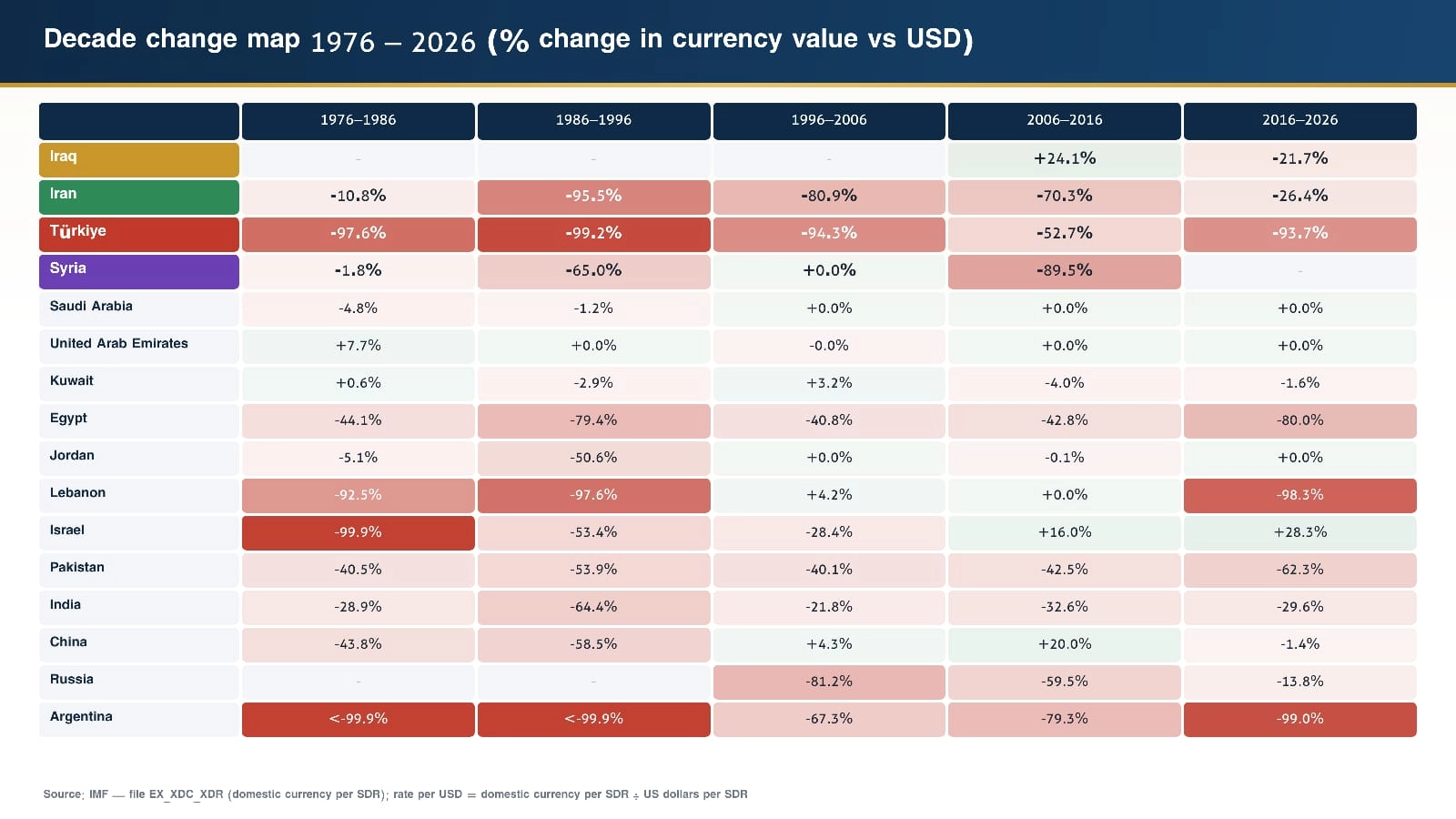
In the Middle East region excluding the Gulf Cooperation Council (GCC) countries whose currencies have remained stable and undepreciated against the dollar most regional currencies have suffered severe declines. In terms of the severity of this depreciation between 1950 and 2026, Turkey ranks first, followed by Iran in second place, Syria in third, and Iraq taking its place within this equation alongside the general 69 percent depreciation trend and historical comparisons.
The fundamental reason for this vast divergence between Middle Eastern nations and developed countries lies in the region's total economic reliance on a single source of income, the absence of a diversified industrial production system, and persistent instability. When external revenues falter or geopolitical crises erupt, these countries' currencies are the first victims to fall into a wave of collapse.
Conclusion
Although lowering the dinar's value by the government is used in the short term as a tool to cover budget deficits and secure public servant salaries, as the Prime Minister Ali al-Zaidi pointed out in his parliamentary briefing, it paralyzes the Iraqi economy over the long term. This unstable monetary policy reduces citizens' purchasing power and drives up poverty and unemployment on one hand, while weakening the investment climate for domestic and foreign capital on the other.
From an economic infrastructure standpoint, Iraq's complete dependence on oil revenues and the importation of goods means that devaluing the dinar does not spur domestic production growth; instead, it merely generates imported inflation. Until Iraq reforms its production, fuel, and administrative sectors, any depreciation of the dinar will only weigh heavier on the shoulders of its citizens.
Ultimately, Iraq's continuation in this cycle of currency valuation roller coasters hinges on the genuine independence of the central bank from political decisions and the formulation of a diversified economic strategy. Without these, leaving the dinar's value at the mercy of oil prices and domestic/external events will steer the country's economy toward deeper crises and more dangerous social consequences.