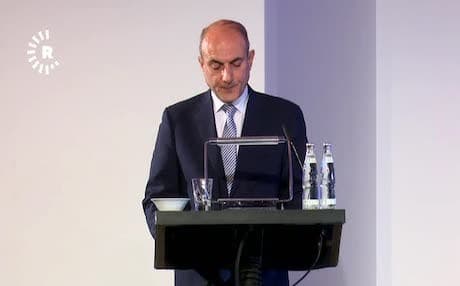

Sindi commenced the first 'Businessmen & Investors Conference: Germany - Iraq - Kurdistan Region' (BICGIK) with a 10-minute speech explaining the Region's past, current, and future economic outlooks to the crowd.
"Germany, as it has always been supportive to the Kurdistan Region, is invited to contribute through the wide experience of its companies, investors and institutions. People of Kurdistan have proved in the past that they can be relied on and they remain so in the future,” he said.
Sindi explained that Germany can stimulate non-oil sectors in the Kurdistan Region like those of agriculture, industry, infrastructure, and tourism.
"The non-oil trade exchange value for the Kurdistan Region of Iraq for the first six months of 2017 through different border gates and airports crossed $8 billion dollars. And the estimation for the second part will be doubled,” he said.
As Kurdistan approaches its independence referendum on September 25, Sindi said, "We are committed to promote business development with all our surroundings and beyond."
The minister elaborated that 100 companies from the Kurdistan Region, 40 companies from other parts of Iraq, and around 100 companies from Germany are currently doing business together.
"It's a clear sign that Kurdistan will remain a strong partner for development for all,” he added.
The Kurdistan Region of Iraq, Sindi explained, has suffered "decades of oppression, neglect and under-development."
"Its infrastructure used to be one of the most under-developed. Roads, electricity, water, sanitation, schools, hospitals and all the sectors were very much behind far from the basic needs of the population,” he recalled.
Sindi expressed because of the establishment of the Kurdistan Regional Government (KRG) in 1992 and other developments many things have changed.
"Through a safe and stable environment — a pluralistic political system — investment was promoted," Sindi said, explaining that friendly relations with its neighbors has changed Kurdistan into a place of "rapid change and opportunity."
The minister told the audience that the millions of diverse IDPs and refugees who came to the Kurdistan Region when ISIS took over cities like Mosul in 2014 have further strained its infrastructure.
The influx increased the population living in the Kurdistan Region by 30 percent.
So he said the KRG first seeks to rebuild areas destroyed by ISIS "in the best way possible," and then continue to build on the economic achievements of the past decades to work towards sustainable growth.
"This has become more demanding to counter the economic crisis in this part of the world," said Sindi, explaining that the KRG has worked with the European Union, the World Bank, and other international institutions to adopt many policies for the short-, medium-, and long-term.
He also announced a partnership between the KRG and MP Consultancy Firm to help company registrations in the Kurdistan Region move "from a manual to an electronic one.”
"The goal of these policies is to diversify the economy away from reliance on oil. KRG is taking further steps towards establishing a vibrant private sector. Definitely, this will come via technical support from the friends and foreign direct investment as well.”
He thanked Germany for its contributions to the anti-ISIS coalition, saying because of their partnership with the Kurdish Peshmerga, the Region can look forward.
Rudaw is the conference’s official media partner. Its correspondent at the event spoke with KRG Tourism and Municipalities Minister Nawroz Maulood.
“Germany is a pioneer in terms of quality and many works they do. So if they become assistive to the government in many servicing projects, a great success would be achieved,” Maulood said.
Panels between German, Kurdish and Iraqi businessmen and officials will continue through Thursday.
Erbil Governor Nawzad Hadi and Duhok Governor Ferhad Atrushi were also in attendance.
.png&w=3840&q=75)