
COPENHAGEN, Denmark – Kurds in Denmark are protesting judicial executions in Iran, raising international awareness through demonstrations and an important presentation in the Danish parliament.
Kurds in Denmark, 2,500 of them of Iranian origin, have been drawing public and government attention to the executions in Iran. Three Kurdish activists were executed late last year in Iran, and an Arab activist was hanged in January.
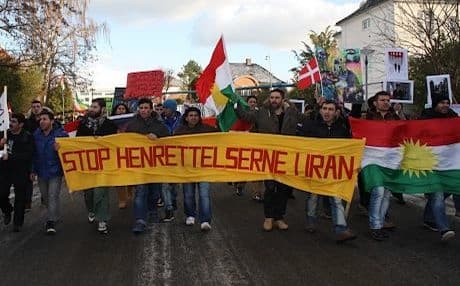
A demonstration outside the Iranian embassy in Copenhagen, at which many protesters were in Kurdish colors or carried Kurdish flags, was covered by Danish television channels. TV reports posted on YouTube show an orderly demonstration of dozens, many carrying pictures of executed Iranians and chanting “Death to the Islamic Republic” or calling for the release of all political prisoners.
The International Campaign for Human Rights in Iran and the Iran Human Rights Documentation Center say that since President Hassan Rouhani took office in June with promises of pursuing moderate policies, the number of executions in Iran have not changed. They say that between January 1 and October 8, 2013 more than 402 executions took place in Iran.
To raise awareness through greater media attention, young Kurds in Denmark erected a tent outside parliament. Another group staged a hunger strike for three days.
Soorat Jamshidi, Zagros Fallahi and Shaho Pirani, who all live in Denmark but come from the Kurdish areas of Iran, presented a lecture, showed pictures and answered questions from Danish legislators about the human rights situation in Iran.
The presentation was before Denmark’s top politicians at the parliament's Committee on Foreign Affairs.The audience included former foreign minister and current chairman of the Committee on Foreign Affairs, Per Stig Moller.
“They were shocking pictures,” Moller said after watching the presentation.
"Iran's use of torture and the death penalty is totally unacceptable and a clear violation of human rights that deserve massive international criticism," said Danish MP Nikolaj Villumsen.
He said he hopes that the West, including Denmark, would support the Kurdish and democratic opposition in Iran against the clerical regime.
"I therefore urge the Danish foreign minister to criticize the regime's murderous campaign," he said.
Former foreign affairs minister, Holger K. Nielsen, has called the executions "extremely worrying."
Last week Denmark got a new foreign minister, Martin Lidegaard. He has not yet commented on the hangings. But the Danish Kurds continue to focus on Iran.
"It's a long struggle, but we will continue to keep the topic alive," said
Adnan Axacan, chairman of SKFD, the Confederation of Kurdish Associations in Denmark, which organized the meeting of young Kurds in parliament.
"We are pleased that the Danish parliament allowed us to talk about what is happening in Iran," said Fallahi, who is originally from Baneh in western Iran.
“Denmark traditionally advocates free speech and human rights,” Fallahi said “Although it is a small country, Denmark is a member of the European Union and can thus put pressure on Iran," he added.
He believes that international pressure on Iran is helpful.
Recently Iranian authorities changed the death sentence of Mansour Arwand from death to life in prison. That came after Arwand’s brother, who lives in Denmark, took his brother’s case to the Danish media. Fallahi says that resulted in raising Danish and European pressure to change the sentence.
"Our aim is to prevent further executions by making the outside world aware of the serious situation," said Axacan.