


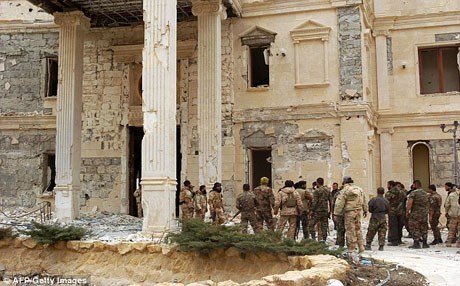
ERBIL, Kurdistan Region – The Syrian army continued its push into the ancient ISIS-occupied city of Palmyra on Saturday, after recapturing its 13th century castle in fierce clashes that have caused “heavy losses” on Islamic State fighters, Syria’s official news agency said.
“Units of (the) army and armed Forces, in cooperation with popular defense groups, continued military operations to tighten control over Palmyra city where fierce clashes are taking place in various areas causing heavy losses upon ISIS terrorists,” the SANA news agency reported.
“Field sources said that the army units advanced in the western neighborhood of Palmyra town after heavy clashes with ISIS terrorists. According to the sources, the army units also launched intensive military operations towards southern orchards, achieving important advances towards the city,” it added.
SANA said that the al-Ameria neighborhood on the northern outskirts of the city, which it called “the last defensive line of ISIS terrorists,” was seized by the military and fierce clashes were ongoing near the airport in the city’s east.
Over the past two days the army has also recaptured Wadi al-Qobor, al-Qosor Mountains, the so-called Qatari Palace and all hills surrounding the city, according to the agency.
After taking over the city in May last year ISIS demolished parts of the city and threatened to destroy the entirety of its archeologically precious Greco-Roman ruins.
On Thursday, the Syrian Army said it was advancing on Palmyra from three directions, securing roads and clearing mines ahead of a major thrust into the city.
ISIS infamously captured Syrian soldiers in Palmyra after its takeover and videotaped their mass execution in the city’s ancient amphitheater.
Palmyra, northeast of the Syrian capital Damascus, sits on Hellenistic and Roman ruins that date back more than 2,000 years.
“Units of (the) army and armed Forces, in cooperation with popular defense groups, continued military operations to tighten control over Palmyra city where fierce clashes are taking place in various areas causing heavy losses upon ISIS terrorists,” the SANA news agency reported.
“Field sources said that the army units advanced in the western neighborhood of Palmyra town after heavy clashes with ISIS terrorists. According to the sources, the army units also launched intensive military operations towards southern orchards, achieving important advances towards the city,” it added.
SANA said that the al-Ameria neighborhood on the northern outskirts of the city, which it called “the last defensive line of ISIS terrorists,” was seized by the military and fierce clashes were ongoing near the airport in the city’s east.
Over the past two days the army has also recaptured Wadi al-Qobor, al-Qosor Mountains, the so-called Qatari Palace and all hills surrounding the city, according to the agency.
After taking over the city in May last year ISIS demolished parts of the city and threatened to destroy the entirety of its archeologically precious Greco-Roman ruins.
On Thursday, the Syrian Army said it was advancing on Palmyra from three directions, securing roads and clearing mines ahead of a major thrust into the city.
ISIS infamously captured Syrian soldiers in Palmyra after its takeover and videotaped their mass execution in the city’s ancient amphitheater.
Palmyra, northeast of the Syrian capital Damascus, sits on Hellenistic and Roman ruins that date back more than 2,000 years.
Comments
Rudaw moderates all comments submitted on our website. We welcome comments which are relevant to the article and encourage further discussion about the issues that matter to you. We also welcome constructive criticism about Rudaw.
To be approved for publication, however, your comments must meet our community guidelines.
We will not tolerate the following: profanity, threats, personal attacks, vulgarity, abuse (such as sexism, racism, homophobia or xenophobia), or commercial or personal promotion.
Comments that do not meet our guidelines will be rejected. Comments are not edited – they are either approved or rejected.
Post a comment