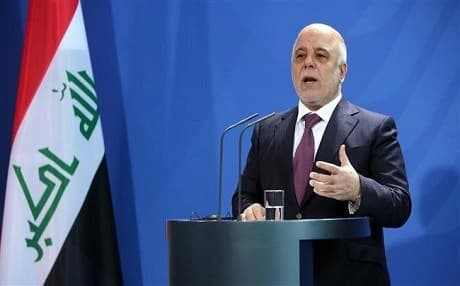

BAGHDAD, Iraq – Iraq's Prime Minister Haidar al-Abadi has said his government is working on a plan with the Kurdistan Region towards a "unified country" based on "mutual interests" and "high levels of coordination."
The comments Tuesday, after a speech in the Shiite holy city of Karbala, suggest that the prime minister will be aiming to put a new deal in place to solve the lingering issues with the Kurdistan Regional Government (KRG) regarding the budget dispute and oil revenues.
Baghdad has frozen payments to the KRG since early 2014 after disagreements deepened with Erbil over independent exports of Kurdish oil.
"From 1991 until 2003, the Kurdistan Region was largely independent. Now we want to set up a common entity within Iraq, with a unified country. That requires high levels of coordination and won't be easy, but both of us have mutual interests," the PM said.
"We don't want an authoritarian central government oppressing its citizens, but a federal administration which is a servant to the people and assists all the provinces," he added.
Abadi expressed the commitment of his government to federalism which, according to him, had granted the provinces and the Kurdistan Region constitutional powers.
The prime minister refrained from providing further details for the new plan, that is most likely a compromise from both parties, but recent meetings between him and KRG officials have displayed a shift of attitudes in both Erbil and Baghdad.
Kurdish President Masoud Barzani's highly unexpected visit to the Iraqi capital in late September and Abadi's courtesy visit to Erbil earlier this month stand in contrast to the strained ties between the two capitals that emerged after the 2014 general elections.
Abadi appears to have taken a broadly pragmatic approach with the KRG, at times even addressing the issue of Kurdish independence with a conciliatory tone.
The PM told a visiting Kurdish delegation in Baghdad in September that self-determination was an undisputed right of every nation including the Kurds, but he also called on Kurdish factions to determine whether they wanted to stay with Iraq or part ways.
With the future of the Nineveh Plains at stakes after the ISIS war – where Baghdad will likely compromise with the KRG's growing role as Peshmerga forces have recaptured disputed territories on a scale unimaginable prior to 2014 – Abadi seems to face the reality of a lingering Kurdish presence in these volatile areas.
Recent remarks by President Barzani regarding a reportedly implicit Kurdish-US deal on keeping Peshmerga forces in the disputed territories sent shockwaves through the Iraqi capital, where many media outlets suspect a plot against Iraq's territorial integrity in support of the Kurds' expanding control in the country.
Barzani has insisted that his Peshmerga fighters will refrain from entering the city of Mosul, where an estimated half a million Kurds live, in return for Kurdish troops remaining in these so-called disputed territories, which the KRG views as part of the Kurdistan Region.
Barzani has also publicly expressed support for the establishment of a Sunni region in the Nineveh Plains after the war, which has appealed to the country's disfranchised Sunni population.
Abadi, a Shiite, also warned against foreign interference in Iraqi affairs and said that Baghdad's victory over ISIS had "shocked" many countries that, according to him, had sought to destroy Iraq.
"Some countries wanted to see the destruction of Iraq, but Iraq's victories have rocked these countries," he said, without mentioning any countries by name.