


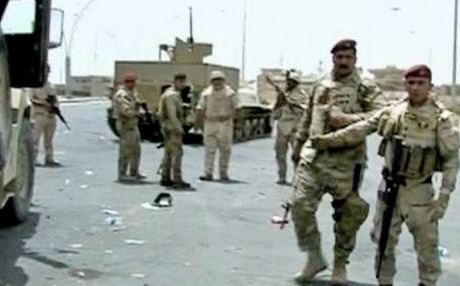
ERBIL, Kurdistan Region - The Pentagon says that 80,000 skilled Iraqi troops will be needed to recapture Iraq’s second city Mosul and other territories lost to Islamic State (ISIS) militants this summer.
"We're going to need about 80,000 competent Iraqi security forces to recapture territory lost, and eventually the city of Mosul, to restore the border,” Gen. Martin Dempsey, Chairman of the Joint Chiefs of Staff told a congressional committee in Washington on Thursday.
He suggested that the US military presence in Iraq – soon to be as many as 3,100 personnel after last week’s announcement that an additional 1,500 troops would be sent to the country -- would train Iraqi Security Forces (ISF).
The CIA estimated in September that ISIS had as many as 31,500 fighters in Syria and Iraq.
Dempsey also put forward the possibility that US combat forces could be involved in future operations to recover roughly a third of Iraq controlled by ISIS.
"I'm not predicting at this point that I would recommend that those forces in Mosul and along the border would need to be accompanied by US forces,” Dempsey said. “But we're certainly considering it.”
This comes after the Iraqi army collapsed in the face of a much smaller ISIS force last June, despite the US government’s investment of $25 billion in training and equipment.
An estimated 1,200 ISIS fighters were able to topple Mosul, which was supposedly protected by 60,000 troops -- although the Iraqi army was rife with corruption, absenteeism and low morale after years of mismanagement and sectarian policies under former Prime Minister Nouri al-Maliki.
On Wednesday, current Iraqi Prime Minister Haider al-Abadi fired 26 military leaders for corruption and incompetence, forcing ten more into retirement, including Kurdish chief of staff of the Iraqi Army, Babakir Zebari.
A number of Shia militias have become increasingly powerful, rivaling the ISF as the most powerful military force in southern and central Iraq.
The distinction between militias and the regular army is increasingly blurry, and the Iraqi cabinet decided on Tuesday that militias -- which the government refers to as “volunteer fighters” -- should enjoy the same rights and privileges as ISF troops.
Meanwhile, Iraq’s most influential Shia figure, Grand Ayotollah Ali al-Sistani, has been openly critical of the state of the armed forces.
Asked earlier this month if the military was corrupt, he answered by way of an aide: "We think that the security deterioration that happened some months ago can answer that.”
“Objectivity demands that the different military positions should be occupied by those who are professional, patriotic, faithful, courageous and not affected in doing their duties by personal and financial influences,” he added.
Comments
Rudaw moderates all comments submitted on our website. We welcome comments which are relevant to the article and encourage further discussion about the issues that matter to you. We also welcome constructive criticism about Rudaw.
To be approved for publication, however, your comments must meet our community guidelines.
We will not tolerate the following: profanity, threats, personal attacks, vulgarity, abuse (such as sexism, racism, homophobia or xenophobia), or commercial or personal promotion.
Comments that do not meet our guidelines will be rejected. Comments are not edited – they are either approved or rejected.
Post a comment