


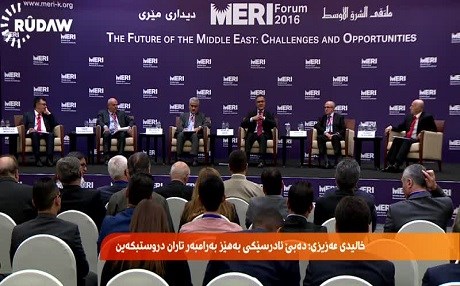
ERBIL, Kurdistan Region — Exiled leaders of Iranian Kurdish groups warn that disintegration among their factions in the country has harmed their struggle for self-rule and call for a "joined approach" towards the Iranian government.
“We haven’t been able to properly study the disintegration among the Kurdish parties of Iran while we all support parties in other parts of Kurdistan,” Ibrahim Alizada, head of the Kurdish communist party of Iran said.
Alizada said at the conference held by the Middle East Research Institute (MERI) that he did not see any serious attempt by Iran to solve the Kurdish issue and that “Iran was deep in crisis and corruption and its people tired of their government.”
He argued that the best hope for Iranian Kurds were leftist and other radical parties “who support self-determination for Kurds in Iran.”
Khalid Azizi, leader of the Kurdistan Democratic Party (of Iran) said Kurds in Iran should be more realistic.
“We are talking about an Iran that has a population of 80 million and the Kurdish movement, even if it is united, would not have the power to do change the political scene in Tehran alone,” he said. “The government in Iran has neither been established by the Kurds, nor have the Kurds been part of it or been able to destroy it,”
“Bringing it down is the work of all the communities of Iran,” he added.
Azizi in the meantime remained optimistic, saying that people have started their own activism especially during national and cultural events “and this popular organization could turn political in our absence.”
“The Islamic Republic is anxious that this kind of civil society activism has spread to every layer of society and causes headache for the regime,” Azizi said, adding that Tehran is more concerned about that kind of opposition than some armed groups.
Azizi argued that bringing down the Islamic Republic was not possible unless their armed activities were merged with people’s opposition inside the country.
“We can bring the Islamic Republic to its knees in the battlefield or bring it to the negotiating table only when our struggle in the mountains merges with people’s activism in the country,” he said.
In the late 2006, Iran’s Kurdistan Democratic Party was divided after years of internal conflict. In the following years relations deteriorated often as their respective media outlets directed accusations at each other.
Since 2011 regular talks have been held between the two sides for complete unification.
The Kurdistan Democratic Party of Iran (PDKI) and its breakaway Kurdistan Democratic Party (PDK) recently made progress in calming relations but no date has been set for unification.
After two years of talks to unify the party talks stalled again in 2015 with the two negotiating sides accusing each other of undermining the unification process.
Komala, a pro-Kurdish leftist party has also seen divisions after it merged with Iran's Union of Communist Militants and virtually became a Kurdish branch of the origination.
"We have not been able to set up a strong [Kurdish] front and jointly address the Iranian regime," said Khalid Azizi, leader of the PDK. "Our struggle has so far been very much in line with partisan interests. If we talk about of a national movement, then there should be a common definition and ground," he added.
Leaders of the five main Kurdish parties of Iran -- Kurdistan Democratic Party (PDK), Kurdistan Democratic Party-Iran (PDKI), the pro-Kurdish Iranian Communist Party (Komala), Komala Party of Iranian Kurdistan and the Kurdistan Toilers Group -- said during a panel of discussion in Erbil that they support wider collaboration among their groups.
“We haven’t been able to properly study the disintegration among the Kurdish parties of Iran while we all support parties in other parts of Kurdistan,” Ibrahim Alizada, head of the Kurdish communist party of Iran said.
Alizada said at the conference held by the Middle East Research Institute (MERI) that he did not see any serious attempt by Iran to solve the Kurdish issue and that “Iran was deep in crisis and corruption and its people tired of their government.”
He argued that the best hope for Iranian Kurds were leftist and other radical parties “who support self-determination for Kurds in Iran.”
Khalid Azizi, leader of the Kurdistan Democratic Party (of Iran) said Kurds in Iran should be more realistic.
“We are talking about an Iran that has a population of 80 million and the Kurdish movement, even if it is united, would not have the power to do change the political scene in Tehran alone,” he said. “The government in Iran has neither been established by the Kurds, nor have the Kurds been part of it or been able to destroy it,”
“Bringing it down is the work of all the communities of Iran,” he added.
Azizi in the meantime remained optimistic, saying that people have started their own activism especially during national and cultural events “and this popular organization could turn political in our absence.”
“The Islamic Republic is anxious that this kind of civil society activism has spread to every layer of society and causes headache for the regime,” Azizi said, adding that Tehran is more concerned about that kind of opposition than some armed groups.
Azizi argued that bringing down the Islamic Republic was not possible unless their armed activities were merged with people’s opposition inside the country.
“We can bring the Islamic Republic to its knees in the battlefield or bring it to the negotiating table only when our struggle in the mountains merges with people’s activism in the country,” he said.
In the late 2006, Iran’s Kurdistan Democratic Party was divided after years of internal conflict. In the following years relations deteriorated often as their respective media outlets directed accusations at each other.
Since 2011 regular talks have been held between the two sides for complete unification.
The Kurdistan Democratic Party of Iran (PDKI) and its breakaway Kurdistan Democratic Party (PDK) recently made progress in calming relations but no date has been set for unification.
After two years of talks to unify the party talks stalled again in 2015 with the two negotiating sides accusing each other of undermining the unification process.
Komala, a pro-Kurdish leftist party has also seen divisions after it merged with Iran's Union of Communist Militants and virtually became a Kurdish branch of the origination.
"We have not been able to set up a strong [Kurdish] front and jointly address the Iranian regime," said Khalid Azizi, leader of the PDK. "Our struggle has so far been very much in line with partisan interests. If we talk about of a national movement, then there should be a common definition and ground," he added.
Comments
Rudaw moderates all comments submitted on our website. We welcome comments which are relevant to the article and encourage further discussion about the issues that matter to you. We also welcome constructive criticism about Rudaw.
To be approved for publication, however, your comments must meet our community guidelines.
We will not tolerate the following: profanity, threats, personal attacks, vulgarity, abuse (such as sexism, racism, homophobia or xenophobia), or commercial or personal promotion.
Comments that do not meet our guidelines will be rejected. Comments are not edited – they are either approved or rejected.
Post a comment