


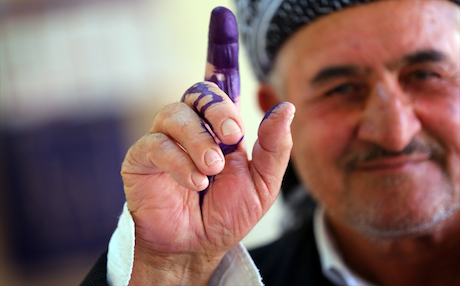
ERBIL, Kurdistan Region – As a month of campaigning for Iraq’s nationwide legislative elections kicks off on April 1, political parties in the Kurdistan Region are expected to feel the pinch in their campaign funds, due to a row with Baghdad that has frozen Erbil’s share of the national budget.
The Kurdistan Democratic Party (KDP) and Patriotic Union of Kurdistan (PUK) each has its own private sources of funding from commercial ventures, but the revenues are not expected to be enough to cover all expenses.
"Certainly, PUK has revenues, KDP has, too. The PUK has companies, but the profits would not be enough to run the whole party," says Arez Abdullah, a PUK leadership member.
Campaigning for Iraq's April 30 legislative election and Kurdistan's provincial elections will start from April 1 and end 48 hours before the election process starts.
Baghdad has stopped regular payments to Erbil from the national budget, following a row over Kurdistan’s intention to begin independent international oil exports.
For the smaller parties, the financial burden will be more acutely felt, since they have no big commercial companies to assist them. To mitigate the financial impact, they say they depend on donors and well-planned election campaigns to capture votes.
The Islamic League of Kurdistan says it will hold big rallies and rely on supporters for contributions. "We will hold big and important occasions, meet people and visit families house-to-house to ensure their votes," said Shwan Rabar a leadership member of the Islamic League.
"The Islamic League has small (commercial) projects, but they are not enough to fund the party," he added.
Unlike the rest of Iraq, the Kurdistan Region has not held provincial elections since 2005. That has left most of the current local officials in power from the ruling KDP and PUK.
While KDP's strongholds in Erbil and Duhok are expected to remain intact, it is widely believed that the new Change Movement (Gorran), a splinter of the PUK, will take over the local administration in Sulaimani.
Officials of the Kurdistan Islamic Union also say they are working on strategies to mitigate the financial impact of trying to get the votes. “We have two plans, one is a random one that relies on social personalities, the candidates and the media, and engages all layers of society,” says Salim Samir, head of the election department of the Islamic Union, which gained 10 seats in the 2013 elections. He said the second part of the plan “specifically targets the independent voters."
The political parties are also squeezed by financial limitation imposed by the Iraqi Higher Electoral Commission (IHEC). It says a political party can spend 250 Iraqi dinars per voter. That means that for a city of one million voters and four political parties, each party can spend 250 million Iraqi dinars for election campaigns.
Gorran, which won 24 seats in the previous election, says the party depends on financial assistance from rich people and some revenues made from advertisements for its electoral campaigns.
"The Kurdistan Democratic Party (KDP) has a firm program for this election and will benefit from previous election errors," says Hemin Hawrami, the head of KDP's Foreign Relations. He adds that the party is depending on support from loyalists and organizations.
Comments
Rudaw moderates all comments submitted on our website. We welcome comments which are relevant to the article and encourage further discussion about the issues that matter to you. We also welcome constructive criticism about Rudaw.
To be approved for publication, however, your comments must meet our community guidelines.
We will not tolerate the following: profanity, threats, personal attacks, vulgarity, abuse (such as sexism, racism, homophobia or xenophobia), or commercial or personal promotion.
Comments that do not meet our guidelines will be rejected. Comments are not edited – they are either approved or rejected.
Post a comment