

17 Photos
Photo Gallery
In pictures: Kurdish artist projects peace at Erbil exhibition
ERBIL, Kurdistan Region — Often referred to by fellow artists as the “Grandfather of Kurdish Art,” renowned Kurdish artist Ismail Khayat has been an activist and inspiration for the Kurdish and Iraqi art movement for decades, working to encourage local peace and harmony through his artwork.
Some of Khayat’s art is currently being showcased at the American Corner Erbil Hub located at the University of Kurdistan Hewler (UKH) in celebration of their one year anniversary, with the theme of “Diversity.”
“Talking along the lines of diversity, gender parity and [International] Women’s Day coming up, we were fortunate enough to meet Mr. Ismail Khayat,” said Lesley Gaj, Director of the UKH Library and American Corner Erbil.
“A lot of his work deals with issues of Anfal, women, people’s lives, relationships, working through issues, troubles and peace,” Gaj added. “We felt that this was quite appropriate for the message we were trying to send as well, so we invited him to have an exhibition in the American Corner.”
Khayat has dedicated much of his work to the suffering of the Kurdish people, especially under the Baathist regime and the 100,000-plus Kurds who died as part of the Anfal genocidal campaign culminating with the Halabja gas attacks in 1988.
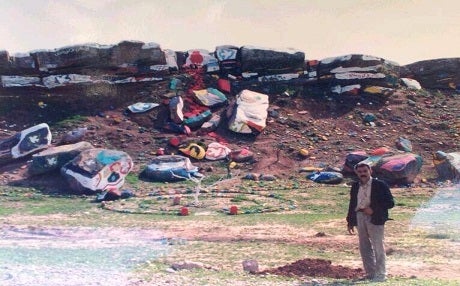
Ismail Khayat stands in front of his paintings during the Kurdish Civil War in the mid-1990's. Photo: Ismail Khayat
“I enjoy doing the masks,” Khayat told Rudaw English. “I’ve been doing them for many years. They represent war, Halabja, and Anfal for me.”
Each mask, or face, represents someone who was killed during Anfal.
Khayat said he held several solo and joint exhibitions in Baghdad in the past and was respected for his artistic talent, but the Baathist regime didn’t realize his artwork represented the suffering of the Kurdish people.
“Through my paintings, I was telling the regime that my people are suffering because of you,” he said. “But they never knew, so I continued my exhibitions in Baghdad.”
However, after the fall of Saddam Hussein, Khayat held an art exhibition in France in 2005.
“It showed the suffering of the Kurdish people," he said. "I felt in that time the world needed to know.”
Khayat also garnered worldwide attention in the mid-1990s for his rock paintings during the intra-Kurdish conflict which killed thousands as the two dominate political parties in the Kurdistan Region fought for land.
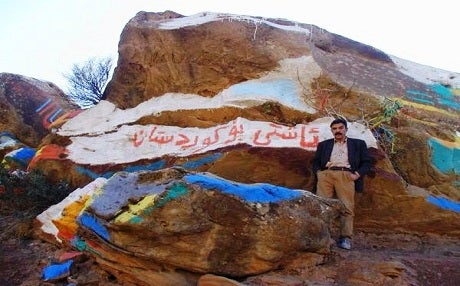
Ismail Khayat standing in front of a painted rock that reads "Peace for Kurdistan" during the Kurdish Civil War in the mid-1990's. Photo: Ismail Khayat
In the midst of conflict, Khayat went to the center of one of the heaviest areas of bloodshed and painted rocks, trees, bullets and any other objects he could find in bright colors, inscribing the words “Peace for Kurdistan” in Kurdish, Arabic and English.
Although Khayat never formally studied art, he taught art and supervised art activities and events in Sulaimani for over 24 years with many aspiring artists and students using his work as a resource.
Now retired, Khayat estimates that he has created 4,000-5,000 paintings and more than 3,000 rock paintings throughout his lifetime. But he said that these works would never satisfy him. He continuously strives to create more.
“I’ll never get tired of creating art,” he added.
Born in Khanaqin in 1944 and currently residing in Sulaimani, Khayat began painting professionally at the age of 20, with many of his works being showcased at exhibitions in the Kurdistan Region, across Iraq and over 15 countries abroad, including Europe and North America.
The artwork currently displayed at the UKH exhibition portrays pieces from the last 13 years.
There are four different collections being showcased at the American Corner which include “Anfal”, “Ladies”, “Masks” and the “Peace” collection.
The exhibition began on Tuesday and will run through Thursday between 9 a.m. and 5 p.m. It is free to the public, although Khayat’s artwork is available for purchase.
Khayat will also be available at the art exhibition for those who are interested in speaking to him about his artwork.
“Such vibrant works as collections or individual pieces are honorable and exquisite depictions of one man’s plea for peace and harmony across our very diverse world,” UKH American Corner Director Gaj stated.
.jpg "28-02 1")
28-02 1
.jpg "28-02 2")
28-02 2
.jpg "28-02 3")
28-02 3
.jpg "28-02 4")
28-02 4
.jpg "28-02 5")
28-02 5
.jpg "28-02 6")
28-02 6
.jpg "28-02 7")
28-02 7
.jpg "28-02 8")
28-02 8
.jpg "28-02 9")
28-02 9
.jpg "28-02 10")
28-02 10
.jpg "28-02 11")
28-02 11
.jpg "28-02 12")
28-02 12
.jpg "28-02 13")
28-02 13
.jpg "28-02 14")
28-02 14
.jpg "28-02 15")
28-02 15
.jpg "28-02 16")
28-02 16
.jpg "28-02 17")
28-02 17
In pictures: Kurdish artist projects peace at Erbil exhibition
In pictures: Kurdish artist projects peace at Erbil exhibition
In pictures: Kurdish artist projects peace at Erbil exhibition
In pictures: Kurdish artist projects peace at Erbil exhibition
In pictures: Kurdish artist projects peace at Erbil exhibition
In pictures: Kurdish artist projects peace at Erbil exhibition
In pictures: Kurdish artist projects peace at Erbil exhibition
In pictures: Kurdish artist projects peace at Erbil exhibition
In pictures: Kurdish artist projects peace at Erbil exhibition
In pictures: Kurdish artist projects peace at Erbil exhibition
In pictures: Kurdish artist projects peace at Erbil exhibition
In pictures: Kurdish artist projects peace at Erbil exhibition
In pictures: Kurdish artist projects peace at Erbil exhibition
In pictures: Kurdish artist projects peace at Erbil exhibition
In pictures: Kurdish artist projects peace at Erbil exhibition
In pictures: Kurdish artist projects peace at Erbil exhibition