


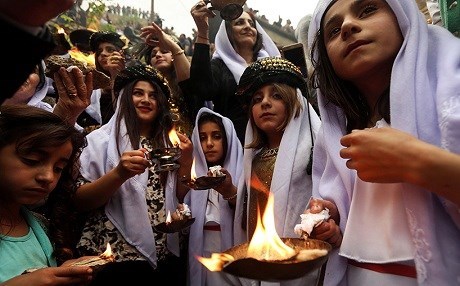
DUHOK, Kurdistan Region – Of the 773 candidates contesting seats in the September 30 Kurdistan Region election, just two are from the Yezidi minority.
Both Yezidi candidates, Hadia Murad who is running for the Kurdistan Democratic Party (KDP) and Pir Haval Baadari for the Patriotic Union of Kurdistan (PUK), are from Duhok province.
There are roughly 30,000 eligible Yezidi voters living in the towns of Baadre, Sheikhan, and Sharyan, and the Region’s major cities.
Although the Yezidis are given a quota seat in the Iraqi parliament as an ethno-religious minority, this is not the case in the Kurdish legislature, despite efforts by the KDP and Yezidis themselves to establish a quota.
The other Kurdish parties have unanimously rejected the idea.
“The KDP has always worked to have as many Yezidi MPs in the parliament as possible,” said Khalid Ahmed, a KDP election officer.
Sheikh Shamo, a Yezidi KDP MP, entered the parliament through the public vote.
“We have once again put a Yezidi candidate in our list,” Mohammed said.
Keen to improve the representation of Yezidi women, who suffered horrific crimes and mass displacement at the hands of ISIS, the KDP has nominated a female Yezidi candidate.
There were no Yezidi MPs in the first round of the Kurdish parliament. In the second round they succeeded in electing two, and just one during the third and fourth rounds. They were all KDP candidates.
The PUK is also trying to send a Yezidi to the parliament. However, the party does not have strong support in Duhok province.
“We have had Yezidi candidates in all elections, so we will have another for this election and we want him to make it,” said Qadir Haider, a PUK official in Duhok.
The Change Movement (Gorran), the second largest bloc in the Kurdistan parliament with 24 seats, has three candidates in Duhok, none of whom are Yezidi.
“We do not have enough supporters among the Yezidis, so it was difficult to have a candidate,” a Gorran official told Rudaw on condition of anonymity.
Yezidis fear they may fail to send a single candidate to the highest lawmaking body in the Region due to the system the parliament adopts.
“Unless they secure a quota seat for the Yezidis in the Kurdistan parliament, there is a possibility that no MP will make it,” said Masoud Misto, a Yezidi civil activist in Duhok.
Both Yezidi candidates, Hadia Murad who is running for the Kurdistan Democratic Party (KDP) and Pir Haval Baadari for the Patriotic Union of Kurdistan (PUK), are from Duhok province.
There are roughly 30,000 eligible Yezidi voters living in the towns of Baadre, Sheikhan, and Sharyan, and the Region’s major cities.
Although the Yezidis are given a quota seat in the Iraqi parliament as an ethno-religious minority, this is not the case in the Kurdish legislature, despite efforts by the KDP and Yezidis themselves to establish a quota.
The other Kurdish parties have unanimously rejected the idea.
“The KDP has always worked to have as many Yezidi MPs in the parliament as possible,” said Khalid Ahmed, a KDP election officer.
Sheikh Shamo, a Yezidi KDP MP, entered the parliament through the public vote.
“We have once again put a Yezidi candidate in our list,” Mohammed said.
Keen to improve the representation of Yezidi women, who suffered horrific crimes and mass displacement at the hands of ISIS, the KDP has nominated a female Yezidi candidate.
There were no Yezidi MPs in the first round of the Kurdish parliament. In the second round they succeeded in electing two, and just one during the third and fourth rounds. They were all KDP candidates.
The PUK is also trying to send a Yezidi to the parliament. However, the party does not have strong support in Duhok province.
“We have had Yezidi candidates in all elections, so we will have another for this election and we want him to make it,” said Qadir Haider, a PUK official in Duhok.
The Change Movement (Gorran), the second largest bloc in the Kurdistan parliament with 24 seats, has three candidates in Duhok, none of whom are Yezidi.
“We do not have enough supporters among the Yezidis, so it was difficult to have a candidate,” a Gorran official told Rudaw on condition of anonymity.
Yezidis fear they may fail to send a single candidate to the highest lawmaking body in the Region due to the system the parliament adopts.
“Unless they secure a quota seat for the Yezidis in the Kurdistan parliament, there is a possibility that no MP will make it,” said Masoud Misto, a Yezidi civil activist in Duhok.
Comments
Rudaw moderates all comments submitted on our website. We welcome comments which are relevant to the article and encourage further discussion about the issues that matter to you. We also welcome constructive criticism about Rudaw.
To be approved for publication, however, your comments must meet our community guidelines.
We will not tolerate the following: profanity, threats, personal attacks, vulgarity, abuse (such as sexism, racism, homophobia or xenophobia), or commercial or personal promotion.
Comments that do not meet our guidelines will be rejected. Comments are not edited – they are either approved or rejected.
Post a comment