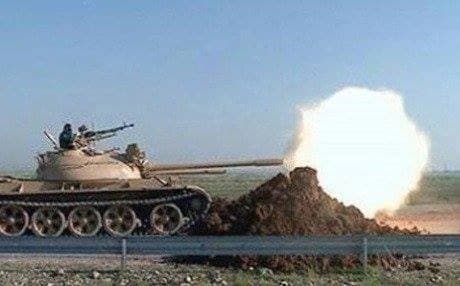

WASHINGTON DC - Backed by coalition air power, Kurdish forces have taken control over three strategic areas near Mosul and are ready to control more territories, the US military said in a statement.
“Security Forces from the Kurdish region seized three bridgeheads on the west bank of the Tigris River, north of Mosul in formerly held Daesh (ISIS) areas,” the statement said. “Combined Joint Task Force-Operation Inherent Resolve (CJTF-OIR) delivered precise and effective airstrikes on enemy positions near Mosul, in support of the Iraqi Government’s fight against ISIL,” it added, referring to the Islamic State group that is known as ISIS or ISIL.
With coalition air support, Kurdish Peshmerga forces have been able to reverse territorial gains by ISIS in Nineveh province since last November. US military officials have hailed the bravery of the Kurdish troops in the fight against ISIS, calling them the most effective and reliable partner on the ground.
According to the statement, “the Coalition executed four close air support airstrikes to facilitate the maneuver of the Kurdish Security Forces and their successful attack.”
The Pentagon said that training and providing “operational intelligence” will also continue to further empower the Kurdish forces to conduct military operations against ISIS successfully.
It also showed confidence in the capability of the Kurdish forces, saying that “Kurdish Peshmerga Forces now hold the gains they have made and are postured to retake additional territory from Daesh (ISIS) in the vicinity of Mosul.”
Lt. Gen. James Terry, the CJTF-OIR commander, explained that the coordination with the Kurdish forces has proved to be effective in countering and defeating ISIS.
“This most recent Peshmerga operation is yet another example of how Daesh can be defeated militarily using a combination of well led and capable ground forces enabled by Coalition Aviation and Advise and Assist capabilities,” he said.
.jpg&w=3840&q=75)