


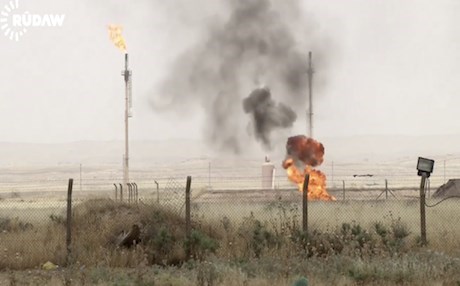
ERBIL, Kurdistan Region—Less than two weeks before Erbil and Baghdad announced a deal to sell Kirkuk’s oil through the Kurdistan Region’s pipelines to Turkey, thereby resuming the exportation of Kirkuk’s oil, the Patriotic Union of Kurdistan (PUK) had requested Baghdad to continue the suspension of oil exports because of lack of transparency and fairness in spending the revenues, and threatened to take “other mechanisms” to halt the exportation of Kirkuk’s oil if Baghdad did not concede.
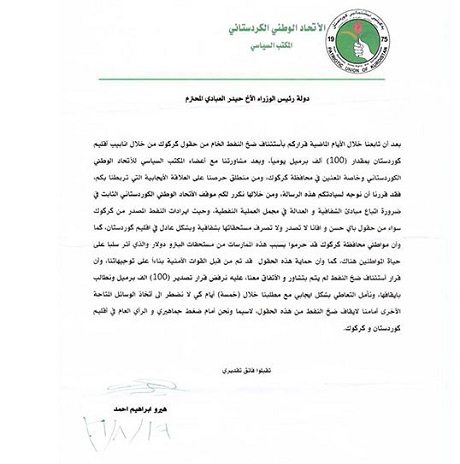
The PUK on Wednesday released a letter sent from Herro Ibrahim Ahmed to Iraqi Prime Minister Haider al-Abadi on August 19 in order to express the PUK’s stand on the issue of Kirkuk’s oil while Baghdad was considering the resumption of its export.
“The Kirkuk oil exports revenue from Bay Hasan and Havana fields was not spent transparently and fairly in the Kurdistan Region,” reads the letter. “Because of this, the citizens of Kirkuk were excluded from receiving petrodollars and this had a negative impact on the life of the people of Kirkuk.”
“The security forces are protecting those fields according to our instructions. The decision to resume exporting oil was not made according to consultations and agreements with us. Therefore we refuse the order to export 100,000 barrels per day and ask to halt it. We hope you respond positively to our request within 5 days, in order that we are not obliged to take other mechanisms to halt it from those fields, especially since we are under pressure from the people of the Kurdistan Region and Kirkuk.”
On August 30, Baghdad and Erbil reached an agreement to export 150,000 barrels of Kirkuk oil daily through Kurdish pipelines to Turkey, with revenues being shared jointly between the two governments. The agreement ended a five month stoppage of Kirkuk’s oil.
Earlier on Wednesday, an official from the Kurdish Ministry of Natural Resources accused the PUK of selling Kirkuk’s oil via truck to Iran. “Without the knowledge of the Kurdistan Regional Government and Sulaimani governorate Kirkuk oil is being exported to Iran and its revenues are not known,” Dr. Sherko Jawdat wrote on his Facebook page.
He accused “people and companies” within the PUK’s administration of exporting 30,000 barrels per day to Iran with revenues of $30 million.
The PUK on Wednesday released a letter sent from Herro Ibrahim Ahmed to Iraqi Prime Minister Haider al-Abadi on August 19 in order to express the PUK’s stand on the issue of Kirkuk’s oil while Baghdad was considering the resumption of its export.
“The Kirkuk oil exports revenue from Bay Hasan and Havana fields was not spent transparently and fairly in the Kurdistan Region,” reads the letter. “Because of this, the citizens of Kirkuk were excluded from receiving petrodollars and this had a negative impact on the life of the people of Kirkuk.”
“The security forces are protecting those fields according to our instructions. The decision to resume exporting oil was not made according to consultations and agreements with us. Therefore we refuse the order to export 100,000 barrels per day and ask to halt it. We hope you respond positively to our request within 5 days, in order that we are not obliged to take other mechanisms to halt it from those fields, especially since we are under pressure from the people of the Kurdistan Region and Kirkuk.”
On August 30, Baghdad and Erbil reached an agreement to export 150,000 barrels of Kirkuk oil daily through Kurdish pipelines to Turkey, with revenues being shared jointly between the two governments. The agreement ended a five month stoppage of Kirkuk’s oil.
Earlier on Wednesday, an official from the Kurdish Ministry of Natural Resources accused the PUK of selling Kirkuk’s oil via truck to Iran. “Without the knowledge of the Kurdistan Regional Government and Sulaimani governorate Kirkuk oil is being exported to Iran and its revenues are not known,” Dr. Sherko Jawdat wrote on his Facebook page.
He accused “people and companies” within the PUK’s administration of exporting 30,000 barrels per day to Iran with revenues of $30 million.
Below is the letter from Herro Ibrahim Ali to Prime Minister Abadi.
Comments
Rudaw moderates all comments submitted on our website. We welcome comments which are relevant to the article and encourage further discussion about the issues that matter to you. We also welcome constructive criticism about Rudaw.
To be approved for publication, however, your comments must meet our community guidelines.
We will not tolerate the following: profanity, threats, personal attacks, vulgarity, abuse (such as sexism, racism, homophobia or xenophobia), or commercial or personal promotion.
Comments that do not meet our guidelines will be rejected. Comments are not edited – they are either approved or rejected.
Post a comment